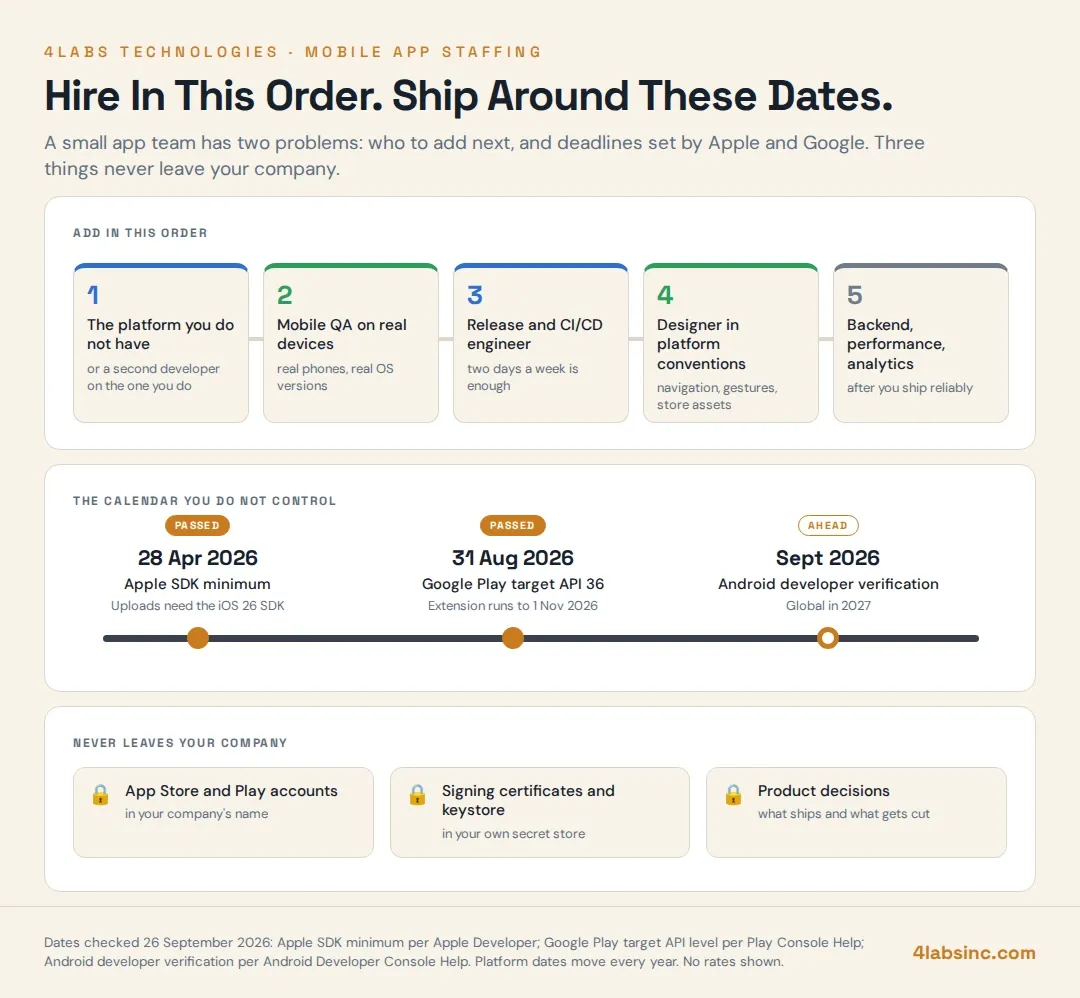
The calendar you do not control
Mobile app development is the only engineering discipline where two outside companies set deadlines for your team. Miss one and you do not slow down, you stop shipping.
Here are the three that matter right now, each verified against Apple's and Google's own developer documentation on 26 September 2026. Check both sites before you plan, because these move every year.
Apple: the SDK minimum
Apple's developer news states that from 28 April 2026, apps and games uploaded to App Store Connect must be built with the iOS 26 and iPadOS 26 SDK or later, with matching requirements for tvOS, visionOS and watchOS.
That deadline has passed. If your app has not shipped an update since April, your next submission includes an Xcode and SDK upgrade that nobody put in the roadmap. Budget it as work, because it often surfaces deprecations across your dependencies.
Google Play: the target API level
Google's Play Console help states that new apps and app updates must target Android 16, API level 36, or higher to be submitted to Google Play. Apps targeting API level 34 or lower are only available on devices running an Android version at or below the app's target level.
The deadline was 31 August 2026, with an extension available through Play Console until 1 November 2026.
Read that second sentence again, because it is the quiet one. A non-compliant app does not get removed. It stops reaching new users on newer phones while your analytics show installs slowly flattening.
Android developer verification, if you ship outside Google Play
Google's developer console help states that from September 2026, apps must be registered by verified developers to be installed from selected app stores onto certified Android devices in Brazil, Indonesia, Singapore and Thailand, with global expansion in 2027.
A free limited-distribution account allows sharing with up to 20 devices without identity verification. Full distribution needs verification and a 25 dollar account.
If you distribute outside Google Play, or your market is one of those four countries, this belongs on your roadmap now.
What this means for staffing
Three things.
Someone owns compliance work as a named responsibility, not as a thing the busiest developer notices. Put it in the contract.
Toolchain upgrades get scheduled, not discovered. April for the SDK, August for the target API, every year, which is why the first augmented developer's first week often includes an upgrade rather than a feature.
Your developer account identity belongs to the company. Verification is attached to an account, and if that account is a contractor's, your distribution now depends on someone who will leave.