Logo
Logo
ServicesIndustriesCase StudiesBlogsCareersLet's Connect
blue-white-icon
black-image
Logo
ServicesIndustriesCase StudiesBlogsCareersLet's Connect
burger-icon
hamburger
staff agumentation common image
Blogs/How Staff Augmentation Works (Step-by-Step): A Complete Guide

How Staff Augmentation Works (Step-by-Step): A Complete Guide

January 4, 2026
Share Now

Table of Contents

  1. 1. What is staff augmentation
  2. 2. How does staff augmentation work
  3. 3. Who does what
  4. 4. What it costs
  5. 5. How 4Labs runs the process
  6. 6. Frequently asked questions

Key takeaways

  • The staff augmentation process: seven steps, two to five weeks. From deciding you have a gap to an engineer committing code. Most of the variance sits on your side, not the provider's.
  • You direct, they employ. That single line separates staff augmentation from outsourcing, managed services and freelancers.
  • Step one decides the rest. A gap written as a sentence with a deliverable and a date gets filled well. "We need more engineering" does not.
  • The contract is where IP is won or lost. Work product assigned to you on creation, in both the service agreement and the provider's own employment contracts.
  • Week one is yours. Access, environments, a walkthrough and a first small ticket. Nothing the provider can do replaces it.

There is a gap between deciding you need another engineer and somebody actually committing code.
Most articles about how staff augmentation works skip that gap. They describe the model, list the benefits, and leave you no clearer about what happens on Monday, who does what, or how long any of it takes.
This guide is the staff augmentation process itself. Seven steps, from writing down the gap to the first review meeting. For each one: what you do, what the provider does, roughly how long it takes, and what goes wrong when it gets rushed.The timings come from how these engagements run in practice, and they are labelled as that rather than dressed up as research. The two statistics in here are traced to named sources with their sample sizes, because most pages on this topic quote numbers nobody can check.

Stay Ahead With 4Labs

Get expert insights, security briefings, and the latest innovations in your inbox.

  • Afghanistan+93
  • Albania+355
  • Algeria+213
  • Andorra+376
  • Angola+244
  • Antigua and Barbuda+1268
  • Argentina+54
  • Armenia+374
  • Aruba+297
  • Australia+61
  • Austria+43
  • Azerbaijan+994
  • Bahamas+1242
  • Bahrain+973
  • Bangladesh+880
  • Barbados+1246
  • Belarus+375
  • Belgium+32
  • Belize+501
  • Benin+229
  • Bhutan+975
  • Bolivia+591
  • Bosnia and Herzegovina+387
  • Botswana+267
  • Brazil+55
  • British Indian Ocean Territory+246
  • Brunei+673
  • Bulgaria+359
  • Burkina Faso+226
  • Burundi+257
  • Cambodia+855
  • Cameroon+237
  • Canada+1
  • Cape Verde+238
  • Caribbean Netherlands+599
  • Cayman Islands+1
  • Central African Republic+236
  • Chad+235
  • Chile+56
  • China+86
  • Colombia+57
  • Comoros+269
  • Congo+243
  • Congo+242
  • Costa Rica+506
  • Côte d'Ivoire+225
  • Croatia+385
  • Cuba+53
  • Curaçao+599
  • Cyprus+357
  • Czech Republic+420
  • Denmark+45
  • Djibouti+253
  • Dominica+1767
  • Dominican Republic+1
  • Ecuador+593
  • Egypt+20
  • El Salvador+503
  • Equatorial Guinea+240
  • Eritrea+291
  • Estonia+372
  • Ethiopia+251
  • Faroe Islands+298
  • Fiji+679
  • Finland+358
  • France+33
  • French Guiana+594
  • French Polynesia+689
  • Gabon+241
  • Gambia+220
  • Georgia+995
  • Germany+49
  • Ghana+233
  • Gibraltar+350
  • Greece+30
  • Greenland+299
  • Grenada+1473
  • Guadeloupe+590
  • Guam+1671
  • Guatemala+502
  • Guinea+224
  • Guinea-Bissau+245
  • Guyana+592
  • Haiti+509
  • Honduras+504
  • Hong Kong+852
  • Hungary+36
  • Iceland+354
  • India+91
  • Indonesia+62
  • Iran+98
  • Iraq+964
  • Ireland+353
  • Israel+972
  • Italy+39
  • Jamaica+1876
  • Japan+81
  • Jordan+962
  • Kazakhstan+7
  • Kenya+254
  • Kiribati+686
  • Kosovo+383
  • Kuwait+965
  • Kyrgyzstan+996
  • Laos+856
  • Latvia+371
  • Lebanon+961
  • Lesotho+266
  • Liberia+231
  • Libya+218
  • Liechtenstein+423
  • Lithuania+370
  • Luxembourg+352
  • Macau+853
  • Macedonia+389
  • Madagascar+261
  • Malawi+265
  • Malaysia+60
  • Maldives+960
  • Mali+223
  • Malta+356
  • Marshall Islands+692
  • Martinique+596
  • Mauritania+222
  • Mauritius+230
  • Mayotte+262
  • Mexico+52
  • Micronesia+691
  • Moldova+373
  • Monaco+377
  • Mongolia+976
  • Montenegro+382
  • Morocco+212
  • Mozambique+258
  • Myanmar+95
  • Namibia+264
  • Nauru+674
  • Nepal+977
  • Netherlands+31
  • New Caledonia+687
  • New Zealand+64
  • Nicaragua+505
  • Niger+227
  • Nigeria+234
  • North Korea+850
  • Norway+47
  • Oman+968
  • Pakistan+92
  • Palau+680
  • Palestine+970
  • Panama+507
  • Papua New Guinea+675
  • Paraguay+595
  • Peru+51
  • Philippines+63
  • Poland+48
  • Portugal+351
  • Puerto Rico+1
  • Qatar+974
  • Réunion+262
  • Romania+40
  • Russia+7
  • Rwanda+250
  • Saint Kitts and Nevis+1869
  • Saint Lucia+1758
  • Saint Pierre & Miquelon+508
  • Saint Vincent and the Grenadines+1784
  • Samoa+685
  • San Marino+378
  • São Tomé and Príncipe+239
  • Saudi Arabia+966
  • Senegal+221
  • Serbia+381
  • Seychelles+248
  • Sierra Leone+232
  • Singapore+65
  • Slovakia+421
  • Slovenia+386
  • Solomon Islands+677
  • Somalia+252
  • South Africa+27
  • South Korea+82
  • South Sudan+211
  • Spain+34
  • Sri Lanka+94
  • Sudan+249
  • Suriname+597
  • Swaziland+268
  • Sweden+46
  • Switzerland+41
  • Syria+963
  • Taiwan+886
  • Tajikistan+992
  • Tanzania+255
  • Thailand+66
  • Timor-Leste+670
  • Togo+228
  • Tonga+676
  • Trinidad and Tobago+1868
  • Tunisia+216
  • Turkey+90
  • Turkmenistan+993
  • Tuvalu+688
  • Uganda+256
  • Ukraine+380
  • United Arab Emirates+971
  • United Kingdom+44
  • United States+1
  • Uruguay+598
  • Uzbekistan+998
  • Vanuatu+678
  • Vatican City+39
  • Venezuela+58
  • Vietnam+84
  • Wallis & Futuna+681
  • Yemen+967
  • Zambia+260
  • Zimbabwe+263
Our Services
Digital Marketing
Staff Augmentation
IT Infrastructure
ERP Solutions
Software Development
Web & App Development
Industries
Cryptocurrency and Blockchain
Banking, Financial Services, and Insurance (BFSI)
Lending and FinTech
Oil and Gas
Energy and Utilities
Automotive and Manufacturing
Agriculture
Real Estate
E-commerce and Retail
Case Studies
Financial Services Test Automation
AI-Driven Customer Risk Profiling
Elevating Mobile Performance
Jewelry Client Transformation
AI Underwriting Revolution
Advanced Cybersecurity Solutions
Eyewear Retailer Transformation
Revolutionizing Manufacturing Operations
Offshore Development Excellence
Company

About Us

Careers

Let's Connect

Business Referral

Engagement Model

Partnership Programs

Resources

Blogs

footer1-iconfooter2-iconiso_iconiso_icon2

4labsicon

Copyright © 2026 4Labs Technologies. All Rights Reserved.

Privacy Policy

Terms & Conditions

Accessibility

fb-icon
twitter-icon
instagram-icon
linkedin-icon

What is staff augmentation?

Staff augmentation is a hiring model where engineers join your team and work under your direction, while a provider employs them, pays them and handles the compliance. You set the priorities, review the code and decide what ships. The engagement runs monthly and you can stop it.
That is the whole model. The complexity is in running it, not understanding it.
Three other models get confused with it, and the difference is always the same question: who directs the work?

  • Outsourcing. You hand over a defined scope and the vendor directs their own people. Our staff augmentation vs outsourcing comparison runs the full decision.
  • Managed services. You buy an outcome with a service level attached, not people. See staff augmentation vs managed services.
  • Freelancers. They work for themselves, usually across several clients, with nobody standing behind replacement or cover.
    Our own staff augmentation services work the way described above: your direction, our employment, your code.

Why companies use staff augmentation instead of hiring

Four reasons, and two of them have evidence behind them.
The people are hard to find. ManpowerGroup's 2026 Global Talent Shortage Survey asked 39,063 employers across 41 countries, and 72% reported difficulty filling roles. The hardest skills to find are now AI model and application development at 20% and AI literacy at 19%, with traditional IT and data skills seventh at 17%. The shortage moved, but it did not go away. Our note on why companies cannot find tech talent covers where it bites hardest.
A salary is not the cost of an employee. The US Bureau of Labor Statistics measured employer costs in June 2026 at $49.46 per hour worked for civilian workers, with benefits making up 31.6% of that. Roughly a third of what an employee costs sits outside the salary line most comparisons use.
Speed. A permanent hire means a search, interviews, an offer and a notice period. An augmented engineer comes from a provider's active bench, which is why the process below runs in weeks rather than a quarter.
Reversibility. A monthly engagement can stop. A permanent hire has a long tail, and unwinding it is a conversation nobody wants. Our comparison against traditional hiring runs the full argument.
None of these makes staff augmentation the right answer on its own. They explain why the question comes up.

How does staff augmentation work? The seven steps

Here is how staff augmentation works, in order. Each step of the staff augmentation process gives you the same four things: what you do, what the provider does, how long it takes, and what goes wrong. The timings are what we see in practice, not a benchmark.

Step 1: Define the gap

You do: write the gap as one sentence with a deliverable and a date. "We need a backend engineer to build the payments integration, live by the end of March." Then the practical details: the stack, the seniority, how many hours of overlap you need, and who will brief this person daily.
The provider does: nothing yet. This step is entirely yours, which is why it gets skipped.
How long: one to three days. It is mostly a conversation between you and the person who will manage the work.
What goes wrong: "we need more engineering capacity" produces a competent person with no clear first task. Two weeks later everyone concludes the model does not work. It was the brief.

Step 2: Choose a provider

You do: shortlist two or three staff augmentation providers. Ask who interviews their engineers, whether you meet the actual person before committing, their median time from signature to first commit, what happens if it is not working in week three, and what the exit looks like.
The provider does: qualifies the requirement, checks their bench against it, and tells you honestly whether they have the skill. The good ones say no sometimes.
How long: one to two weeks, and this is where most of the calendar goes. Run the conversations in parallel rather than one after another.
What goes wrong: choosing on rate alone. A cheaper engineer who needs more supervision costs more. Our guide to choosing a staff augmentation company turns those questions into a weighted scorecard.

Step 3: Shortlist and interview

You do: meet the people who would actually join, not a senior stand-in. Run your normal technical screen, shortened. A take-home exercise is usually unnecessary; a ninety-minute conversation about work they have shipped in your stack tells you more.
The provider does: presents two or three profiles, arranges the calls, and handles the scheduling across time zones.
How long: three to seven days, depending on how quickly your engineers can free up an hour.
What goes wrong: delegating the interview entirely. If nobody technical on your side has met the person, the first week is a discovery exercise you are paying for.

Step 4: Contract, IP and access

You do: get the service agreement reviewed. Three clauses matter most: work product assigned to your company on creation, a notice period you can live with, and a replacement process if the fit is wrong.
The provider does: supplies the agreement, confirms their own employment contracts assign engineer output to them, and completes your security and compliance paperwork.
How long: three to five days with a responsive legal team. Longer in an enterprise, and worth starting in parallel with step 3.
What goes wrong: the IP chain has a hole. Your agreement assigns work to you, but the provider's contract with the engineer does not assign it to the provider. Ask for both. An investor or acquirer will.

Step 5: Onboard

You do: repository access, environments, accounts, a walkthrough of the architecture, and a first ticket small enough to finish in two days. Introduce the augmented engineer in the same channel as your in-house team. Name who answers their questions.
The provider does: equipment, their internal setup, and a check-in at the end of week one.
How long: week one. The access requests should be raised before the start date, not on it.
What goes wrong: access takes four days. It happens constantly, it is entirely avoidable, and it is billable time spent reading documentation. Raise the requests when the contract is signed.

Step 6: Run the work

You do: brief, review, and treat the augmented engineer like any in-house team member. Same board, same stand-up, same code review standard, same channels. Answer questions the same day.
The provider does: manages employment, payroll, leave and cover, monitors delivery quietly, and steps in if something is going wrong before you have to raise it.
How long: ongoing. The first month is the one to watch closely.
What goes wrong: slow code review. A week-old pull request wastes the capacity you just bought. The second failure mode is separate channels, which creates a second-class team that stops asking questions. Our note on how staff augmentation reduces project delays covers the delivery side in more detail.

Step 7: Review, extend or ramp down

You do: a real review at the end of month one, then monthly. Is the work landing? Is the direction clear? Do you still need this in three months? When you stop, give notice and ask for a paid overlap so knowledge transfers.
The provider does: reports on delivery, flags whether the engagement still fits, and handles the wind-down or the extension.
How long: a monthly cycle, then whatever the notice period is, usually 30 days.
What goes wrong: the engagement renews by default for a year and nobody asks whether the role has quietly become permanent. If the same augmented engineer is doing the same core work twelve months in, that is a signal to hire.
How staff augmentation works (1).webp

Who does what: your side and the provider's side

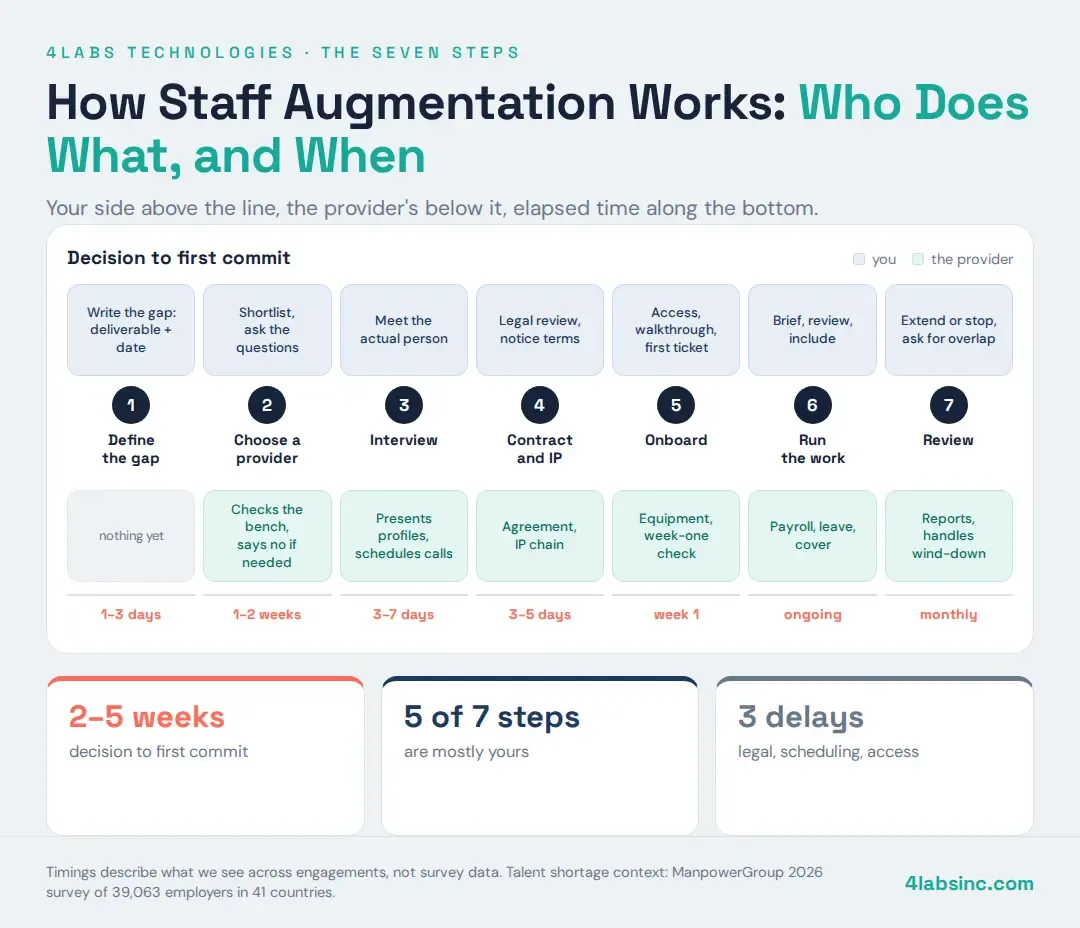
The short version of the staff augmentation process, split by who owns each part. Print it, or send it to whoever is asking how staff augmentation works.

Step You The provider
1. Define the gap Write the gap, the stack, the overlap hours and who briefs the work Nothing. This one is entirely yours
2. Choose a provider Shortlist, ask the seven questions, check references Qualifies the need, checks the bench, says no if the skill is not there
3. Shortlist and interview Meet the actual person, run a short technical screen Presents profiles, schedules the calls across time zones
4. Contract, IP and access Legal review, agree notice and replacement terms Supplies the agreement, confirms the IP chain, completes your compliance paperwork
5. Onboard Access, environments, architecture walkthrough, first ticket, named contact Equipment, internal setup, week-one check-in
6. Run the work Brief, review, include, and answer questions the same day Employment, payroll, leave, cover, delivery monitoring
7. Review and decide Monthly review, decide extend or stop, ask for a paid overlap Reports delivery, flags fit, handles wind-down or extension

Count the left column. Five of the seven steps are mostly yours, and the two that are not still need you in the room. That is the honest answer to "how much work is this for us", and it is the part the model's marketing tends to leave out.

How long does the whole staff augmentation process take?

The staff augmentation process runs two to five weeks from the decision to the first commit, in most engagements

StageTypical elapsed time
Define the gap1 to 3 days
Choose a provider1 to 2 weeks
Shortlist and interview3 to 7 days
Contract, IP and access3 to 5 days, run in parallel with interviews
Onboarding to first commitWeek one

Three things stretch it, and all three are on the client side.
Legal review. A week of waiting for a contract to come back is common in larger companies. Start it in parallel with the interviews rather than after them.
Interview scheduling. If your senior engineers cannot free an hour for ten days, the process waits ten days.
Access provisioning. The most avoidable delay of the three. Raise the requests the day the contract is signed, not the day the person starts.
Compare that with a permanent hire: search, interviews, offer, then a notice period that is usually a month or three. Our note on the fast hiring model covers where that time actually goes.
One caution about speed claims. Any provider promising an engineer on Monday either has someone idle who may not fit, or is about to start recruiting for you. Ask which.

Which model fits: engagement types and locations

Two choices sit inside step 2 of the staff augmentation process, and both have a post of their own.

How you buy the time.

Hourly suits unpredictable or part-time work. Monthly per engineer is the common default and the easiest to plan against. A dedicated pod gives you a small team with its own lead, which suits a whole workstream rather than a single gap. Our engagement models guide compares the three properly.

Where the people sit.

Onshore means the same country and the highest rate. Nearshore buys a few hours of overlap at a lower rate. Offshore gives the widest talent pool and the biggest time-zone gap, which is workable when the overlap hours are agreed in writing. Our offshore and nearshore models note covers the trade-offs.
A rule that holds across both: agree the overlap hours before you sign, not after the first missed stand-up. Three or four shared hours covers a stand-up, questions and a handover, and that is usually enough regardless of where the engineer sits.

When staff augmentation does not fit

Four situations where staff augmentation is not the answer, and another model is.

Nobody has time to direct the work.

This is the big one. Augmented engineers build what they are asked to build. If your only senior engineer is already at capacity, adding two people makes their week worse before it makes it better. Fix that first, or buy an outcome instead of people.

The scope is fully defined and you do not want to manage it.

A project with a clear specification and a fixed deliverable is outsourcing. Hand over the scope and let the vendor direct their own people.

You need an operation run, not a task done.

Monitoring, service desk, infrastructure support. That is a managed service with a service level attached, not a person on your board.

The work is core and permanent.

The first person on your core architecture should be an in-house employee. They accumulate the context that makes every later decision cheaper, and you do not want that context leaving on a notice period.
If you are weighing this by company size rather than by work type, our guide for startups and guide for enterprises take it from there.

What it costs, and what to compare it against

We are not publishing staff augmentation rates here. They move by skill, seniority and region, and any number in an article is out of date or wrong for your case.
What is worth knowing is the shape of the number.
What sits inside the monthly cost: the augmented engineer's time, their employment and benefits, equipment, the provider's recruitment and screening, replacement cover, and the provider's margin. One rate, one invoice, and it stops when you stop it.
What sits outside a salary when you hire instead: benefits, which the US Bureau of Labor Statistics measured at 31.6% of civilian employer compensation costs in June 2026; recruitment fees or your own hours spent interviewing; equipment and software seats; onboarding time before anyone is productive; and the empty months between deciding to hire and someone starting.
The comparison that matters: total cost of an employee against a stoppable monthly cost, over the period you actually need the skill. Not hourly rate against hourly salary, which is the comparison that makes augmentation look expensive and tells you nothing.
Our breakdown of the hidden costs of full-time hiring runs that line by line.
One honest note: staff augmentation is not automatically cheaper per hour. It is faster to start, reversible, and lighter in commitment. Whether it is cheaper depends on how long you need the person.

Not sure whether this fits your gap? Tell us the role, the deliverable and the date. We will say whether staff augmentation is the right model, what the first month would look like, and when you would be better off hiring. No obligation.

How 4Labs Technologies runs the process

The same staff augmentation process, with our specifics.
We help write step 1 before we quote. If the gap is not a sentence with a deliverable and a date, we work on that first. It costs nothing and it is the step that decides whether the rest works.
Engineers interview engineers. Every candidate you meet has passed a technical screen run by someone who works in that stack. You meet the person who will actually join, not a senior stand-in.
IP and accounts are yours from the first commit. Work product assigned to your company in the service agreement, and our own employment contracts assign engineer output to us, so the chain is complete. Repositories in your organisation, cloud accounts in your name.
Start small. One engineer, a defined first month, a review at the end of it. Scale up if it works. Stop if it does not, without a penalty conversation.
We say when the answer is no. Sometimes the right advice is to wait a quarter and hire one person properly. A short engagement that works beats a long one that does not.
We cover full-stack, QA and automation, DevOps and cloud, data and mobile, in hourly, monthly and dedicated pod models.

Tell us the gap, the deliverable and the date. We will come back with the people, a plan for the first month, and an honest view on whether you should do this at all. Talk to 4Labs Technologies.

Frequently asked questions

How does staff augmentation work in simple terms?

Here is how staff augmentation works in practice. You tell a provider what skill you are missing. They put forward engineers from their bench, you interview and choose, and the person joins your team under your direction while the provider employs and pays them. You brief the work and review the code. The engagement bills monthly and you can stop it.

How long does it take to get an augmented developer started?

Two to five weeks from decision to first commit in most cases: one to three days to define the gap, one to two weeks to choose a provider, three to seven days to interview, three to five days for contracting, then onboarding in week one. Running contracting in parallel with interviews is what keeps it at the shorter end.

Who manages the augmented engineer?

You do, day to day. You set priorities, review code and decide what ships. The provider manages employment, payroll, leave, cover and replacement. If nobody on your side has time to brief and review the work, the model will disappoint regardless of who you choose.

What is the difference between staff augmentation and outsourcing?

Direction. In staff augmentation the engineer works under your management inside your in-house team. In outsourcing you hand over a defined scope and the vendor directs their own people to deliver it. Augmentation suits an ongoing skill gap; outsourcing suits a bounded project you do not want to manage.

Who owns the code an augmented developer writes?

You do, if the contract says so. The service agreement must assign work product to your company on creation, and the provider's own employment contracts must assign their engineers' output to the provider. Ask to see that both exist. A gap between them is what diligence finds later.

Can you stop a staff augmentation contract early?

Yes, within the notice period, which is commonly 30 days. That is the main advantage over a permanent hire. Ask before signing what happens if the fit is wrong in week three, and whether there is a replacement process without a penalty. Ask for a paid overlap at the end so knowledge transfers rather than walking out with the person.

The model is simple, the preparation is not

How staff augmentation works is not complicated. Seven steps, two to five weeks, one rule: you direct, they employ.
What separates the engagements that work from the ones that disappoint is the preparation. A gap written as a sentence with a deliverable and a date. Someone named to brief and review. Access raised before the start date. A contract where the IP chain is complete on both sides.
Get those four right and the rest of the process takes care of itself. Skip them and you have bought an invoice for someone waiting to be told what to do.

Talk to 4Labs Technologies about your gap · 30 minutes, no obligation.

‹ PreviousNext ›
author_icon
About the Author

Jithesh Rajasekharan

CTO

A technology-focused Chief Technology Officer driving innovation, scalable solutions, and digital transformation. Experienced in leading technical teams, shaping technology strategies, and building reliable solutions aligned with business goals.