Logo
Logo
ServicesIndustriesCase StudiesBlogsCareersLet's Connect
blue-white-icon
black-image
Logo
ServicesIndustriesCase StudiesBlogsCareersLet's Connect
burger-icon
hamburger
QA and Automation Testing Staff Augmentation
Blogs/QA and Automation Testing Staff Augmentation: Strengthen Product Quality with On-Demand Testing Experts

QA and Automation Testing Staff Augmentation: Strengthen Product Quality with On-Demand Testing Experts

January 30, 2026
Share Now

Table of Contents

  1. 1. What It Actually Is
  2. 2. Staff Augmentation Comparison
  3. 3. Five QA Roles
  4. 4. QA Staff Augmentation Is The Right Shape
  5. 5. First Thirty Days Should Produce
  6. 6. Screen An Automation Engineer
  7. 7. Test Suite Survive The Contract
  8. 8. What To Ask
  9. 9. Talk to our QA team and FAQs

The regression suite takes four days to run. The release is in six weeks. Hiring a permanent QA engineer takes longer than the release does.

That is the moment most enterprise teams start reading about QA and automation testing staff augmentation. It is a reasonable answer to a real problem. It is also the point where a lot of money gets spent on the wrong role, the wrong expectation, or a test suite nobody owns twelve months later.

This page is written for the person doing that reading. It covers what QA staff augmentation is and how it differs from managed testing services. It sets out the five QA roles and which problem each one solves, how to screen an automation engineer properly, and what the first month should produce.

It also covers the part the vendor pages leave out: when adding QA engineers will not improve your product quality, and what to do instead.

Key takeaways

  • QA staff augmentation means testers and automation engineers join your team under your management. You direct the work, and you carry the risk of directing it well.

Stay Ahead With 4Labs

Get expert insights, security briefings, and the latest innovations in your inbox.

  • Afghanistan+93
  • Albania+355
  • Algeria+213
  • Andorra+376
  • Angola+244
  • Antigua and Barbuda+1268
  • Argentina+54
  • Armenia+374
  • Aruba+297
  • Australia+61
  • Austria+43
  • Azerbaijan+994
  • Bahamas+1242
  • Bahrain+973
  • Bangladesh+880
  • Barbados+1246
  • Belarus+375
  • Belgium+32
  • Belize+501
  • Benin+229
  • Bhutan+975
  • Bolivia+591
  • Bosnia and Herzegovina+387
  • Botswana+267
  • Brazil+55
  • British Indian Ocean Territory+246
  • Brunei+673
  • Bulgaria+359
  • Burkina Faso+226
  • Burundi+257
  • Cambodia+855
  • Cameroon+237
  • Canada+1
  • Cape Verde+238
  • Caribbean Netherlands+599
  • Cayman Islands+1
  • Central African Republic+236
  • Chad+235
  • Chile+56
  • China+86
  • Colombia+57
  • Comoros+269
  • Congo+243
  • Congo+242
  • Costa Rica+506
  • Côte d'Ivoire+225
  • Croatia+385
  • Cuba+53
  • Curaçao+599
  • Cyprus+357
  • Czech Republic+420
  • Denmark+45
  • Djibouti+253
  • Dominica+1767
  • Dominican Republic+1
  • Ecuador+593
  • Egypt+20
  • El Salvador+503
  • Equatorial Guinea+240
  • Eritrea+291
  • Estonia+372
  • Ethiopia+251
  • Faroe Islands+298
  • Fiji+679
  • Finland+358
  • France+33
  • French Guiana+594
  • French Polynesia+689
  • Gabon+241
  • Gambia+220
  • Georgia+995
  • Germany+49
  • Ghana+233
  • Gibraltar+350
  • Greece+30
  • Greenland+299
  • Grenada+1473
  • Guadeloupe+590
  • Guam+1671
  • Guatemala+502
  • Guinea+224
  • Guinea-Bissau+245
  • Guyana+592
  • Haiti+509
  • Honduras+504
  • Hong Kong+852
  • Hungary+36
  • Iceland+354
  • India+91
  • Indonesia+62
  • Iran+98
  • Iraq+964
  • Ireland+353
  • Israel+972
  • Italy+39
  • Jamaica+1876
  • Japan+81
  • Jordan+962
  • Kazakhstan+7
  • Kenya+254
  • Kiribati+686
  • Kosovo+383
  • Kuwait+965
  • Kyrgyzstan+996
  • Laos+856
  • Latvia+371
  • Lebanon+961
  • Lesotho+266
  • Liberia+231
  • Libya+218
  • Liechtenstein+423
  • Lithuania+370
  • Luxembourg+352
  • Macau+853
  • Macedonia+389
  • Madagascar+261
  • Malawi+265
  • Malaysia+60
  • Maldives+960
  • Mali+223
  • Malta+356
  • Marshall Islands+692
  • Martinique+596
  • Mauritania+222
  • Mauritius+230
  • Mayotte+262
  • Mexico+52
  • Micronesia+691
  • Moldova+373
  • Monaco+377
  • Mongolia+976
  • Montenegro+382
  • Morocco+212
  • Mozambique+258
  • Myanmar+95
  • Namibia+264
  • Nauru+674
  • Nepal+977
  • Netherlands+31
  • New Caledonia+687
  • New Zealand+64
  • Nicaragua+505
  • Niger+227
  • Nigeria+234
  • North Korea+850
  • Norway+47
  • Oman+968
  • Pakistan+92
  • Palau+680
  • Palestine+970
  • Panama+507
  • Papua New Guinea+675
  • Paraguay+595
  • Peru+51
  • Philippines+63
  • Poland+48
  • Portugal+351
  • Puerto Rico+1
  • Qatar+974
  • Réunion+262
  • Romania+40
  • Russia+7
  • Rwanda+250
  • Saint Kitts and Nevis+1869
  • Saint Lucia+1758
  • Saint Pierre & Miquelon+508
  • Saint Vincent and the Grenadines+1784
  • Samoa+685
  • San Marino+378
  • São Tomé and Príncipe+239
  • Saudi Arabia+966
  • Senegal+221
  • Serbia+381
  • Seychelles+248
  • Sierra Leone+232
  • Singapore+65
  • Slovakia+421
  • Slovenia+386
  • Solomon Islands+677
  • Somalia+252
  • South Africa+27
  • South Korea+82
  • South Sudan+211
  • Spain+34
  • Sri Lanka+94
  • Sudan+249
  • Suriname+597
  • Swaziland+268
  • Sweden+46
  • Switzerland+41
  • Syria+963
  • Taiwan+886
  • Tajikistan+992
  • Tanzania+255
  • Thailand+66
  • Timor-Leste+670
  • Togo+228
  • Tonga+676
  • Trinidad and Tobago+1868
  • Tunisia+216
  • Turkey+90
  • Turkmenistan+993
  • Tuvalu+688
  • Uganda+256
  • Ukraine+380
  • United Arab Emirates+971
  • United Kingdom+44
  • United States+1
  • Uruguay+598
  • Uzbekistan+998
  • Vanuatu+678
  • Vatican City+39
  • Venezuela+58
  • Vietnam+84
  • Wallis & Futuna+681
  • Yemen+967
  • Zambia+260
  • Zimbabwe+263
Our Services
Digital Marketing
Staff Augmentation
IT Infrastructure
ERP Solutions
Software Development
Web & App Development
Industries
Cryptocurrency and Blockchain
Banking, Financial Services, and Insurance (BFSI)
Lending and FinTech
Oil and Gas
Energy and Utilities
Automotive and Manufacturing
Agriculture
Real Estate
E-commerce and Retail
Case Studies
Financial Services Test Automation
AI-Driven Customer Risk Profiling
Elevating Mobile Performance
Jewelry Client Transformation
AI Underwriting Revolution
Advanced Cybersecurity Solutions
Eyewear Retailer Transformation
Revolutionizing Manufacturing Operations
Offshore Development Excellence
Company

About Us

Careers

Let's Connect

Business Referral

Engagement Model

Partnership Programs

Resources

Blogs

footer1-iconfooter2-iconiso_iconiso_icon2

4labsicon

Copyright © 2026 4Labs Technologies. All Rights Reserved.

Privacy Policy

Terms & Conditions

Accessibility

fb-icon
twitter-icon
instagram-icon
linkedin-icon
  • In a managed testing service the provider owns the outcome. That single difference decides which model fits your situation.
  • Most disappointing engagements are a hiring mismatch. A manual tester, an SDET and an automation architect solve three different problems.
  • Adding QA engineers does not fix unclear acceptance criteria, a missing definition of done, or thin observability. Those are system problems, not capacity problems.
  • The test suite outlives the contract. Name an owner on your side before the engagement starts, not in the final week.
  • What QA and automation testing staff augmentation actually is

    QA staff augmentation means testers and automation engineers join your existing QA team, under your management, working your process and your tools. They attend your stand-ups. Their code goes through your review. You set the priorities.

    That last part is the whole model. Your QA team grows, your software testing process does not, and you are buying skilled hands rather than a managed outcome.

    Staff augmentation, managed testing services and QA outsourcing

    The split is who carries the risk. In staff augmentation you carry it: you direct the work, and if the work is directed badly the result is yours. In a managed testing service the provider carries it, because you buy a result rather than a person.

    QA outsourcing usually means the second with less integration. The provider runs your software testing from further away, often with their own environments and their own reporting.

    Staff augmentationManaged testing serviceQA outsourcing
    Who sets prioritiesYouAgreed scope, provider plansAgreed scope
    Who owns the test planYour QA leadThe providerThe provider
    Who carries the riskYouThe providerThe provider
    What you need alreadyA test strategy and someone to leadClear requirements and acceptance criteriaClear requirements, stable releases
    Best whenYou know what to build and lack handsYou lack QA leadership or bandwidthTesting is separable from development

    Read that fourth row carefully, because it is where most decisions go wrong. Staff augmentation asks you to bring the test strategy. If you do not have one, you are buying execution for a plan that does not exist yet, and the engineers will end up writing the plan in their first month whether or not you budgeted for that.

    The commercial shape sits on top of this. Hourly, monthly retainer and dedicated team each suit different QA work, and that comparison has its own home in our guide to staff augmentation engagement models. Pick the model after you have picked the role, not before.

    The five QA roles, and which problem each one solves

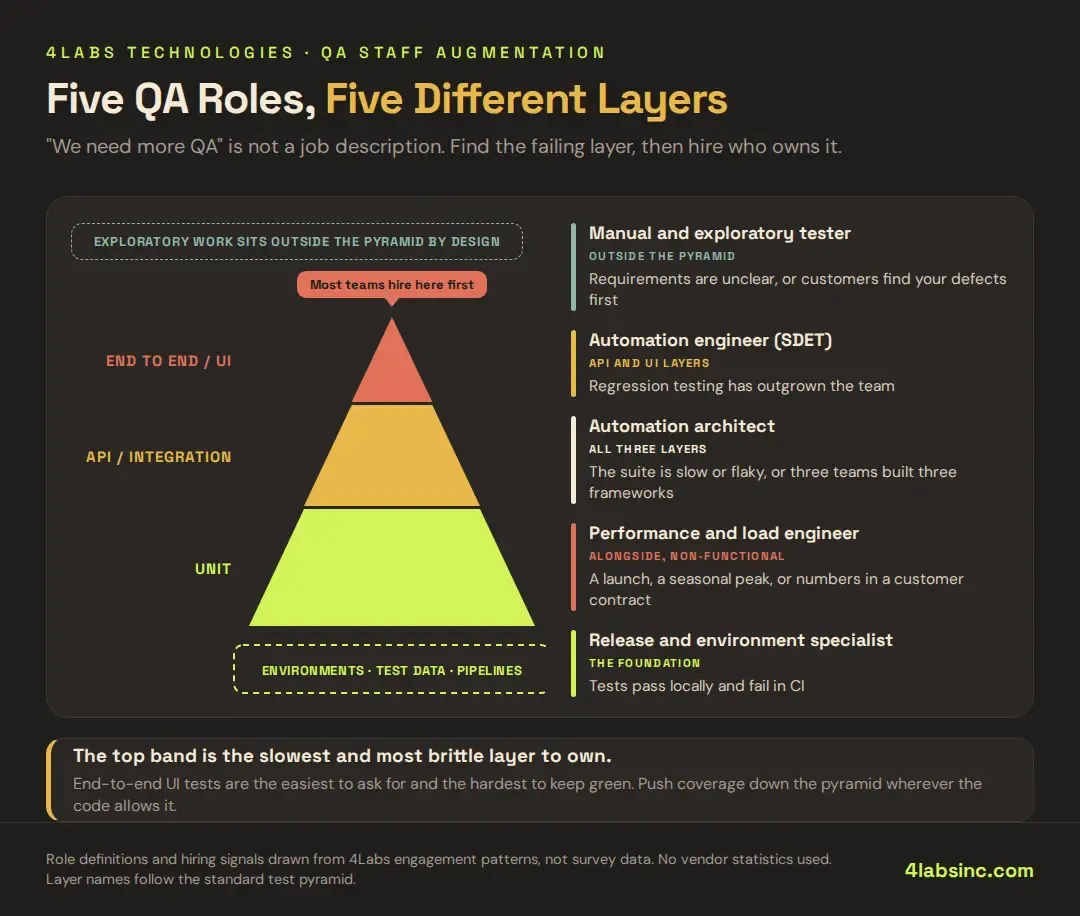
    Most disappointing engagements are a hiring mismatch, not a quality problem. The team asked for "more QA", got a capable person, and found six weeks later that the capable person does not work at the layer that was failing.
    Test pyramid showing five QA roles.webp

    Five roles sit under the QA label, and only two of them write test automation. They command different rates, they own different layers, and they fail in different ways.

    Manual and exploratory tester

    Finds what scripts miss. They work from risk and curiosity rather than a written case, which is exactly why automation cannot replace them.

    Hire when: requirements are unclear, the feature is new, or your defects are found by customers rather than by tests.

    Cannot fix: a regression suite that takes four days. Exploratory work does not scale by repetition.

    Automation engineer or SDET

    Writes and maintains the test automation suite. Most of the job is maintenance rather than authoring, and that distinction matters when you screen them. Test automation rewards the engineer who deletes as readily as they add.

    Hire when: regression testing has outgrown the team, or releases slip because nobody can verify them quickly enough.

    Cannot fix: a codebase with no seams to test against. If everything runs through the UI, automation will be slow and brittle whoever writes it.

    Automation architect

    Chooses the test automation framework, the layering and the standards. Decides what gets tested at unit level, at API level and at end-to-end level, then makes those choices hold across teams.

    Hire when: the suite is flaky, slow, or three teams have built three incompatible frameworks.

    Cannot fix: a shortage of hands. An architect who spends their time writing test cases is an expensive test writer.

    Performance and load engineer

    Owns non-functional requirements: throughput, latency, capacity under a scale event. Different tooling, different mindset, rarely the same person as your functional automation engineer.

    Hire when: you have a launch, a seasonal peak, or a customer contract with numbers in it.

    Cannot fix: functional defects. A fast, wrong answer is still wrong.

    Release and environment specialist

    Owns test data, environments and the pipelines that run the suite. This is the role buyers forget and then urgently need, because a test suite with no reliable environment produces noise rather than signal.

    Hire when: tests pass locally and fail in CI, or your team spends more time fixing environments than testing.

    Cannot fix: test design. They make the suite runnable, not correct.

    Work out which layer is failing before you write the job description. The answer is usually narrower than "we need more QA", and the narrower answer is cheaper.


    When QA staff augmentation is the right shape, and when it is not

    QA staff augmentation works when you know what needs testing and lack the hands or the skill to do it. It disappoints when the real problem sits upstream of testing.

    This is the section most provider pages skip. We would rather you read it and decide we are wrong for your situation than start an engagement that was never going to work.

    Three conditions where it works

    You have a defined scope. Somebody can say which areas need coverage and which risks matter most. It does not have to be a formal document. It has to exist in one head that is available to the new engineers.

    You have an owner on your side. A QA lead, an engineering manager, someone with time to answer questions and review test code. Your QA team has to have room for this. Without it, augmented engineers make their own decisions, and those decisions become your maintenance problem.

    You have a test strategy on paper, even a rough one. What is tested at unit level, what at API level, what end to end. If this does not exist, hire an automation architect first and the hands second.

    Four situations where it will disappoint

    No acceptance criteria. If the team cannot agree what "working" means, testers will find defects that developers dispute. You will buy arguments, not quality. Fix the criteria first, which costs nothing but attention.

    No definition of done. Where code merges before anyone tests it, more QA engineers means a longer queue behind the same bottleneck. The fix is a process change, not a headcount change.

    A suite nobody owns. Adding people to an unowned suite produces a bigger unowned suite. Name the owner first. This is covered properly further down.

    Quality problems that are really requirements problems. When defects trace back to ambiguous specifications rather than missed test cases, more test execution finds the same defects later and more expensively. That is a product and analysis problem, and hiring QA engineers to solve it is the most common expensive mistake in this space.

    Be honest about which of these describes you. Three of the four cost nothing to fix and make the eventual engagement work far better.

    There is also a cost question sitting underneath all of this, because the alternative is a permanent hire. Our breakdown of what a full-time QA hire really costs covers the parts that do not appear in the salary line.

    Not sure which side of this you are on? A short conversation usually settles it, and sometimes the answer is that neither augmentation nor a managed service is what you need yet.

    What the first thirty days should produce

    Not new test coverage. That surprises people, and it is the expectation that decides whether the engagement feels like a success or a disappointment.

    An automation engineer joining an enterprise team inherits an existing suite, existing environments and existing conventions. Adding tests on top of something they do not understand yet is how you get a suite that fails for reasons nobody can explain.

    Week 1: access and assessment

    Accounts, repository access, a working local environment, a CI login. Then a read of the existing suite and a written assessment: which tests are flaky, which are slow, which cover nothing, which duplicate each other.

    That written assessment is the first deliverable. Ask for it. If a provider says their engineer will be writing tests in week one, they are telling you the engineer will skip this step.

    Weeks 2 to 3: stabilise before extending

    Fix or delete the flaky tests. A suite that fails randomly trains your team to ignore failures, and a suite everybody ignores has negative value.

    This is where inherited technical debt shows up. If the suite is in poor shape, most of this window goes into repair rather than new coverage. No provider page mentions this, and every experienced QA lead recognises it.

    Week 4: first new coverage

    New test coverage in the highest-risk area, written as automated tests, reviewed by your engineers, merged into your repository, running in your pipeline. Small and correct beats large and unreviewed.

    The honest version

    If the inherited suite is bad, month one produces confidence rather than coverage numbers. You will end it knowing what your test automation actually covers, which many teams have never known, and with a suite whose failures mean something. Test coverage numbers mean little until that point.

    If you need a coverage number in thirty days, say so before you start. It is achievable in a narrow area, and it changes what the engineer does with weeks 2 and 3. What does not work is expecting both and discovering the mismatch in the first review.

    How to screen an automation engineer

    A CV full of tool names tells you almost nothing. Writing a passing test is the easy part of test automation. Keeping five hundred of them fast, meaningful and trusted for two years is the hard part, and that is what you should screen for.
    Six questions. Each one has an answer that should reassure you and an answer that should end the interview.

    1. How do you decide what not to automate?

    Good: they have a rule. Low-risk areas, features still changing weekly, anything cheaper to check by eye than to maintain. They talk about maintenance cost as a real cost.

    Bad: "automate everything." That answer produces a suite that costs more to maintain than the bugs it catches.

    2. What do you do with a test that fails once a week?

    Good: investigate, and if it cannot be made reliable, delete it or quarantine it with a deadline. They understand that an ignored failing test is worse than no test.

    Bad: rerun it, or add a wait. Retry logic used as a fix rather than as a diagnosis is the single most common cause of a suite nobody trusts.

    3. Where did test data come from in your last project?

    Good: a specific mechanism. Fixtures, factories, a seeded environment, an API that creates and tears down what each test needs.

    Bad: a vague answer, or a shared staging database everyone edits. Test data is where most enterprise automation quietly falls apart.

    4. How do you keep a suite fast as it grows?

    Good: they push tests down the stack. More at unit and API level, fewer end to end. They mention parallel execution, tagging, and a fast smoke suite separate from the full regression run.

    Bad: "add more machines." Hardware hides the problem for a while and gets expensive.

    5. Show me a test you deleted, and tell me why

    Good: an immediate example. Engineers who maintain suites delete tests regularly, and they can explain the judgement.

    Bad: they have never deleted one. That tells you they have authored tests but never owned a suite over time.

    6. What does your handover look like?

    Good: documentation written as they go, a README somebody else can follow, and named people on your side who can already run and fix the suite.

    Bad: "I'll write it up at the end." It never gets written at the end.

    If these questions are useful to you, run them. We run the same screen on every QA engineer before we propose them, which is why our shortlists are shorter than most.

    Making the test suite survive the contract

    The test automation suite is an asset you keep. The engineer is not. So the handover starts on day one, not in the final week.

    This is the difference between QA staff augmentation that pays off for three years and QA staff augmentation that leaves you with a folder of tests your team deletes eight months later. Five things make the difference.

    Name an owner before the engagement starts. Someone on your payroll who will hold the suite afterwards. Not a committee, not "the QA team". If you cannot name that person, you are not ready to start.

    Test code goes through your review. Your engineers review it the way they review application code. This is the single highest-leverage thing on the list, because reviewing the tests is how your team learns the suite while it is being written.

    Tests live in your repository, running in your pipeline, from day one. Not on the contractor's machine, not in a separate repo, not "we'll merge it at the end". If the tests are not running in your continuous integration by week two, something is wrong.

    Documentation is part of the definition of done, not a final task. A README that explains how to run the suite, how to add a test, and where test data comes from. Written as the work happens, reviewed like the code.

    Run the exit test early. Halfway through the engagement, have one of your own engineers run the suite, diagnose a failure and add a test, without help. Whatever goes wrong is what your handover plan needs to fix, and you still have time to fix it.

    Teams that scale engineering capacity well treat every external contribution this way, not only software testing. The same ownership questions apply when you scale an engineering team without losing control of it.

    What to ask a QA staff augmentation provider

    Ask about replacement, ramp and ownership. Headcount and years in business tell you about the provider. These questions tell you what your engagement will feel like, and how your software testing will run day to day.

    What happens if the engineer is not right? A good answer names a window and a process, and does not make you argue for it. A bad answer is reassurance with no mechanism.

    Who technically screened this person, and how? A good answer describes the screen, and the screener has written test automation themselves. A bad answer is "our vetting process", with no detail.

    What does week one look like? A good answer matches the thirty-day shape above: access, assessment, then work. A bad answer promises new tests on day two.

    Can I speak to the engineer before I commit? A good answer is yes, without a chaperone. Anything else is a flag.
    What happens if they leave mid-engagement? A good answer covers notice, overlap and documented handover. A bad answer treats it as unlikely.

    Who owns the test code? A good answer is you, in writing, in the contract. Ask before you sign. It is awkward to raise afterwards.

    One more thing worth checking, and it is not a question. Notice whether the provider tells you when their service is the wrong fit. A partner who never says no is selling capacity, not judgement, and you can find capacity anywhere.

    Getting QA and automation testing staff augmentation right

    Four decisions carry the whole thing. Work out which layer is failing and hire the role that owns it. Set the thirty-day expectation before anyone starts. Screen for maintenance rather than authoring. Plan the handover on day one, so your QA team keeps what was built.

    Get those right and augmented QA engineers raise your product quality and leave a suite your team keeps using. Get them wrong and you buy test execution at a premium for six months.

    And if the honest answer is that your acceptance criteria are the problem, fix that first. It costs nothing and it makes everything after it work.

    Talk to our QA team

    A first conversation covers three things: which layer is actually failing, which role fits it, and what the handover should look like. We work that out before we send any profiles, because sending profiles first is how engagements start badly.

    If QA staff augmentation is not the right shape for your situation, we will say so. Sometimes the answer is a managed testing service, and sometimes it is a process change that costs nothing.

    Talk to our QA team

    Frequently asked questions

    What is QA staff augmentation?

    QA staff augmentation means testers and automation engineers join your existing QA team under your management. They use your tools, follow your process and work to your priorities. You direct the work and own the outcome, which is what separates it from a managed testing service.

    What is the difference between QA staff augmentation and managed testing services?

    Who carries the risk. In QA staff augmentation you direct the engineers and own the result. In a managed testing service the provider plans and runs the testing, and you buy an outcome. Augmentation fits teams with a test strategy and a QA lead. A managed service fits teams without either.

    How quickly can augmented QA engineers become productive?

    Expect assessment in week one, suite stabilisation in weeks two and three, and first new test coverage in week four. If the existing suite is flaky, month one produces a trustworthy suite rather than a bigger one. Anyone promising new tests on day two is skipping the assessment.

    Should we hire a manual tester or an automation engineer?

    Depends which layer is failing. Hire a manual and exploratory tester when requirements are unclear or customers find your defects. Hire an automation engineer when regression testing has outgrown the team. Hire an automation architect when the suite itself is slow, flaky or unowned.

    What happens to our test automation when the contract ends?

    Only what you planned for. Name an owner on your side before the engagement starts, keep test code in your repository under your review, and treat documentation as part of the definition of done. Then have one of your own engineers run and extend the suite unaided at the halfway point.

    ‹ PreviousNext ›
    author_icon
    About the Author

    Jithesh Rajasekharan

    CTO

    A technology-focused Chief Technology Officer driving innovation, scalable solutions, and digital transformation. Experienced in leading technical teams, shaping technology strategies, and building reliable solutions aligned with business goals.