Logo
Logo
ServicesIndustriesCase StudiesBlogsCareersLet's Connect
blue-white-icon
black-image
Logo
ServicesIndustriesCase StudiesBlogsCareersLet's Connect
burger-icon
hamburger
staff agumentation common image
Blogs/Offshore vs Nearshore Staff Augmentation: How to Choose the Right Model

Offshore vs Nearshore Staff Augmentation: How to Choose the Right Model

February 20, 2026
Share Now

Table of Contents

  1. 1. Offshore and nearshore are distances
  2. 2. What staff augmentation is, briefly
  3. 3. Nearshore staff augmentation
  4. 4. The three models
  5. 5. Legal, IP and data residency
  6. 6. Frequently asked questions

Most guides to offshore and nearshore staff augmentation treat them as two categories you pick between, like choosing a plan. They are not categories, they are distances from wherever you are.
That sounds like a technicality, but it is the whole decision.
Once you see it that way, the question stops being "which model is better" and becomes something you can actually answer: how many hours of your working day do you need your engineers to be awake for? Everything else — cost, culture, hiring speed, coordination load — follows from that number.
This guide covers what each staff augmentation model means, and it adds onshore so the comparison is complete. It also gives you a way to work out the overlap you need, plus the legal and data questions that decide which regions are even available to you.
4Labs runs both offshore and nearshore staff augmentation teams, so we have no reason to push you towards either.

Offshore and nearshore are distances from you, not places

No country is offshore and no country is nearshore. Those words describe a relationship between two places, and the relationship changes depending on where you are sitting.

The same country can be both

Stay Ahead With 4Labs

Get expert insights, security briefings, and the latest innovations in your inbox.

  • Afghanistan+93
  • Albania+355
  • Algeria+213
  • Andorra+376
  • Angola+244
  • Antigua and Barbuda+1268
  • Argentina+54
  • Armenia+374
  • Aruba+297
  • Australia+61
  • Austria+43
  • Azerbaijan+994
  • Bahamas+1242
  • Bahrain+973
  • Bangladesh+880
  • Barbados+1246
  • Belarus+375
  • Belgium+32
  • Belize+501
  • Benin+229
  • Bhutan+975
  • Bolivia+591
  • Bosnia and Herzegovina+387
  • Botswana+267
  • Brazil+55
  • British Indian Ocean Territory+246
  • Brunei+673
  • Bulgaria+359
  • Burkina Faso+226
  • Burundi+257
  • Cambodia+855
  • Cameroon+237
  • Canada+1
  • Cape Verde+238
  • Caribbean Netherlands+599
  • Cayman Islands+1
  • Central African Republic+236
  • Chad+235
  • Chile+56
  • China+86
  • Colombia+57
  • Comoros+269
  • Congo+243
  • Congo+242
  • Costa Rica+506
  • Côte d'Ivoire+225
  • Croatia+385
  • Cuba+53
  • Curaçao+599
  • Cyprus+357
  • Czech Republic+420
  • Denmark+45
  • Djibouti+253
  • Dominica+1767
  • Dominican Republic+1
  • Ecuador+593
  • Egypt+20
  • El Salvador+503
  • Equatorial Guinea+240
  • Eritrea+291
  • Estonia+372
  • Ethiopia+251
  • Faroe Islands+298
  • Fiji+679
  • Finland+358
  • France+33
  • French Guiana+594
  • French Polynesia+689
  • Gabon+241
  • Gambia+220
  • Georgia+995
  • Germany+49
  • Ghana+233
  • Gibraltar+350
  • Greece+30
  • Greenland+299
  • Grenada+1473
  • Guadeloupe+590
  • Guam+1671
  • Guatemala+502
  • Guinea+224
  • Guinea-Bissau+245
  • Guyana+592
  • Haiti+509
  • Honduras+504
  • Hong Kong+852
  • Hungary+36
  • Iceland+354
  • India+91
  • Indonesia+62
  • Iran+98
  • Iraq+964
  • Ireland+353
  • Israel+972
  • Italy+39
  • Jamaica+1876
  • Japan+81
  • Jordan+962
  • Kazakhstan+7
  • Kenya+254
  • Kiribati+686
  • Kosovo+383
  • Kuwait+965
  • Kyrgyzstan+996
  • Laos+856
  • Latvia+371
  • Lebanon+961
  • Lesotho+266
  • Liberia+231
  • Libya+218
  • Liechtenstein+423
  • Lithuania+370
  • Luxembourg+352
  • Macau+853
  • Macedonia+389
  • Madagascar+261
  • Malawi+265
  • Malaysia+60
  • Maldives+960
  • Mali+223
  • Malta+356
  • Marshall Islands+692
  • Martinique+596
  • Mauritania+222
  • Mauritius+230
  • Mayotte+262
  • Mexico+52
  • Micronesia+691
  • Moldova+373
  • Monaco+377
  • Mongolia+976
  • Montenegro+382
  • Morocco+212
  • Mozambique+258
  • Myanmar+95
  • Namibia+264
  • Nauru+674
  • Nepal+977
  • Netherlands+31
  • New Caledonia+687
  • New Zealand+64
  • Nicaragua+505
  • Niger+227
  • Nigeria+234
  • North Korea+850
  • Norway+47
  • Oman+968
  • Pakistan+92
  • Palau+680
  • Palestine+970
  • Panama+507
  • Papua New Guinea+675
  • Paraguay+595
  • Peru+51
  • Philippines+63
  • Poland+48
  • Portugal+351
  • Puerto Rico+1
  • Qatar+974
  • Réunion+262
  • Romania+40
  • Russia+7
  • Rwanda+250
  • Saint Kitts and Nevis+1869
  • Saint Lucia+1758
  • Saint Pierre & Miquelon+508
  • Saint Vincent and the Grenadines+1784
  • Samoa+685
  • San Marino+378
  • São Tomé and Príncipe+239
  • Saudi Arabia+966
  • Senegal+221
  • Serbia+381
  • Seychelles+248
  • Sierra Leone+232
  • Singapore+65
  • Slovakia+421
  • Slovenia+386
  • Solomon Islands+677
  • Somalia+252
  • South Africa+27
  • South Korea+82
  • South Sudan+211
  • Spain+34
  • Sri Lanka+94
  • Sudan+249
  • Suriname+597
  • Swaziland+268
  • Sweden+46
  • Switzerland+41
  • Syria+963
  • Taiwan+886
  • Tajikistan+992
  • Tanzania+255
  • Thailand+66
  • Timor-Leste+670
  • Togo+228
  • Tonga+676
  • Trinidad and Tobago+1868
  • Tunisia+216
  • Turkey+90
  • Turkmenistan+993
  • Tuvalu+688
  • Uganda+256
  • Ukraine+380
  • United Arab Emirates+971
  • United Kingdom+44
  • United States+1
  • Uruguay+598
  • Uzbekistan+998
  • Vanuatu+678
  • Vatican City+39
  • Venezuela+58
  • Vietnam+84
  • Wallis & Futuna+681
  • Yemen+967
  • Zambia+260
  • Zimbabwe+263
Our Services
Digital Marketing
Staff Augmentation
IT Infrastructure
ERP Solutions
Software Development
Web & App Development
Industries
Cryptocurrency and Blockchain
Banking, Financial Services, and Insurance (BFSI)
Lending and FinTech
Oil and Gas
Energy and Utilities
Automotive and Manufacturing
Agriculture
Real Estate
E-commerce and Retail
Case Studies
Financial Services Test Automation
AI-Driven Customer Risk Profiling
Elevating Mobile Performance
Jewelry Client Transformation
AI Underwriting Revolution
Advanced Cybersecurity Solutions
Eyewear Retailer Transformation
Revolutionizing Manufacturing Operations
Offshore Development Excellence
Company

About Us

Careers

Let's Connect

Business Referral

Engagement Model

Partnership Programs

Resources

Blogs

footer1-iconfooter2-iconiso_iconiso_icon2

4labsicon

Copyright © 2026 4Labs Technologies. All Rights Reserved.

Privacy Policy

Terms & Conditions

Accessibility

fb-icon
twitter-icon
instagram-icon
linkedin-icon

Eastern Europe is offshore for a company in Chicago and nearshore for a company in Berlin. Nothing about the engineers changes, but the time-zone gap does, and that is the only thing the labels are really tracking.
India is offshore for a US business and nearshore for one in Dubai, where the gap is ninety minutes. Latin America is nearshore for the US and firmly offshore for anyone in Europe.
So when a guide tells you "nearshore means better collaboration", it is really telling you "more shared working hours means better collaboration". That is true, and it has nothing to do with the map.

What this means for your decision

It means you can stop comparing labels and start measuring one thing.
Work out how many hours of overlap your team genuinely needs, then look at which regions give you that. Sometimes the answer is a country two time zones away, and sometimes it is a country eight time zones away that works a shifted day. The label attached to it afterwards does not matter.
That calculation is in the overlap section below, and it is the most useful part of this page.

What staff augmentation is, briefly

Staff augmentation means adding skilled engineers to your existing team through a partner, under your management, for as long as the work lasts.

How the model works

The augmented engineer joins your standup and uses your tools, and you set their priorities and review their work. The partner employs them and handles payroll, benefits and replacement.
You are buying capacity and skills rather than an employee, which is where every advantage and every limitation of the model comes from. Our full comparison of staff augmentation and traditional hiring goes through that trade-off properly, and we cover how it differs from outsourcing separately.

Why geography became a choice

For most of software's history you hired whoever lived within commuting distance. Remote work turned location from a constraint into a variable, and the talent shortage made using that variable worth the effort.
Korn Ferry projected a global shortfall of 4.3 million technology workers by 2030 in its 2018 report The Global Talent Crunch. Treat that as a projection made eight years ago rather than a measurement, but the direction it points is the one every hiring manager recognizes.
So the question is no longer whether to hire globally. It is how far away is workable.

Offshore staff augmentation

Offshore staff augmentation means engineers far enough away that you share few working hours, usually eight or more time zones. You get the deepest talent pools and the lowest rates, and you pay for it in coordination.
For a US company the big offshore talent markets are India, South East Asia and parts of Eastern Europe, and for a European company they are South and East Asia or Latin America.

What offshore gives you

Depth of talent. The large offshore talent markets produce developers at a scale no single domestic market matches, which is what makes specialist roles findable. DevOps, QA automation, cloud and SAP BTP are all easier to staff offshore than locally.
The lowest rates of the three models. This is the reason most companies look offshore first, and it is real.
Speed. An established offshore partner can put a vetted developer on your project in days, because the bench already exists.
Scale. Adding four engineers is the same process as adding one, and domestic hiring does not work that way.

What offshore costs you

Shared hours, and the discipline to work without them.
A question asked at 4pm your time gets answered the next morning. That is not a problem in itself, but it becomes one when your team is used to asking questions in real time and nobody has changed how they work.
The around-the-clock claim, honestly. You will read that offshore teams keep working after your day ends, so development runs continuously. That is true, with conditions. It requires written handovers at the end of each day, clear ownership of every workstream, and a rule that nobody leaves a blocking question open overnight. With those, the time gap genuinely buys you hours. Without them, it adds a day to every decision, so the claim is real but not free.

Where offshore works best

Long-running work with defined scope. Specialist skills you cannot find locally. Teams that already document decisions rather than settling them in conversation. Sustained delivery where the work is understood and the requirement is capacity.
It works least well for product discovery, for anything where the scope changes weekly, and for teams whose process depends on someone being available to ask.

Nearshore staff augmentation

Nearshore staff augmentation means engineers close enough to share most of your working day, usually within one to four time zones, so you save less money and share more hours.
For a US company that is Latin America, for the UK and Western Europe it is Eastern Europe, and for the UAE it is India or Eastern Europe. Same idea each time: far enough for a cost difference, close enough for a conversation.

What nearshore gives you

Overlap. Four to six shared hours, often more, and nobody takes a call at eleven at night, which matters more for retention than people admit.
Agile rituals that work. Standups, planning and retrospectives happen once, with everyone present, because a daily standup nobody can attend is a status email with extra steps.
Faster answers. A blocking question gets resolved the same hour rather than the next day, and on fast-moving work that difference compounds quickly.
Cultural and working-style proximity. Similar business hours, overlapping holidays in some pairings, and often closer working norms, which is a real advantage and is usually overstated.

What nearshore costs you

Rates sit between onshore and offshore, which is the trade. You pay more per engineer for hours you can actually use.
The nearshore talent pool is also smaller. Some specialisms are thin in some nearshore regions, and a rare skill may simply not be available at the level you want. That is a per-skill question rather than a per-region one, and it is worth asking a partner directly.

Where nearshore works best

Work where the scope changes weekly. Product discovery and design. Incident response. Teams that pair, or that make decisions in conversation rather than in documents.
It is also the right answer when your internal process is not yet disciplined enough to run asynchronously. That is not a criticism, but building that discipline takes time, and a first augmented engagement is a bad place to attempt it.

And onshore, which most comparisons skip

Onshore staff augmentation means engineers in your own country. Most offshore-versus-nearshore guides leave it out, which makes them incomplete, because plenty of decisions end there for reasons that have nothing to do with collaboration.

When onshore is the right answer

Regulated or classified data. Some contracts and regulations require the work to happen inside a specific country, full stop, and when that applies the comparison is over before it starts.
Security clearance. Government and defense work usually requires nationality and clearance that only a domestic hire satisfies.
On-site presence. Hardware, secure facilities, or a client who expects people in the room.
Client contract terms. Your own customers may require it, and that clause is easy to miss until it is quoted at you.

What you pay for it

The highest rates of the three, and the smallest talent pool, in exchange for removing every geographic constraint at once.
Which is sometimes exactly what you are buying. If a regulation or a contract makes location non-negotiable, onshore is not the expensive option but the only option, and the cost comparison is irrelevant.

The three models, side by side

Ten factors across all three staff augmentation models, each row written to make sense on its own, because this is the part people screenshot.

FactorOnshoreNearshoreOffshore
Typical overlapThe full working dayFour to six hoursOne to three hours
Relative costHighest of the threeMiddleLowest of the three
Talent poolSmallest, limited to your marketModerate, varies by skillDeepest, especially for specialist roles
Speed to onboardSlowest, competing with local employersFastFastest, where a partner keeps a bench
Suits which working styleAny, including fully synchronousSynchronous with some asyncAsync-first, with written handoffs
Cultural and language proximityClosestUsually closeVaries, and worth asking about per team
Legal and data complexityLowest, one jurisdictionModerate, often within one regulatory blocHighest, cross-border data and contracts
Holiday calendar frictionNoneSome overlap, some notTwo separate calendars to plan around
Best suited toRegulated, classified or on-site workChanging scope, discovery, incident responseDefined scope, sustained delivery, specialist skills
Worst suited toAnything cost-sensitive at scaleRare specialisms in thin regionsTeams that settle decisions by conversation

Two rows are worth a second look.
Legal complexity rises with distance, and it is the row most likely to remove an option entirely. It is covered properly further down.
Holiday calendars are not a footnote. Two teams with two sets of national holidays lose more working days to scheduling than most managers expect, and unlike time zones it surprises you mid-sprint.

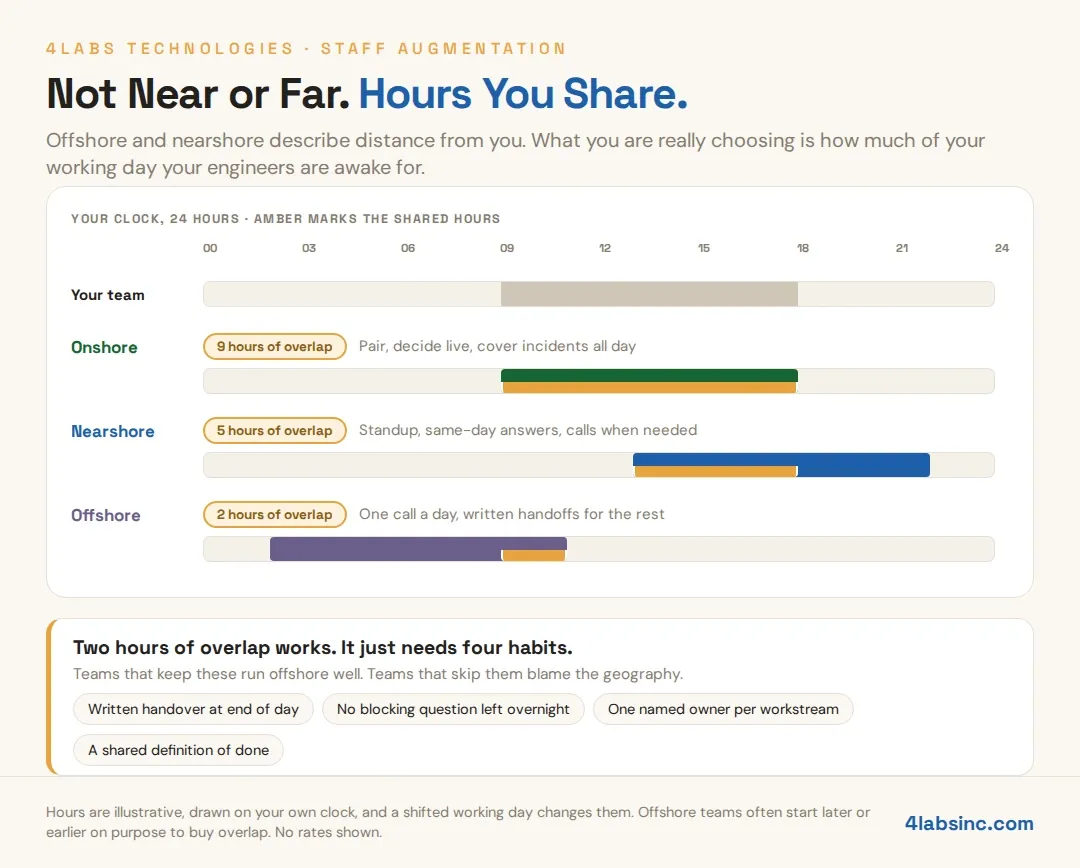
How much time-zone overlap do you actually need?

offshore-nearshore-overlap-hours
This is the question that settles the staff augmentation decision, and almost nobody asks it directly. Work out the number first, then look at which regions provide it.

Six or more hours

You need this if engineers pair regularly, if product decisions get made in conversation, or if someone must be available for incident response during your business day.
That means onshore, or nearshore in a close pairing, and it is the most expensive answer that is nonetheless the right one for some teams.

Three to four hours

Enough for a daily standup, a same-day answer to a blocking question, and a call when something needs discussing, while the rest of the work happens asynchronously.
Most teams sit here, and this is the band people underestimate: three to four hours is achievable with offshore teams if both sides shift their day deliberately. An engineer starting at noon in India overlaps well with a morning in London, and a US East Coast team starting at 7am reaches a good part of an Eastern European afternoon.
The overlap you get is a scheduling decision as much as a time zone one.

One to two hours

Enough for one call a day and no more, and it works when scope is defined, handoffs are written, and the rhythm is weekly rather than hourly.
This is where offshore is most cost-effective, and where it fails hardest if the working habits are not in place.

How to make small overlap work

Four habits, and they are not optional at one or two hours.
Written handovers at the end of every day. What was done, what is next, what is blocked. Five minutes of writing saves a day of waiting.
No blocking question left open overnight. If an answer is needed to continue, it gets asked during the overlap window or the work gets re-sequenced. This single rule is the difference between offshore working and offshore crawling.
One named owner per workstream. Ambiguous ownership across a time gap means nobody moves until the next call.
A shared definition of done. Rework discovered a day later costs two days.
Teams that do these four run offshore engagements successfully, and teams that skip them conclude that offshore does not work and blame the geography.

Not sure how much overlap you need? Tell us how your team works — how decisions get made and how often — and we will tell you the overlap that fits and which regions give you it. No obligation.

Legal, IP and data residency

Check this before you shortlist regions rather than after, because it can remove options entirely and it is the part almost every staff augmentation comparison skips.

Which law governs the contract

Every cross-border agreement names a governing law and a place where disputes are heard, so read both.
The governing law matters less than the enforcement question: if something went badly wrong, where would you have to go to do anything about it, and how long would that take? A contract governed by a law you understand, enforceable somewhere you can reach, is worth more than a favorable clause in a jurisdiction you would never pursue.
A good partner has a standard answer here and will give it on the first call.

IP assignment across borders

Three things to confirm, and they are easy to confirm.
That intellectual property created during the engagement assigns to you, unambiguously and in writing. That the partner's own agreement with each engineer passes that obligation down, because an assignment the engineer never signed is not an assignment. And that confidentiality survives the end of the engagement rather than expiring with it.
Ask to see the clauses, because a partner who has done this before sends them without arranging a meeting first.

Data residency

This is the one that settles decisions before cost is discussed.
Some regulations restrict where personal data may be processed or stored. Under GDPR and its equivalents, moving data outside a region needs a lawful basis and appropriate safeguards. In healthcare, finance and public sector work, the restrictions are often tighter still.
So the practical question is not "can engineers abroad work on this" but "what data will they touch, and is that permitted". Sometimes the answer is that they can work on the system and never see production data, which resolves it neatly, and sometimes the answer is onshore, which is why onshore belongs in the comparison.
Our notes on securing the applications customers touch cover the access controls that make a distributed arrangement defensible.

The mundane one: public holidays

Two countries, two national calendars, and no overlap between them in some pairings.
It sounds trivial until a sprint loses four days nobody planned for. Get both calendars at the start of the engagement, put them in the same place your team looks, and plan releases around them. This is the cheapest problem on this page to solve and the one most often ignored.

The hybrid model, and how to run it

Most companies that use staff augmentation at any scale end up running a hybrid of more than one model, and usually by accident before they design it.

What usually goes where

Nearshore or onshore for the work that needs conversation: discovery, architecture decisions, anything customer-facing, incident response.
Offshore for the work that has a defined shape: sustained delivery, test automation, platform and infrastructure work, specialist skills used continuously.
The split follows the overlap requirement rather than the org chart, which is the point of working it out first. Our guide to how engagement models are priced covers how to structure more than one at once.

The failure mode

Two teams sharing a repository and slowly diverging.
It shows up the same way every time: a separate standup for the offshore engineers, a second definition of done, and a quiet assumption that one group does the interesting work. Once that settles in, the cost saving is real and so is the quality gap.
The fix is unglamorous. One set of standards, one set of ceremonies at a time everybody can attend, documentation written as a deliverable rather than a favor, and architecture decisions owned in one place. Teams that hold those run a hybrid model without noticing they have one.

Choosing your model

The short version of this guide is one question: how many hours of your working day do you need your engineers awake for?
Answer that honestly, check what the regulations allow, and the staff augmentation model chooses itself. Six hours or more points to onshore or close nearshore, and three to four is the band most teams need and the one offshore can reach with deliberate scheduling. One or two works well if your handoffs are written and your scope is defined.
Worth saying plainly: 4Labs runs both offshore and nearshore staff augmentation teams. We have no commercial reason to steer you towards either, which is not true of every guide you will read on this topic.
A first conversation covers three things:

  • The roles. What skills you need and how quickly.
  • The overlap. How your team makes decisions, and therefore how many shared hours you actually need.
  • The constraints. Data residency, contractual requirements, anything that rules a region out before cost is discussed.
    If the right answer for your situation is onshore, we will say so. No obligation and no pitch deck.
    Talk to our staff augmentation team

Frequently asked questions

What is the difference between offshore and nearshore staff augmentation?

Distance, and therefore shared working hours. Nearshore engineers are within a few time zones and share four to six hours of your day, while offshore engineers are eight or more time zones away and share one to three. Neither label describes a fixed set of countries; both are relative to where you are.

Is offshore cheaper than nearshore?

Usually, yes. Offshore rates are typically the lowest of the three staff augmentation models and onshore the highest, with nearshore between them. What you spend on coordination narrows the gap, so the saving is real but smaller than a rate card suggests.

How much time-zone overlap do I need?

It depends on how your team makes decisions. Six hours or more if you pair or decide in conversation, and three to four if a daily standup and same-day answers are enough, which covers most teams. One to two works with defined scope and written handoffs.

Can I use offshore and nearshore together?

Yes, and most companies using staff augmentation at any scale end up doing so. This hybrid split puts nearshore or onshore on work needing conversation and offshore on defined delivery. The risk is ending up with two teams rather than one, which is managed with shared standards and ceremonies everyone can attend.

What are the legal risks of hiring engineers in another country?

The main ones are IP assignment, governing law and data residency. Confirm that IP assigns to you and that the partner's agreement with each engineer passes that down. Check where disputes would be heard. Then check what data the engineers may lawfully touch.

‹ PreviousNext ›
author_icon
About the Author

Ratheesh Raveendran

CEO

Visionary Chief Executive Officer focused on business growth, innovation, and long-term strategy. Experienced in leading teams, driving digital transformation, and building solutions that create lasting value for clients and businesses.