When to switch models, and how to write that in
Most staff augmentation engagements should change model at least once. The usual progression:
Hourly to retainer. The trigger is discovering that the work does not stop. If you have run hourly for two or three months and the hours are consistently near a full-time level, you are paying flexibility pricing for continuous work. Move to a retainer.
Retainer to dedicated team. The trigger is ownership. When the same people have been on your product long enough that losing them would hurt, and when the work has become maintaining something rather than delivering a list, the dedicated model protects what you have built.
Dedicated team back to retainer, or to nothing. This happens and it is fine. A product moves into a quieter phase, or you hire permanently. Plan it rather than letting the contract auto-renew into work that no longer exists.
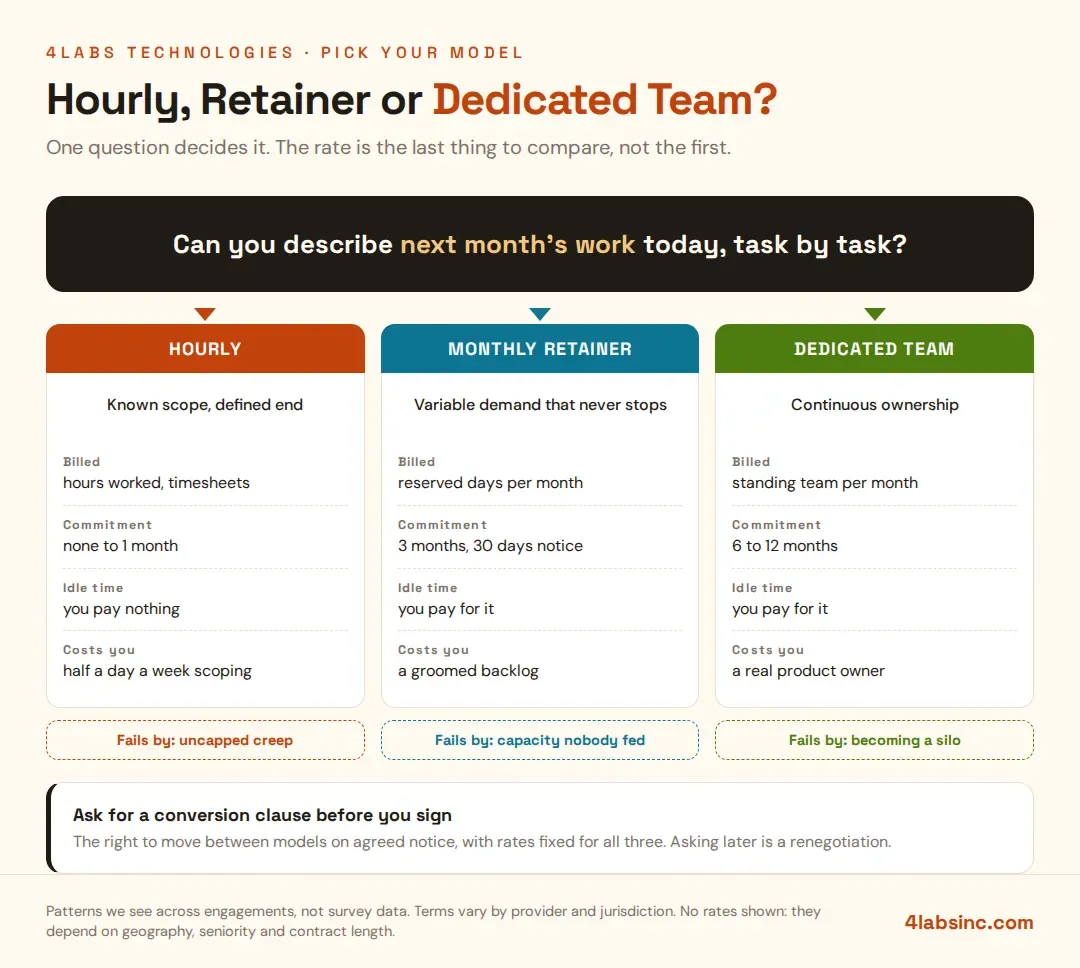
The clause to ask for at signature. Ask for the right to convert between engagement models on an agreed notice, with the rate for each model fixed in the original agreement. One short paragraph, added before you sign, when the provider is still trying to win the work.
Ask for it later and it is a renegotiation, with all the leverage on the other side. Providers who work this way regularly will agree without much argument. A provider who resists a conversion clause is telling you something about how they think the relationship goes.
When you do switch, our guide to how staff augmentation works step by step covers the onboarding and handover work that each transition needs.
How each model fails
Each engagement model has one predictable failure. Knowing which one you are signing up for is most of the defence.
Hourly fails through uncapped creep. Work expands, hours climb, and because each individual request is small nobody notices until the monthly invoice arrives. Then the relationship changes: you start counting hours, the provider starts justifying them, and both sides spend energy on accounting rather than delivery.
Early warning: you find yourself asking how long something took before asking whether it worked.
The defence: a monthly ceiling written into the contract, with anything above it needing explicit approval. Not a limit on the work, a limit on surprise.
The retainer fails through unfed capacity. You reserved the days and did not have the work ready. Three months later someone asks what the retainer delivered and the honest answer is thin, not because the person underperformed but because nobody briefed them.
Early warning: the weekly check-in is about finding work rather than reviewing it.
The defence: name the person responsible for the backlog before the contract starts, and review utilisation monthly rather than at renewal.
The dedicated team fails by becoming a silo. The team knows the system better than anyone inside your company. They are productive, and they are also the only ones who understand what they built. Now the commitment is not really optional, which is a weaker position than you intended.
Early warning: nobody on your payroll can review the team's work in detail.
The defence: rotate one of your own engineers through the team, insist on documentation as a deliverable, and keep code review shared. It costs a little velocity and buys you your options back.
None of these is exotic. All three are visible months before they hurt, if someone is looking.