Logo
Logo
ServicesIndustriesCase StudiesBlogsCareersLet's Connect
blue-white-icon
black-image
Logo
ServicesIndustriesCase StudiesBlogsCareersLet's Connect
burger-icon
hamburger
Why You Can't Find Tech Talent: It Is Probably Not a Shortage
Blogs/Why You Can't Find Tech Talent: It Is Probably Not a Shortage

Why You Can't Find Tech Talent: It Is Probably Not a Shortage

February 3, 2026
Share Now

Table of Contents

  1. 1. There is no general tech talent shortage
  2. 2. Three hiring failures is yours
  3. 3. Why your hiring process
  4. 4. What changes when you hire
  5. 5. Four ways to solve a tech talent shortage
  6. 6. Getting hiring moving again
  7. 7. Frequently asked questions

The role has been open four months. The shortlist is thin. Two good people went somewhere else, one of them after your final interview.

Somewhere around month three, most teams decide the market is broken. It is a comfortable conclusion, because nothing in it is your fault.

It is also usually wrong, and believing it stops you fixing what is actually going on. There is no general tech talent shortage. There is a very specific scarcity, sitting next to a surplus, and a hiring process that turns a difficult market into an impossible one.

This page covers four things. What the market really looks like right now. A three-way test to work out which hiring failure is yours, because "we cannot find people" means three different things. What genuinely changes when you hire tech talent globally, including the one thing nobody warns you about. And your realistic options once you know what you are actually solving.

Key takeaways

  • There is no general tech talent shortage. Senior engineers in a few areas are scarce, while junior and mid-level applications pile up.

Stay Ahead with 4Labs

Get expert insights, security briefings, and the latest innovations in your inbox.

  • Afghanistan+93
  • Albania+355
  • Algeria+213
  • Andorra+376
  • Angola+244
  • Antigua and Barbuda+1268
  • Argentina+54
  • Armenia+374
  • Aruba+297
  • Australia+61
  • Austria+43
  • Azerbaijan+994
  • Bahamas+1242
  • Bahrain+973
  • Bangladesh+880
  • Barbados+1246
  • Belarus+375
  • Belgium+32
  • Belize+501
  • Benin+229
  • Bhutan+975
  • Bolivia+591
  • Bosnia and Herzegovina+387
  • Botswana+267
  • Brazil+55
  • British Indian Ocean Territory+246
  • Brunei+673
  • Bulgaria+359
  • Burkina Faso+226
  • Burundi+257
  • Cambodia+855
  • Cameroon+237
  • Canada+1
  • Cape Verde+238
  • Caribbean Netherlands+599
  • Cayman Islands+1
  • Central African Republic+236
  • Chad+235
  • Chile+56
  • China+86
  • Colombia+57
  • Comoros+269
  • Congo+243
  • Congo+242
  • Costa Rica+506
  • Côte d'Ivoire+225
  • Croatia+385
  • Cuba+53
  • Curaçao+599
  • Cyprus+357
  • Czech Republic+420
  • Denmark+45
  • Djibouti+253
  • Dominica+1767
  • Dominican Republic+1
  • Ecuador+593
  • Egypt+20
  • El Salvador+503
  • Equatorial Guinea+240
  • Eritrea+291
  • Estonia+372
  • Ethiopia+251
  • Faroe Islands+298
  • Fiji+679
  • Finland+358
  • France+33
  • French Guiana+594
  • French Polynesia+689
  • Gabon+241
  • Gambia+220
  • Georgia+995
  • Germany+49
  • Ghana+233
  • Gibraltar+350
  • Greece+30
  • Greenland+299
  • Grenada+1473
  • Guadeloupe+590
  • Guam+1671
  • Guatemala+502
  • Guinea+224
  • Guinea-Bissau+245
  • Guyana+592
  • Haiti+509
  • Honduras+504
  • Hong Kong+852
  • Hungary+36
  • Iceland+354
  • India+91
  • Indonesia+62
  • Iran+98
  • Iraq+964
  • Ireland+353
  • Israel+972
  • Italy+39
  • Jamaica+1876
  • Japan+81
  • Jordan+962
  • Kazakhstan+7
  • Kenya+254
  • Kiribati+686
  • Kosovo+383
  • Kuwait+965
  • Kyrgyzstan+996
  • Laos+856
  • Latvia+371
  • Lebanon+961
  • Lesotho+266
  • Liberia+231
  • Libya+218
  • Liechtenstein+423
  • Lithuania+370
  • Luxembourg+352
  • Macau+853
  • Macedonia+389
  • Madagascar+261
  • Malawi+265
  • Malaysia+60
  • Maldives+960
  • Mali+223
  • Malta+356
  • Marshall Islands+692
  • Martinique+596
  • Mauritania+222
  • Mauritius+230
  • Mayotte+262
  • Mexico+52
  • Micronesia+691
  • Moldova+373
  • Monaco+377
  • Mongolia+976
  • Montenegro+382
  • Morocco+212
  • Mozambique+258
  • Myanmar+95
  • Namibia+264
  • Nauru+674
  • Nepal+977
  • Netherlands+31
  • New Caledonia+687
  • New Zealand+64
  • Nicaragua+505
  • Niger+227
  • Nigeria+234
  • North Korea+850
  • Norway+47
  • Oman+968
  • Pakistan+92
  • Palau+680
  • Palestine+970
  • Panama+507
  • Papua New Guinea+675
  • Paraguay+595
  • Peru+51
  • Philippines+63
  • Poland+48
  • Portugal+351
  • Puerto Rico+1
  • Qatar+974
  • Réunion+262
  • Romania+40
  • Russia+7
  • Rwanda+250
  • Saint Kitts and Nevis+1869
  • Saint Lucia+1758
  • Saint Pierre & Miquelon+508
  • Saint Vincent and the Grenadines+1784
  • Samoa+685
  • San Marino+378
  • São Tomé and Príncipe+239
  • Saudi Arabia+966
  • Senegal+221
  • Serbia+381
  • Seychelles+248
  • Sierra Leone+232
  • Singapore+65
  • Slovakia+421
  • Slovenia+386
  • Solomon Islands+677
  • Somalia+252
  • South Africa+27
  • South Korea+82
  • South Sudan+211
  • Spain+34
  • Sri Lanka+94
  • Sudan+249
  • Suriname+597
  • Swaziland+268
  • Sweden+46
  • Switzerland+41
  • Syria+963
  • Taiwan+886
  • Tajikistan+992
  • Tanzania+255
  • Thailand+66
  • Timor-Leste+670
  • Togo+228
  • Tonga+676
  • Trinidad and Tobago+1868
  • Tunisia+216
  • Turkey+90
  • Turkmenistan+993
  • Tuvalu+688
  • Uganda+256
  • Ukraine+380
  • United Arab Emirates+971
  • United Kingdom+44
  • United States+1
  • Uruguay+598
  • Uzbekistan+998
  • Vanuatu+678
  • Vatican City+39
  • Venezuela+58
  • Vietnam+84
  • Wallis & Futuna+681
  • Yemen+967
  • Zambia+260
  • Zimbabwe+263
Our Services
Digital Marketing
Staff Augmentation
IT Infrastructure
ERP Solutions
Software Development
Web & App Development
Industries
Cryptocurrency and Blockchain
Banking, Financial Services, and Insurance (BFSI)
Lending and FinTech
Oil and Gas
Energy and Utilities
Automotive and Manufacturing
Agriculture
Real Estate
E-commerce and Retail
Case Studies
Financial Services Test Automation
AI-Driven Customer Risk Profiling
Elevating Mobile Performance
Jewelry Client Transformation
AI Underwriting Revolution
Advanced Cybersecurity Solutions
Eyewear Retailer Transformation
Revolutionizing Manufacturing Operations
Offshore Development Excellence
Company

About Us

Careers

Let's Connect

Business Referral

Engagement Model

Partnership Programs

Resources

Blogs

footer1-iconfooter2-iconiso_iconiso_icon2

4labsicon

Copyright © 2026 4Labs Technologies. All Rights Reserved.

Privacy Policy

Terms & Conditions

Accessibility

fb-icon
twitter-icon
instagram-icon
linkedin-icon
  • "We cannot find people" is three different problems: you cannot find them, you cannot hire them, or you cannot keep them. Each needs a different fix.
  • The most common failure is the hiring process itself. A three-month process cannot hire someone who accepts an offer in two weeks.
  • Hiring globally widens the tech talent pool and adds frictions. Notice periods are the one that catches people out, and almost nobody mentions them.
  • Fix the diagnosis before you fix the hiring. Two of the four options cost nothing.
  • There is no general tech talent shortage

    The tech talent market has polarised. Senior engineers in a handful of areas are genuinely scarce, while junior and mid-level developers send applications nobody reads.
    Both things are true at once. That is why the market feels broken from inside a hiring process and looks oversupplied from inside a job search.

    Where the scarcity actually is

    It sits with senior developers and engineers in a few specific areas. Cloud infrastructure. Security. Machine learning and the systems around it. Anyone who can safely modernise a system nobody wants to touch.
    These roles share a trait. You cannot grow someone into them in six months, because what makes them valuable is production experience with consequences attached. A course does not produce a person who has run a migration that could have taken the business down.
    So the pool refills slowly, and it refills at the speed people accumulate real years.

    Where the surplus is

    At the other end. Junior and mid-level developers are applying in volume for a shrinking number of entry-level roles.
    Part of that is teams quietly stopping junior developer hiring. Training someone takes senior time, and senior time is the scarcest thing in the building, so the junior role gets cut first when a budget tightens.
    That decision makes sense in any single quarter. Repeated across an industry for several years, it produces exactly the senior shortage everyone is now complaining about.

    Why the layoffs did not fix it

    The tech layoffs of recent years moved people around. They did not release a wave of the engineers most companies were short of.
    Some of those people were in roles that no longer existed. Many found work quickly. The specific senior skills that were scarce before stayed scarce afterwards, because a redistribution is not an increase.

    What this means for your open role

    If you are hiring a senior engineer in one of those areas, you are competing in a real shortage and you should plan accordingly.
    If you are hiring anything else and still cannot fill it, the tech talent shortage is not your problem. Something closer to home is, and the next section works out what.

    Which of the three hiring failures is yours

    Tech talent hiring fails in three distinct ways. "We cannot find people" usually means one of them. They need different fixes, and applying the wrong one is how a team spends six months getting nowhere.
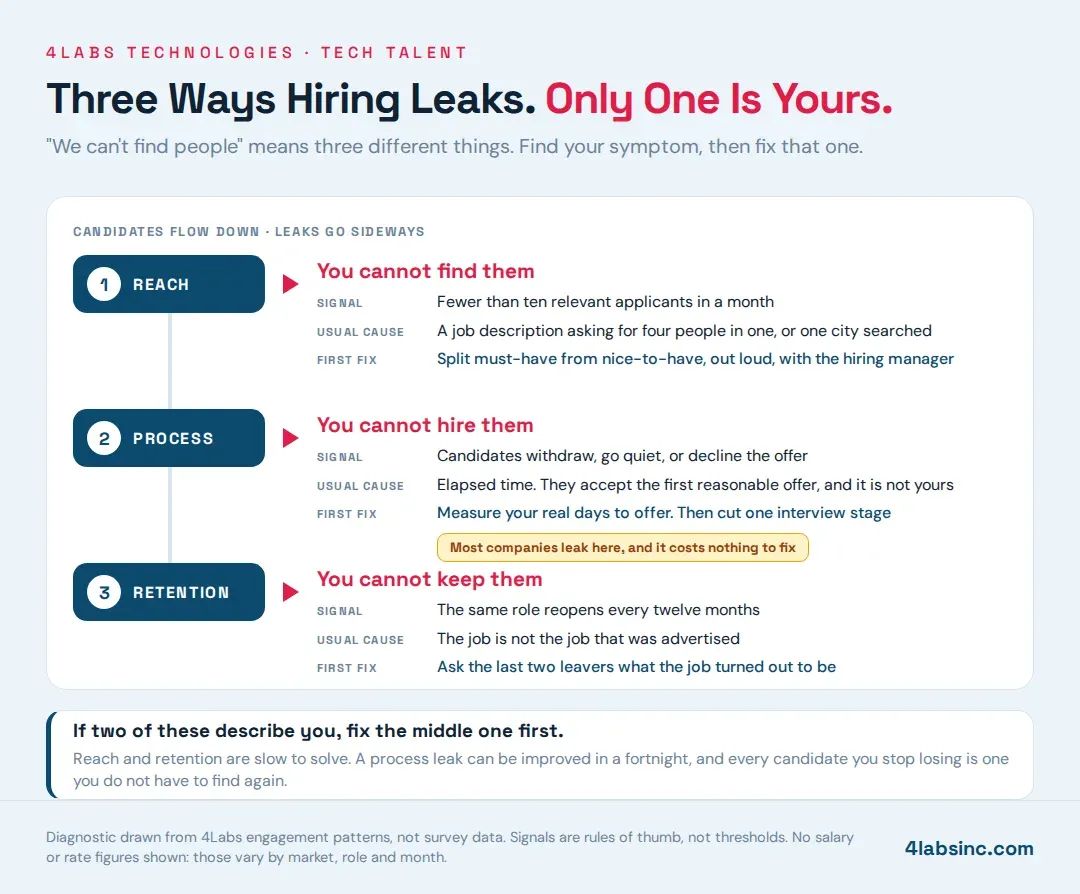
    Diagram of three hiring leaks.webp
    Read the three signals below. One of them will describe your last quarter uncomfortably well.

    You cannot find them

    Few applicants arrive, and the ones who do are not close. The shortlist is thin or empty.

    The signal

    Fewer than ten relevant applicants in a month of an open role.

    The usual cause

    One of two things, and often both.
    The job description is a wish list rather than a job. Eight years of a framework that is six years old. Four specialisms that rarely live in one person. Every requirement added by someone protecting themselves from a bad hire, and the combined effect is a role nobody applies for. Good developers read it and move on.
    Or you are searching one city when the work does not need one. That is a reach problem, and hiring globally solves it directly.

    What to do first

    Split the requirements into must-have and nice-to-have, out loud, with the hiring manager in the room. Most lists lose half their must-haves in twenty minutes. Then decide whether the role genuinely needs to sit in one place.

    You cannot hire them

    Good candidates arrive and then leave. This is the most common failure, and the least diagnosed.

    The signal

    Candidates withdraw part-way through, go quiet after a stage, or decline the offer. You have a pipeline. It leaks.

    The usual cause

    Elapsed time, almost always. Strong developers are in process with two or three companies and accept the first reasonable offer. Whoever moves fastest wins, and it is often not the company with the best role.

    What to do first

    Measure your actual time to hire, from first contact to offer. Not your intended number, the real one from your last three hires. Most teams are surprised, and the surprise is the useful part. The next section is about this.

    You cannot keep them

    People join, and inside a year they leave. It presents as a hiring problem because the role keeps coming back.

    The signal

    The same position opens every twelve months. Exit conversations are polite and vague.

    The usual cause

    The job is not the job that was advertised. Someone joined to build and spends their week on incidents. Or ownership was promised and the decisions happen elsewhere.

    What to do first

    Stop recruiting for a month and ask the last two leavers what the job actually turned out to be. Hiring into an unfixed retention problem is the most expensive thing on this page, and teams that scale engineering capacity without losing control of it treat this as a structural question rather than a people one.

    If two of these describe you

    Fix the process one first.

    A reach problem is slow to solve and a retention problem is slow to solve. A process problem can be improved in a fortnight, and it makes the other two cheaper to work on, because every candidate you stop losing is one you do not have to find again.
    Not sure which of the three you have? A short conversation and your last three hiring timelines usually settle it, and there is nothing to buy at that stage.


    Why your hiring process is the real tech talent shortage

    A process that takes three months cannot hire someone who accepts an offer in two weeks. That is not a market problem. It is arithmetic, and it is the most fixable thing on this page.

    The arithmetic

    Strong developers do not job-hunt for long. They are usually in process with two or three companies at once, and once one of those makes a decision, the rest of the pipeline closes.
    So the window is not "how long until we find someone good". It is "how long that good person stays available", and that window is measured in weeks. Your time to hire has to fit inside it.
    Measure your own elapsed time to hire from first contact to signed offer, using your last three hires rather than your intended process. If the gap between your number and their window is large, you do not have a tech talent shortage. You have a queue.

    Four self-inflicted wounds

    These come up on nearly every engagement where hiring has stalled.
    The requirements list written as a wish list. Every stakeholder adds one thing. Nobody removes anything. The result is a role that describes four people, and the developers who would have been excellent at the actual job never apply.
    Four or more interview stages. Each stage adds scheduling delay, not just interview time. Two weeks of calendar for forty minutes of conversation is normal, and three of those is most of your window gone.
    A take-home exercise that costs a weekend. Senior developers with options decline these, and the ones who accept are often the ones with fewer options. The exercise selects against exactly who you want.
    An approval chain nobody has timed. The offer needs finance, then a director, then someone on holiday. Every hop adds days, and the candidate is counting them.

    What to change this month

    Four changes, none of which costs money.
    Cut one interview stage. Not the technical one. Usually there is a stage that exists because it always has, and nobody can say what it decides.
    Set a decision deadline per stage, in hours rather than days, and hold people to it.
    Separate must-have from nice-to-have in writing before the role is posted, and put only the must-haves in the advert.
    Give the hiring manager authority to make the offer inside an agreed band. If three people must approve every offer, three diaries are running your hiring.
    A team that does these four things typically halves its elapsed time, and the candidates it was losing at week seven start signing. The full cost picture of a slow hiring process, including the parts that never appear on a budget line, is covered in our breakdown of what a full-time hire really costs.

    What changes when you hire tech talent globally

    Hiring tech talent globally widens the pool enormously, and it introduces three frictions nobody puts in the brochure. None of them is a reason not to do it. All three will surprise you if nobody says them out loud first.

    Notice periods, the one nobody warns you about

    This is the friction that catches teams out, and it is almost never mentioned in guides on how to hire tech talent globally.
    Notice periods vary enormously by market. In India, 30 to 90 days is normal and 60 is common for experienced engineers. In the UK, one to three months is usual at senior level. In the US, two weeks is the convention rather than a contractual requirement. The UAE has its own statutory arrangements, and they differ again.
    Work through what that means. You find an excellent engineer in week two. They accept in week four. They start in month four. Your global search was fast, and your hire still took a third of a year.
    Ask about the notice period in the first conversation, not at offer stage. Put it in the plan. And if the start date genuinely cannot move, that is an argument for a different route rather than a different candidate.

    Time zone overlap

    Count the hours your team actually shares, not the distance between the cities.
    Four hours of overlap is usually enough for a team that works asynchronously and writes things down. Below two, every question costs a day, and the cost compounds on exactly the work that needs conversation.
    Decide which roles need overlap before you decide where to look. A senior engineer doing focused work can sit anywhere. Someone in a lot of live design discussions cannot.

    The employment model

    Four routes, and they commit you to different things.
    Setting up your own entity gives full control and takes months. An employer of record hires on your behalf in a country where you have no presence, which is fast and comes with an ongoing fee. Contractors are flexible and carry classification risk that varies by country. A partner arrangement puts the employment relationship with somebody else.
    Pick this deliberately. It is easier to change a job description than an employment structure.

    What the main markets are genuinely like

    Short, honest notes rather than a ranking. Every one of these markets produces excellent developers, and tech talent is hired differently in each.
    The United States. The deepest senior pool and the most competitive. Short notice periods, strong salary expectations, and a market where speed decides outcomes more than anything else.
    The United Kingdom. Strong engineering depth, particularly in fintech and data. Longer notice periods at senior level, and a smaller pool than the US for specialist roles.
    The UAE. A growing hub with strong regional access and good time zone overlap with both Europe and South Asia. Employment and visa arrangements need planning rather than improvisation.
    India. Very deep talent pool across the full range of engineering skills, and strong overlap with European hours. The notice-period point above matters most here, and planning for it is the difference between a smooth hire and a surprised hiring manager.
    We hire across all four, and what we tell clients is the same in every case. Pick the market for the role, not the rate, and plan the start date honestly.

    Four ways to solve a tech talent shortage

    The fix follows the diagnosis. Two of these four cost nothing, and only one of them involves hiring anybody from outside.

    Fix the hiring process

    Free, fastest, and the right answer more often than anyone expects.
    If your diagnosis was "cannot hire them", start here and change nothing else for a month. Cut a stage, set decision deadlines, give the hiring manager authority. Then look at your numbers again.
    Teams are often reluctant, because a process problem is embarrassing in a way that a market problem is not. It is also the only one you can fix by Friday.

    Change the role

    Also free, and underused.
    A brief that asks for four specialisms in one person can usually be split into two hireable roles, and two good hires beat one imaginary one. Or hire a strong mid-level developer and give them room to grow, which is slower on paper and often faster in practice, because they exist.
    This is the right answer when the diagnosis was "cannot find them" and the job description turned out to be the problem.

    Hire globally, directly

    The widest tech talent pool available, and the most operational overhead.
    You take on the employment model, the notice periods, the time zone planning and the local compliance. Done properly it gives you permanent team members anywhere, which nothing else on this list does.
    This is the right answer when you have the capacity to run it and the roles are long-term.

    Staff augmentation

    Staff augmentation puts engineers into your team, under your management, working your process. It solves reach and speed, because the finding and the employment are handled elsewhere.
    Be clear about what it does not solve. Staff augmentation does not fix a broken hiring process, because you will still be slow at deciding. It does not fix an unclear role, because somebody still has to say what the work is. And it does not fix a retention problem, because a team people leave is a team contractors also leave.
    It is the right answer when the work is real, the scope is understood, and the constraint is genuinely that you cannot get the right people fast enough. If you get there, the commercial shapes differ more than people expect, and our guide to hourly, retainer and dedicated team models covers which suits which kind of work.
    For specialist functions the screening question changes too. Hiring test automation is a different exercise from hiring a backend engineer, and our guide to screening a QA automation engineer sets out what to ask.

    Picking between them

    Match the option to the diagnosis rather than to the urgency.
    Cannot find them, and the brief is the problem: change the role. Cannot find them, and the brief is fine: hire tech talent globally, directly or through a partner. Cannot hire them: fix the process first, whatever else you do. Cannot keep them: fix that before you add anyone, because otherwise you are filling a bucket with a hole in it.

    Getting hiring moving again

    Diagnose before you fix. Work out whether you cannot find them, cannot hire them, or cannot keep them, because the three need different answers and only one of them is about the market.
    If there is one thing to take from this page, it is the arithmetic. A three-month hiring process cannot hire someone who accepts an offer in two weeks. Before you widen the search, widen the budget or blame the tech talent shortage, measure your own elapsed time. Most teams find their answer there, and it costs nothing to fix.

    Talk to our team

    A first conversation covers three things. Which of the three hiring failures your last quarter actually looks like. What your realistic options are, including the two that cost nothing. And what hiring in the US, the UK, the UAE or India would genuinely involve for the role you have open.
    If the answer is that you need to fix your process rather than hire anybody from us, we will say that. It is a shorter conversation and a more useful one.
    Talk to our team

    Frequently asked questions

    Is the tech talent shortage real?

    Partly. Senior engineers in cloud, security, machine learning and legacy modernisation are genuinely scarce, because that experience takes years to build. Junior and mid-level developers are in surplus. So the market has polarised rather than emptied, and most open roles fail for reasons closer to home.

    Why is it so hard to hire software developers right now?

    Usually one of three reasons. Your reach is too narrow or your job description asks for four people in one. Your hiring process takes longer than candidates stay available. Or people join and leave, so the same role keeps reopening. Diagnose which before changing anything.

    How long should hiring a developer take?

    Shorter than it currently does. Strong developers are typically in process with two or three companies and accept the first reasonable offer, so the window is weeks rather than months. Measure your real time to hire from first contact to signed offer across your last three hires, then cut a stage.

    How do I hire tech talent globally?

    Decide the employment model first: your own entity, an employer of record, contractors or a partner. Then pick markets by the role rather than the rate, check time zone overlap, and ask about notice periods in the first conversation. In India they are commonly 30 to 90 days, and in the UK one to three months at senior level.

    Does staff augmentation solve a talent shortage?

    Staff augmentation solves reach and speed. Engineers join your team under your management without you running the search or the employment. It does not fix a slow hiring process, an unclear role, or a retention problem, and using it to paper over any of those three costs more than solving them.

    ‹ PreviousNext ›