Search for how to build an app like Uber and you will find the same guide a dozen times: market research, a feature list split into rider app and driver app, a tech stack, a cost range, a contact form.
Every one of those taxi booking app feature lists is accurate. Not one tells you which features to build first, which three parts of a ride-hailing app are genuinely difficult, or what a new set of rules is about to require of the software itself.
This guide covers those, and it covers the thing that kills most taxi booking app startups, which is not a feature and not a line of code.
One thing it does not do is print a cost to build figure. Several competing pages quote an MVP at thirty to fifty thousand dollars with no scope attached, and a range without a scope is not information. The section near the end explains what to ask instead.
The problem nobody puts in the feature list
A ride-hailing platform is worth nothing to riders until drivers are on it, and nothing to drivers until riders are. That is the hardest problem in this business, it is not technical, and no taxi booking app feature list mentions it.
Economists call it a two-sided marketplace, and founders meet it as a launch week where the taxi booking app works perfectly and nobody uses it.
Why a rider who sees no cars never comes back
A rider opens your app once, and if the map is empty or the wait is eighteen minutes, they close it and open the ride-hailing app that works. Getting a second chance costs far more than getting the first.
The same applies on the other side, where a driver who sits idle for two hours goes back to the ride-hailing platform that pays. Drivers talk to each other, and a reputation for empty shifts spreads faster than any marketing.
So the goal at launch is density rather than coverage: enough drivers in one small area that a rider opening your taxi booking app sees a car two minutes away. One suburb with forty drivers beats a whole city with four hundred.
What that means for what you build
The feature lists you have read assume marketplace liquidity already exists. Surge pricing only matters when demand exceeds supply, fleet dashboards only matter when there are fleets, and driver behaviour scores only matter when you have enough drivers to rank.
Build for the first hundred rides rather than the hundred thousandth. That single decision cuts more from the cost to build a ride-hailing app than any technology choice in this guide.
What a taxi booking app is actually made of
An Uber-like taxi booking app is four applications rather than one, and founders budget for two.
The rider app. Request a ride, see the driver approaching, watch the route, pay, rate. This is the part everybody pictures, and the cheapest of the four.
The driver app. Go online and offline, receive and accept requests, navigate, end the trip, see earnings. It looks simpler than the rider app and is usually harder, because it runs for eight hours in a pocket, in and out of signal, draining a battery.
The dispatch service. The part with no screen: it knows where every driver is, decides who gets each request, and handles the case where the chosen driver does not respond. Nobody demos dispatch, and it is the heart of the product.
The admin panel. Approve drivers, suspend accounts, resolve disputes, refund a ride, see what is happening right now. Every founder leaves this until launch week.
The piece founders forget
The admin panel, every time.
It gets skipped because users never see it. Then the taxi booking app goes live, and somebody has to approve a driver's documents, refund a rider charged twice, and suspend an account after a complaint. Without a panel, those jobs happen in the database, by an engineer, under pressure.
There is a second reason it can no longer wait, which the regulation section sets out: suspending a driver is about to become a workflow with legal requirements attached rather than a button.
The three parts that are genuinely hard
Most of a ride-hailing app is ordinary software. Registration, profiles, notifications, ratings and receipts are all well-trodden, and any competent team ships them without drama.
Three parts of ride-hailing are not ordinary, and they are where the budget goes, where the timeline slips, and where the difference between a good development partner and a cheap one shows up. No competing guide separates them from the rest of the list.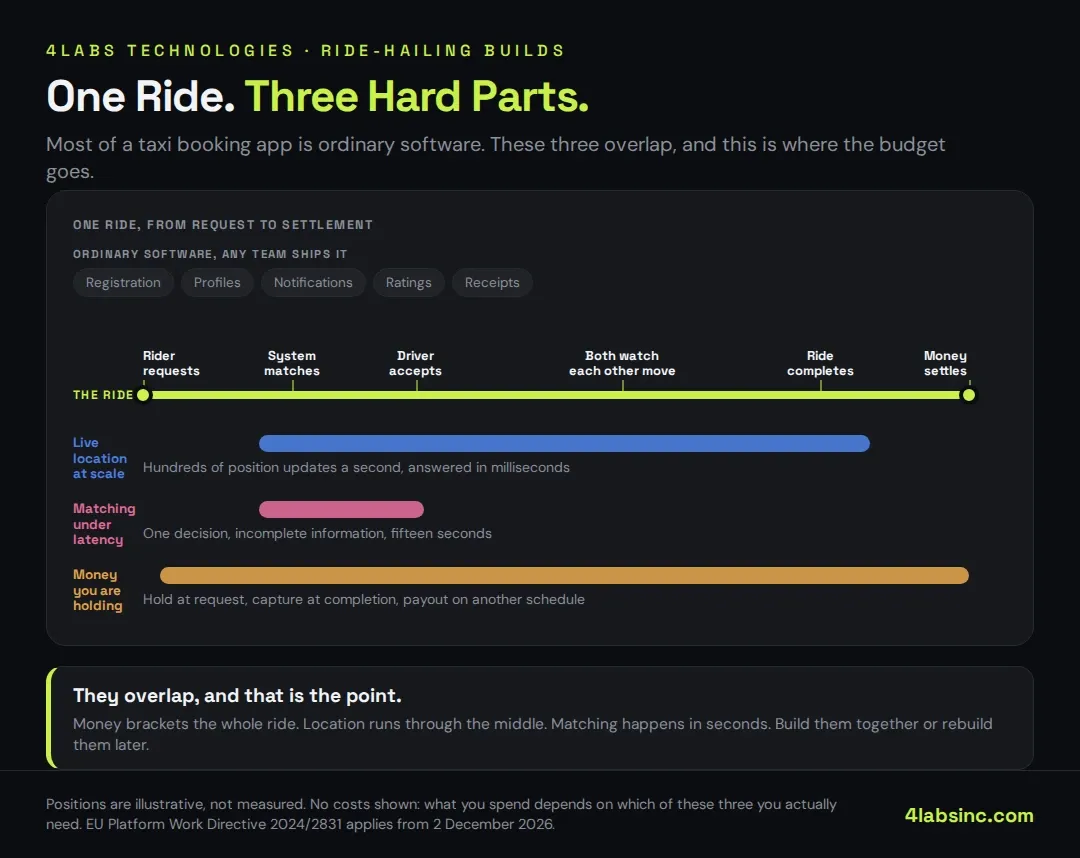
One: live location at scale
Why it is harder than it looks. Every driver who is online sends their position every few seconds, so a thousand drivers is a few hundred updates a second. Each has to be stored somewhere that can answer a different question fast: which drivers are near this rider, right now?
A normal database query cannot do this at speed. You need a geospatial index and an answer in milliseconds, because a rider is watching a loading spinner. You also need a real-time channel pushing positions to the rider's screen, rather than the app asking the server every second, which drains batteries and melts your server bill.
What it costs you to get wrong. Two things, both expensive. The driver app kills the phone battery, so drivers stop using it, and the map lags, so riders watch a car thirty seconds behind where it really is. Getting real-time right is an infrastructure problem as much as an app development one, and our guide to building a scalable IT infrastructure covers the measure-first approach that applies here.
Two: matching under latency
Why it is harder than it looks. "Assign the nearest driver" is one line in a feature list and a distributed-systems problem in practice, which is why matching belongs here rather than in the ordinary pile.
The nearest driver may be across a river, or about to finish another trip, or may not answer at all, so you need a fallback within seconds. Two riders may request at the same moment and the dispatch service must not promise both of them the same car. A rider waits about fifteen seconds before deciding your taxi booking app is broken, so every one of those decisions happens inside that window, with incomplete information.
What it costs you to get wrong. Double-assigned drivers, which is the worst possible first impression on both sides, long waits, which lose riders, and a matching rule nobody can explain, which becomes a real problem under the regulation below because that rule now needs an audit trail.
Three: money that moves before the ride ends
Why it is harder than it looks. Taking a card payment is a solved problem, and being the party in the middle is not.
A ride-hailing platform holds the rider's card at booking, captures a different amount at completion because the route changed, and handles the cancellation in between. It then pays the driver on a schedule that is not the rider's, and deals with the dispute three weeks later. You are handling other people's money and holding it briefly, which is a different regulatory position from selling something.
What it costs you to get wrong. Drivers not paid on time, which ends a platform faster than any outage, and riders charged twice, which ends it slower but just as surely. Both are handled in the admin panel, the third reason it cannot be an afterthought. Payment flows also carry the sharpest security requirements here, and our notes on securing the applications customers touch cover the controls involved. Real-time systems also fail in ways a normal test suite misses, so budget for load and concurrency testing with our QA and software testing services.
What to build first, and what to leave out
Here is a complete first version of a taxi booking app, and it is shorter than every feature list on this query, which is the point.
A rider can request a ride, a nearby driver can accept it, and both can see each other move on a map. The fare is calculated when the trip ends, the rider pays, and you can suspend either of them.
That is the MVP. Six capabilities, and an app like Uber with those six can complete a real ride and take real money, which is the only thing that proves anything.
What is deliberately not in version one
Six things every competing guide puts in its taxi booking app feature list, and the reason each one waits.
Surge pricing. It solves a problem you do not have yet, because surge balances demand against supply and at launch you have neither in quantity. Build it when drivers turn down rides because they are all busy.
Scheduled rides. A different product with different failure modes, and a driver who forgets a booking made three days ago is worse than not offering booking at all.
Fleet dashboards. These matter when fleet owners sign up with twenty cars, and on day one your drivers are individuals you onboard in person.
Driver behaviour scores. Ranking requires enough drivers to make a ranking meaningful, and below about a hundred you know all of them by name.
Loyalty and promo codes. Every one is a discount you are funding, so prove people will pay full price before you decide what to give away.
Multiple vehicle classes. Each class splits an already-thin driver pool into smaller pools, which makes the wait longer in all of them, so keep one class until the pool is deep.
None of these is wrong, and each is a bet that gets cheaper after you have evidence. Leaving all six out of version one removes more from the cost to build an app like Uber than any other decision a founder makes.
The one exception: safety cannot wait
Three things ship in version one even though they look like version-two features.
Identity verification on both sides, meaning document checks for drivers and a verified phone number for riders. Not optional, and not something to add after the first incident.
Trip sharing, so a rider can send a live link to someone they trust. It is a small piece of work and the most requested safety feature in ride-hailing.
An in-app emergency action: one button, clearly placed, that reaches emergency services and flags the trip to your team.
The reasoning is not technical. A ride-hailing platform that puts strangers in cars together carries a duty from its first ride, and "we were still an MVP" is not a defence anybody accepts.
The regulation that changes the specification
This section appears on no other page about how to build an app like Uber, and it carries a deadline ten weeks from the time of writing.
EU Platform Work Directive 2024/2831 entered into force on 1 December 2024. Member states must transpose it into national law by 2 December 2026.
Two parts matter, and only one of them is about employment law.
The part that changes your business model
The directive creates a rebuttable presumption that platform workers engaged on or after that date are employees rather than independent contractors. It defers to each member state's existing test rather than prescribing a new one, so how it lands depends on the country.
For a founder that changes the cost per driver and possibly the whole model. It does not change the code, and this guide is not the place for legal advice, so take proper advice for each market you enter.
The part that changes your backlog
This is the part that belongs in an app development guide, because the directive puts requirements on software that uses automated decision-making or monitoring, which is to say on your dispatch service.
Written notice about automated decisions, given to a worker no later than their first working day.
Human review of any decision that restricts or terminates an account, carried out by someone with the competence, training and authority to override the automated decision.
Impact evaluations every two years, shared with worker representatives.
No collection of personal data while a worker is offline, and no processing of data about their emotional or psychological state.
Read those as a specification and four items land in your backlog.
An audit trail on matching. Every dispatch decision needs to be reconstructable, meaning which drivers were considered and why this one was chosen, so a matching rule nobody can explain is now a problem.
A human-review queue on suspensions. "Admin can suspend a driver" is one line in every competing feature list, and it becomes a workflow: automated flag, human reviewer, recorded decision, override capability, notification to the driver.
A hard offline boundary in the driver app, so that when a driver goes offline, location collection stops. Not throttled, stopped, and provably so.
A data model that can prove all three. Retention, access logs, and the ability to produce the evidence when asked.
None of this is expensive if you build it in, and all of it is expensive to retrofit, because audit trails cannot be backdated.
If you are not launching in the EU
Then it does not bind you, and you should still read it. Regulation of this kind travels, the four backlog items above are reasonable engineering anywhere, and an audit trail is what you will want the first time a driver disputes a suspension. Building it now costs a fraction of adding it later.
A tech stack that fits the problem
The tech stack matters less than founders expect, because almost any competent combination will carry your first ten thousand rides and the choice will not decide whether the business works.
What the tech stack decides is what year two costs. Here is one that suits a ride-hailing app, described by what each piece has to do rather than by brand.
One mobile codebase for two apps. A rider app and a driver app on both iOS and Android is four builds if you go native and two if you do not, so a cross-platform framework halves the mobile app development work and every release after it. Flutter and React Native both do this well.
A backend that handles many things at once, because dispatch is concurrency rather than computation. Node.js, Go and modern Java or Kotlin all suit it, so pick the one your team knows.
A database with geospatial support, where PostgreSQL with PostGIS is the common answer and a good one. The requirement is a real spatial index, not a latitude and longitude column you filter on.
A real-time channel, meaning WebSockets or a managed service that wraps them, which is what pushes driver positions to a rider's map without the app asking every second.
A maps and routing provider such as Google Maps, Mapbox or an OpenStreetMap-based option, giving you geocoding, routing, ETAs and a map to draw. Managed cloud infrastructure underneath all of it.
A payment provider that supports holds, because not every gateway does pre-authorisation and marketplace payouts well. Check this before you choose, since it is the constraint most likely to force a change later.
The two choices you cannot cheaply reverse
Most of the tech stack above can be swapped with effort. Two cannot.
Your maps provider. Routing, geocoding and map rendering wire into both apps and the dispatch service, and pricing is per call, so the bill grows exactly as you succeed. Model that cost at ten times your launch volume before you commit.
Your payment provider. Holds, split payouts, refunds, dispute handling and compliance all sit here, implemented against that provider's specific model, so moving later means rebuilding the money flow and migrating stored payment methods. It is the most unpleasant migration in this product.
Everything else is a preference. These two are a commitment.
What actually moves the cost
We do not publish a cost to build an app like Uber, and it is worth saying why before giving you something more useful.
Several pages ranking for build an app like Uber quote an MVP at thirty to fifty thousand dollars and a full platform at eighty to a hundred and fifty, with no scope attached to either. An MVP with the six capabilities listed earlier and an MVP with surge pricing, scheduled rides, fleet dashboards and three vehicle classes differ by a factor of several, and both get called an MVP.
A range you cannot trace to a scope is not information, so here is what moves your number instead.
How many apps you ship. Rider and driver on two platforms is the baseline, cross-platform halves it, and native for all four roughly doubles the mobile app development work and every release afterwards.
How much real-time you need. Live tracking with sub-second updates and a matching engine handling hundreds of concurrent requests is a different build from a booking system that assigns a driver and sends a text, so be honest about which you need at launch.
Whether you handle the money. Passing riders to a payment provider is straightforward, while holding funds, splitting them, paying drivers on a schedule and handling disputes is substantial work with compliance attached. This is usually the largest single line nobody budgets for.
How much trust and safety you build, covering document verification, background checks, in-app emergency features, trip sharing and review moderation. Each is small, and together they are one of the largest groups in a ride-hailing build.
How deep the admin panel goes. Basic admin that cannot suspend a driver, refund a ride or approve documents is not an admin panel, and under the regulation above it also needs a review queue and an audit trail.
One city or several. Multiple cities means multiple regulatory positions, currencies, languages, fare rules and driver onboarding processes, which multiplies the operational surface long before it multiplies the code. Running costs scale with rides too: maps calls, payment processing, notifications, hosting and support.
Three questions to ask any agency
Instead of comparing quotes, compare answers.
Which of the six MVP capabilities above is in this quote, and which are not? A good answer is a feature list with a line drawn through it, and a bad answer describes scope in adjectives.
What does the matching logic do when the chosen driver does not respond? This tests whether they have built dispatch before, and anyone who has will answer immediately and in detail.
What will this cost to run per month at a thousand rides, and at ten thousand? Maps, payments, notifications and hosting, and an agency that has launched a ride-hailing app will answer without hesitating.
If you want the same treatment for marketplace builds more broadly, our guide to what it costs to build a marketplace app works through the equivalent drivers for two-sided platforms without ride-hailing's real-time demands.
Getting this built
Two conversations for founders who want to build an app like Uber, depending on where you are.
Still scoping. Tell us the city you want to launch in, how you plan to get your first fifty drivers, and what you think version one contains. We will tell you which parts belong in it, which of the three hard problems your idea needs, and what the regulation means for your market. If your scope is twice the size it should be, we will say so.
Half-built and stalled. More common than founders admit: the map lags, matching double-assigns, the payment flow works until a cancellation, or the whole thing runs fine with ten drivers and falls over with sixty. All of that is fixable, and none of it means the idea was wrong.
Our custom software development services cover the whole path of taxi booking app development: scoping the first version, building it, and running what comes after. If you already have a team and need specific real-time or payments experience alongside them, you can hire developers through staff augmentation instead.
No obligation and no pitch deck.
Frequently asked questions
How much does it cost to build an app like Uber?
It depends on scope, and we publish no figure because any number without a scope attached is misleading. Six things move it: how many apps you ship, how much real-time you need, whether you handle money directly, how much trust and safety you build, how deep the admin panel goes, and whether you launch in one city or several. Ask any agency which of those six their quote covers, and what the taxi booking app costs to run per month at a thousand rides.
How long does it take to build a ride-hailing app?
The six-capability version described above takes months rather than weeks, if the scope holds. What extends it is rarely the code: it is document verification integrations, payment provider onboarding, and regulatory work in your launch city. Teams that ship on time started those three in week one rather than week twenty.
Should I use an Uber clone script?
A clone script launches an Uber-like app fast and cheap, and the cost arrives when you need to change something. You work inside someone else's assumptions about matching, pricing and payouts, which are exactly the parts you will want to change once you have real drivers. Use an Uber clone script to test whether anyone in your city wants this, and build custom once you know what your platform needs to do differently.
What is the hardest part of building a taxi booking app?
Technically, three things: live location at scale, matching drivers under a fifteen-second deadline, and handling money you hold on someone else's behalf. Everything else is ordinary software. Commercially the hardest part is not technical at all, and it is having enough drivers in one small area that the first riders see a car when they open your taxi booking app.
Do I need both a rider app and a driver app?
Yes, and you need two more besides. The dispatch service that decides who gets each ride has no screen and is the heart of the product, and the admin panel is where you approve drivers, handle refunds and suspend accounts. Four applications rather than two, and the two without screens are the ones founders under-budget.
What regulations affect a ride-hailing platform?
Local transport licensing in every city you operate in, and increasingly the rules covering platform workers. In the EU, Directive 2024/2831 must be transposed into national law by 2 December 2026. It creates a rebuttable presumption of employment and puts direct requirements on software that makes automated decisions: human review of account suspensions, notice about automated decision-making, and no data collection while a worker is offline. Take legal advice for each market, and build the audit trail wherever you launch.