What you are actually building
A marketplace app is two products sharing a database, plus a third that nobody puts in the budget: the buyer app, the seller app, and the admin tooling you need to run the thing.
Here is the full feature set for a marketplace app like OLX, grouped the way a build gets scoped.
User management
Registration and login by email or phone with OTP verification, plus social login, and profiles that users can create and update with images and saved preferences. Roles that separate buyers, sellers and administrators, each with their own permissions.
This is the least glamorous part of the build and one of the more expensive foundations, because every other feature depends on identity being right.
Listings
Sellers create listings with details, photos and a price, while buyers search and filter by category, price range, condition and location. Users save favorites so they can come back to them.
Search is the feature to watch, because it is straightforward at a thousand listings and an engineering project at a million, which is covered under architecture below.
Communication
In-app messaging between buyers and sellers, in real time and private to the pair, plus notifications for new messages, new offers and status changes.
Messaging looks like a chat window, and it is not, which the next section explains.
Transactions
Bidding and offers, so a buyer can negotiate inside the platform rather than leaving it, payments through an established gateway, and order tracking from confirmation to delivery.
This whole group of features is optional in version one, and leaving it out is often the right call, as the scope section argues.
Trust and safety
Seller ratings, product reviews, reporting, and the moderation tooling behind them. This is what makes buyers and sellers willing to send money to a stranger, and it is the group of features most often underestimated.
The part founders forget: the admin panel
Every feature above needs an administrative view. Somebody has to remove a fraudulent listing, suspend an abusive account, refund a disputed payment, fix a mis-categorized item and answer a support ticket with the full history in front of them.
Built properly, the admin panel is a substantial share of a marketplace build. Founders leave these features out of the list because users never see them, then discover in month one that the platform cannot be operated without them.
Ask any agency quoting you whether admin tooling is in the number. It is the single most common reason a quote comes in lower than a competitor's and then grows during the project.
The five features that drive most of the cost
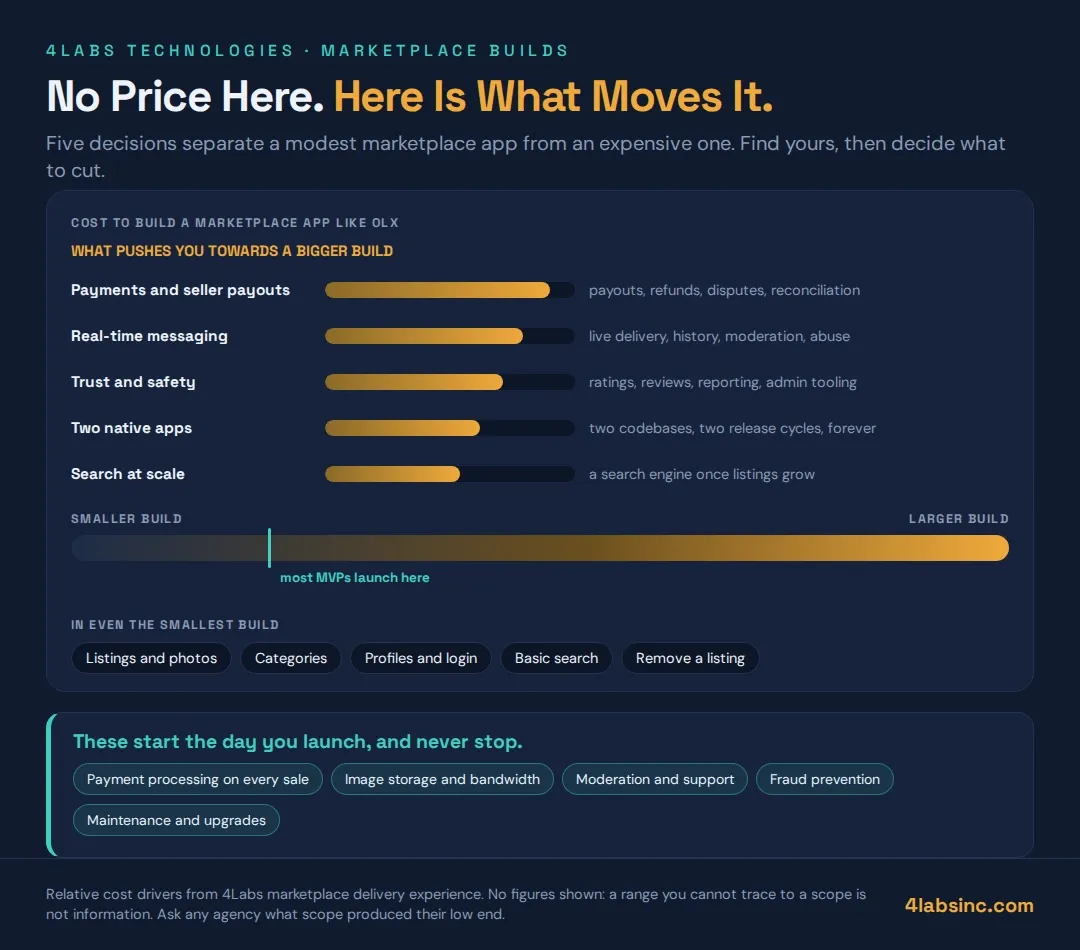
Five features account for most of the difference between a modest marketplace build and an expensive one, and everything else is rounding.
| What drives it | Why it costs more than it looks |
|---|
| Real-time messaging | Live infrastructure, delivery guarantees, message history, plus moderation and abuse handling on top |
| Payments and seller payouts | A gateway is the easy half. Payouts, refunds, disputes and reconciliation are the other half |
| Trust and safety | Ratings, reviews, reporting and the admin tooling behind all of it |
| Search at scale | Fine on a small catalog, a dedicated search engine once listings grow |
| Two native apps | Two codebases, two release cycles, two review processes, indefinitely |
Why messaging costs more than it looks
A chat window is a week of work, and a messaging system is not.
You need a live connection that survives a phone losing signal, message delivery that does not drop or duplicate, history that loads quickly on an old device, and push notifications when the app is closed. Then you need the part nobody plans for: people will use messaging to harass each other, to move the deal off-platform, and to run scams. Handling that is moderation tooling, reporting, and someone's time forever.
If your marketplace can work with a reveal-phone-number button instead of chat, version one is markedly cheaper. That is a real product decision, not a compromise, and plenty of classifieds platforms run that way.
Why payments are never just a gateway
Taking a payment is a well-solved problem, and being a marketplace that handles money is not.
The moment you sit between a buyer and a seller you inherit: paying sellers out on a schedule, holding funds until delivery if you promise that, refunds and partial refunds, chargebacks, disputes where both parties are certain they are right, commission calculation, and reconciliation so your ledger matches the processor's. In some categories and countries you also inherit identity verification.
Each of those is small, and together they are commonly the largest single group of features in a marketplace build.
Why search gets expensive later
Search on ten thousand listings is a database query, while search on several million, with filters, location, ranking and typo tolerance, is a search engine you have to run and tune.
The cost is not usually in version one. It arrives when the marketplace works, which is the worst time to discover that the architecture cannot take it. The fix is not to build for millions on day one — it is to choose a data layer that can be moved without a rewrite, which is the architecture section below.
Not sure where your marketplace sits on these five? Send us your feature list and we will mark which items are driving your cost and which are close to free. It is a scoping session, not a sales call, and it produces a prioritized feature list you can take to any agency.