Logo
Logo
ServicesIndustriesCase StudiesBlogsCareersLet's Connect
blue-white-icon
black-image
Logo
ServicesIndustriesCase StudiesBlogsCareersLet's Connect
burger-icon
hamburger
blog-image
Blogs/Cryptocurrency Trading Platform

Cryptocurrency Trading Platform Development: The Decisions That Come Before the Code

December 1, 2025
Share Now

Table of Contents

  1. 1. What you are actually building when you build a crypto exchange
  2. 2. Licensing and crypto exchange compliance come first, not last
  3. 3. Custody is the decision that shapes everything else
  4. 4. The matching engine, and why it is not a normal backend service
  5. 5. Crypto exchange architecture around the engine
  6. 6. Liquidity: the problem no amount of engineering solves
  7. 7. Build, buy or license: how to decide
  8. 8. What drives the cost to build a crypto exchange
  9. 9. Cryptocurrency trading platform development: quick answers
  10. 10. Where to take your cryptocurrency trading platform next

Most teams start this project in the wrong place. They pick a stack, sketch an architecture, list the features, and then discover six weeks in that the licence they need changes half of it.

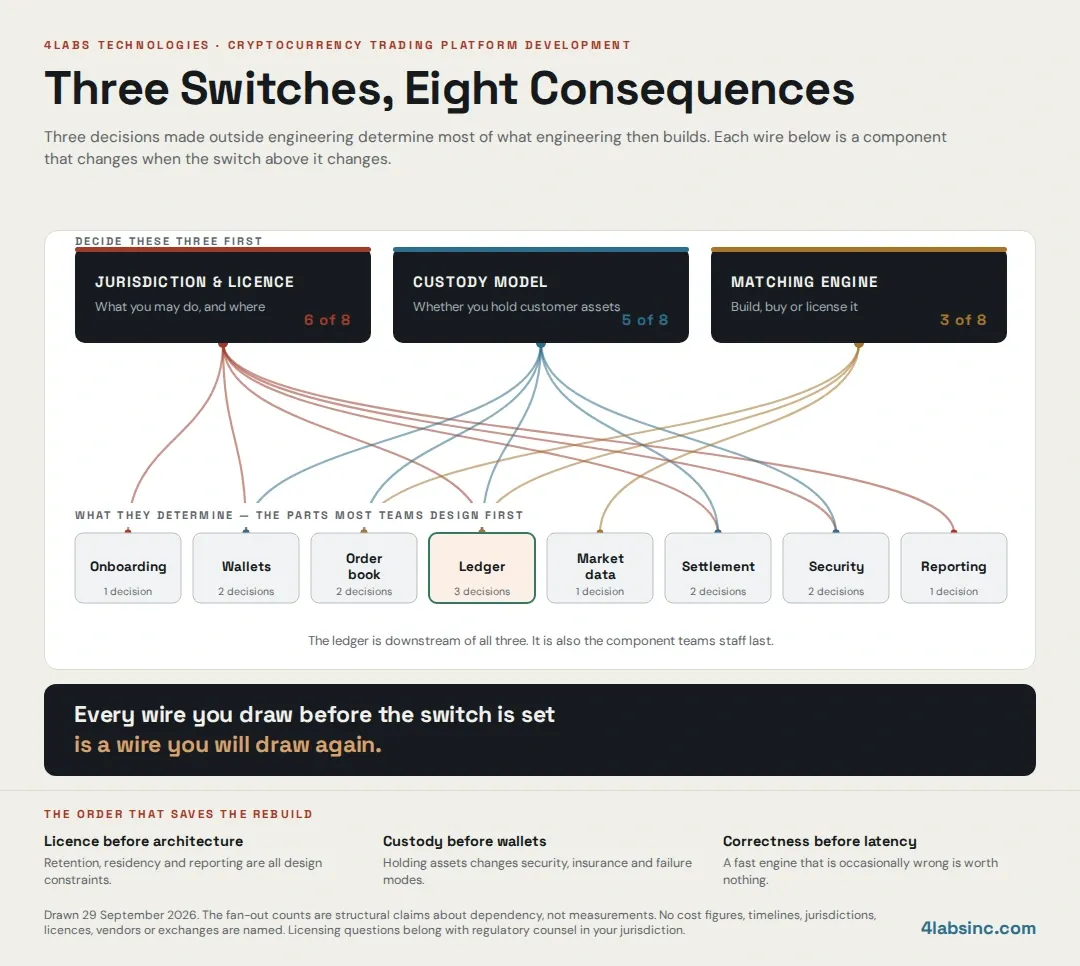
Cryptocurrency trading platform development is unusual in that three decisions made outside engineering determine most of what engineering then builds. Which jurisdiction you will be licensed in. Whether you will hold customer assets. And whether you will build, buy or license the matching engine. Settle those three and the architecture largely follows. Leave them open and you will build the same system twice.

crypto-platform-three-switches.webp

So this guide runs in that order. What you are actually building. Why licensing comes before architecture. Why custody shapes everything downstream. The matching engine, which is the component most teams underestimate. Then the rest of the architecture, the liquidity problem engineering cannot solve, the buy-versus-build decision, and what genuinely drives cost.

Stay Ahead With 4Labs

Get expert insights, security briefings, and the latest innovations in your inbox.

  • Afghanistan+93
  • Albania+355
  • Algeria+213
  • Andorra+376
  • Angola+244
  • Antigua and Barbuda+1268
  • Argentina+54
  • Armenia+374
  • Aruba+297
  • Australia+61
  • Austria+43
  • Azerbaijan+994
  • Bahamas+1242
  • Bahrain+973
  • Bangladesh+880
  • Barbados+1246
  • Belarus+375
  • Belgium+32
  • Belize+501
  • Benin+229
  • Bhutan+975
  • Bolivia+591
  • Bosnia and Herzegovina+387
  • Botswana+267
  • Brazil+55
  • British Indian Ocean Territory+246
  • Brunei+673
  • Bulgaria+359
  • Burkina Faso+226
  • Burundi+257
  • Cambodia+855
  • Cameroon+237
  • Canada+1
  • Cape Verde+238
  • Caribbean Netherlands+599
  • Cayman Islands+1
  • Central African Republic+236
  • Chad+235
  • Chile+56
  • China+86
  • Colombia+57
  • Comoros+269
  • Congo+243
  • Congo+242
  • Costa Rica+506
  • Côte d'Ivoire+225
  • Croatia+385
  • Cuba+53
  • Curaçao+599
  • Cyprus+357
  • Czech Republic+420
  • Denmark+45
  • Djibouti+253
  • Dominica+1767
  • Dominican Republic+1
  • Ecuador+593
  • Egypt+20
  • El Salvador+503
  • Equatorial Guinea+240
  • Eritrea+291
  • Estonia+372
  • Ethiopia+251
  • Faroe Islands+298
  • Fiji+679
  • Finland+358
  • France+33
  • French Guiana+594
  • French Polynesia+689
  • Gabon+241
  • Gambia+220
  • Georgia+995
  • Germany+49
  • Ghana+233
  • Gibraltar+350
  • Greece+30
  • Greenland+299
  • Grenada+1473
  • Guadeloupe+590
  • Guam+1671
  • Guatemala+502
  • Guinea+224
  • Guinea-Bissau+245
  • Guyana+592
  • Haiti+509
  • Honduras+504
  • Hong Kong+852
  • Hungary+36
  • Iceland+354
  • India+91
  • Indonesia+62
  • Iran+98
  • Iraq+964
  • Ireland+353
  • Israel+972
  • Italy+39
  • Jamaica+1876
  • Japan+81
  • Jordan+962
  • Kazakhstan+7
  • Kenya+254
  • Kiribati+686
  • Kosovo+383
  • Kuwait+965
  • Kyrgyzstan+996
  • Laos+856
  • Latvia+371
  • Lebanon+961
  • Lesotho+266
  • Liberia+231
  • Libya+218
  • Liechtenstein+423
  • Lithuania+370
  • Luxembourg+352
  • Macau+853
  • Macedonia+389
  • Madagascar+261
  • Malawi+265
  • Malaysia+60
  • Maldives+960
  • Mali+223
  • Malta+356
  • Marshall Islands+692
  • Martinique+596
  • Mauritania+222
  • Mauritius+230
  • Mayotte+262
  • Mexico+52
  • Micronesia+691
  • Moldova+373
  • Monaco+377
  • Mongolia+976
  • Montenegro+382
  • Morocco+212
  • Mozambique+258
  • Myanmar+95
  • Namibia+264
  • Nauru+674
  • Nepal+977
  • Netherlands+31
  • New Caledonia+687
  • New Zealand+64
  • Nicaragua+505
  • Niger+227
  • Nigeria+234
  • North Korea+850
  • Norway+47
  • Oman+968
  • Pakistan+92
  • Palau+680
  • Palestine+970
  • Panama+507
  • Papua New Guinea+675
  • Paraguay+595
  • Peru+51
  • Philippines+63
  • Poland+48
  • Portugal+351
  • Puerto Rico+1
  • Qatar+974
  • Réunion+262
  • Romania+40
  • Russia+7
  • Rwanda+250
  • Saint Kitts and Nevis+1869
  • Saint Lucia+1758
  • Saint Pierre & Miquelon+508
  • Saint Vincent and the Grenadines+1784
  • Samoa+685
  • San Marino+378
  • São Tomé and Príncipe+239
  • Saudi Arabia+966
  • Senegal+221
  • Serbia+381
  • Seychelles+248
  • Sierra Leone+232
  • Singapore+65
  • Slovakia+421
  • Slovenia+386
  • Solomon Islands+677
  • Somalia+252
  • South Africa+27
  • South Korea+82
  • South Sudan+211
  • Spain+34
  • Sri Lanka+94
  • Sudan+249
  • Suriname+597
  • Swaziland+268
  • Sweden+46
  • Switzerland+41
  • Syria+963
  • Taiwan+886
  • Tajikistan+992
  • Tanzania+255
  • Thailand+66
  • Timor-Leste+670
  • Togo+228
  • Tonga+676
  • Trinidad and Tobago+1868
  • Tunisia+216
  • Turkey+90
  • Turkmenistan+993
  • Tuvalu+688
  • Uganda+256
  • Ukraine+380
  • United Arab Emirates+971
  • United Kingdom+44
  • United States+1
  • Uruguay+598
  • Uzbekistan+998
  • Vanuatu+678
  • Vatican City+39
  • Venezuela+58
  • Vietnam+84
  • Wallis & Futuna+681
  • Yemen+967
  • Zambia+260
  • Zimbabwe+263
Our Services
Digital Marketing
Staff Augmentation
IT Infrastructure
ERP Solutions
Software Development
Web & App Development
Industries
Cryptocurrency and Blockchain
Banking, Financial Services, and Insurance (BFSI)
Lending and FinTech
Oil and Gas
Energy and Utilities
Automotive and Manufacturing
Agriculture
Real Estate
E-commerce and Retail
Case Studies
Financial Services Test Automation
AI-Driven Customer Risk Profiling
Elevating Mobile Performance
Jewelry Client Transformation
AI Underwriting Revolution
Advanced Cybersecurity Solutions
Eyewear Retailer Transformation
Revolutionizing Manufacturing Operations
Offshore Development Excellence
Company

About Us

Careers

Let's Connect

Business Referral

Engagement Model

Partnership Programs

Resources

Blogs

footer1-iconfooter2-iconiso_iconiso_icon2

4labsicon

Copyright © 2026 4Labs Technologies. All Rights Reserved.

Privacy Policy

Terms & Conditions

Accessibility

fb-icon
twitter-icon
instagram-icon
linkedin-icon

Two things this page will not do. It will not give you a price, because every range published on this subject omits the scope that makes it meaningful. And it will not tell you which licence you need, because that is a question for regulatory counsel in your jurisdiction, not for a development partner.

What we can tell you is how the answer changes the build, and that is where our custom software development services work starts.

What you are actually building when you build a crypto exchange

The phrase trading platform covers several very different systems, and the first useful thing you can do is say which one you mean.

A venue where users trade against each other through an order book is a different product from one where users trade against you at a quoted price. A platform that holds assets is a different business from one that never touches them. A product that lists two assets is a different engineering problem from one that lists two hundred.

Get specific before anyone opens an editor. The rest of this page assumes an order-book venue, because that is the hardest case and the one the query usually means.

Centralized, decentralized and hybrid: what changes with each

The centralized and decentralized exchange distinction is usually explained in terms of ideology. The useful version is in terms of what you are responsible for.

A centralized exchange runs the order book, holds the assets and settles internally. Trades happen in your database, not on a chain, and only deposits and withdrawals touch the network. You own the performance, the custody, the compliance and the failure modes. Almost every high-volume venue works this way, because an order book on-chain is slow and expensive.

A decentralized exchange executes through smart contracts. Users hold their own assets and the contract settles trades. You are not custodian, which removes a large regulatory and security burden, and you also cannot reverse anything, cannot fix a bug after deployment without a migration, and inherit the network's latency and cost. The engineering is smaller and far less forgiving.

Hybrid designs match off-chain and settle on-chain. They are attractive on paper and they carry both sets of problems: you still have the matching engine, and you still have the settlement complexity.

One point worth making plainly. Decentralized does not mean unregulated. Whether an activity needs authorisation depends on what it does and where, not on whether a smart contract does it. Treat we are decentralised so this does not apply as a question for counsel rather than a conclusion.

The six components every cryptocurrency exchange development project contains

Whatever model you choose, six things have to exist. Teams reliably underestimate the middle two.

Onboarding and identity. Registration, verification, sanctions screening, risk scoring, and the records that prove all of it happened.

Wallets and custody. Key generation, deposit address management, hot and cold segregation, withdrawal authorisation, reconciliation against the chain.

The matching engine. The order book, the matching rules, and the guarantee that it is correct under load. Its own section below.

The ledger. Every balance, every movement, every fee, reconcilable at any moment. This is an accounting system and it is usually staffed as if it were a database table.

Market data. Prices, depth, trade history, charts, and the feeds that carry them to clients fast enough to be useful.

Operations and reporting. Admin tooling, monitoring, incident response, regulatory reporting, and the ability to answer a question about a specific trade from eighteen months ago.

The front end sits on top of all six and is the part clients ask about first. It is also the part most easily replaced later, which is why it should not drive the architecture. The same discipline applies here as in any web application development project: the interface is a client of the system, not the system.

Licensing and crypto exchange compliance come first, not last

On most guides this is a section near the end, after the tech stack. That ordering is the single most expensive mistake available in this project.

Here is why. The authorisation you hold, and where you hold it, sets what you may do, who you may serve, what you must record, how long you must keep it, where the data may live, what you must report and to whom, and whether you may hold customer assets at all. Every one of those is an architectural constraint. Discover them after the architecture is drawn and you rebuild.

To be direct about our own limits: 4Labs builds software. We are not a law firm and this page is not legal advice. Get regulatory counsel in your target jurisdiction early, before the architecture is fixed. What follows is how their answer lands on the engineering.

Jurisdiction decides your architecture

Requirements differ by country, and in some cases by state or province within a country. Two teams building what looks like the same product under different regimes will end up with materially different systems.

The differences that reach the code most often are these.

Who you may serve. Geographic restrictions mean geolocation, address verification and blocking logic, not a checkbox in the terms of service.

Whether you may hold assets. Some authorisations permit custody and some do not. This decides the next section entirely.

What you must record, and for how long. Retention periods drive storage design, archival, and whether you can ever delete anything.

Where the data may live. Residency requirements constrain your cloud regions, your backups and your disaster recovery design.

What you must report. Reporting obligations are queries against your ledger. If the ledger was not designed to answer them, you will be exporting and reconciling by hand for years.

Decide the jurisdiction first, or accept that you are building a prototype.

KYC, AML and transaction monitoring as engineering requirements

Compliance arrives in engineering as three systems, and teams routinely budget for one.

Identity verification at onboarding. Document capture, liveness, data extraction, checks against the details provided, and a manual review queue for the cases that fail automatically. Most teams integrate a vendor here, which is sensible, and then underestimate the review queue, which is where the operational cost sits.

Screening against sanctions and politically exposed person lists, at onboarding and continuously afterwards, because lists change. Continuous screening means re-running your entire user base on a schedule, which is a batch job with real cost.

Transaction monitoring, which watches behaviour rather than identity. It needs rules, a case management system for what those rules flag, and an audit trail of what was decided. This is the one most often discovered late, and it is a product in its own right.

What onboarding actually has to record

Not the outcome, the evidence.

Which documents were seen, when, and what they showed. Which checks ran, against which data, and what each returned. Which lists were screened and on what date. Who reviewed the case, when, and what they decided. What the user was shown and agreed to, in the version that existed at the time.

That last one catches teams out. If your terms change, you need to know which version each user accepted, and you cannot reconstruct that later.

Design onboarding as an append-only record of what happened, not as a status field on a user row. A status field tells you the user is verified. It cannot tell you why, when, or on what basis, and those are the questions you will be asked.

Custody is the decision that shapes everything else

If you hold customer assets, you are running a vault with a trading interface attached. If you do not, you are running a trading interface. These are different companies, and most guides treat the difference as a checkbox.

Make this decision explicitly and early, with the licensing answer in hand, because it determines the security model, the insurance conversation, the operational burden and the ways the platform can fail badly.

Holding customer assets, or not

If you hold assets, you carry the consequences. Keys must be generated, stored and used without ever being exposed. Withdrawals need authorisation controls that a compromised account cannot bypass. Balances must reconcile against the chain continuously, not nightly. You will probably need insurance, and the insurer will have opinions about your architecture. And a mistake here is unrecoverable in a way that almost nothing else in software is.

If you do not hold assets, users keep their own keys, you never move anything on their behalf, and a large part of the above disappears. You gain a different problem: users lose keys, and there is nothing you can do about it. Your support burden shifts from where is my withdrawal to I have lost access to everything, and the second conversation has no good ending.

There is no right answer, only a decision, and it needs to be made before the wallet design, not during it.

Hot wallets, cold storage and crypto wallet integration

If you do hold assets, crypto wallet integration splits into two systems with opposite priorities.

The hot wallet is online and can sign transactions automatically. It funds ordinary withdrawals. It holds as little as possible, because it is the part an attacker can reach, and as little as possible is a number you calculate from withdrawal volume rather than guess.

Cold storage is offline and holds the rest. Moving anything out of it requires people, procedure and time. That friction is the control, and every proposal to make cold storage more convenient is a proposal to make it less cold.

Between them sits the part that is genuinely hard: the replenishment process. Hot wallet runs low, funds move from cold, and that movement needs authorisation, dual control, monitoring and a record. Teams build the two wallets and discover the process between them in production, usually at the worst moment.

Deposits need their own design. Address generation per user, monitoring for incoming transactions, confirmation thresholds before crediting, and handling for the cases that do not fit: wrong asset, wrong network, amount below the fee, deposit to a retired address. Every one of those happens, and each needs a decided answer rather than an incident.

Key management, and the failure you cannot recover from

Key management is where custody becomes concrete, and it is the part of this build with no undo.

A private key is not a password, and there is no reset. If it is lost or copied, the assets are gone. Both failures are permanent and neither announces itself.

So the design questions are narrow and unforgiving. How are keys generated, and on what hardware. Where do they live, and who can reach them. How many people must act to authorise a movement, and can any one person act alone. What happens if a key holder leaves, or is unavailable during an incident. How do you rotate a key that may have been exposed, and have you ever rehearsed it.

Multi-signature and threshold schemes exist because single-key custody concentrates the failure. Requiring several independent approvals for any movement is the standard answer, and the point is not the cryptography, it is that no single compromised machine or person can move anything.

Write the procedures down, then rehearse them. A key ceremony nobody has practised is a document, not a control, and the same test applies here as in any audit: if you cannot evidence it, you do not have it.

The matching engine, and why it is not a normal backend service

Most feature lists put the matching engine between user authentication and the admin dashboard. It belongs in a category of its own.

Everything else on the platform is a normal web system: requests arrive, work happens, responses go out, and a delay is an annoyance. The matching engine is a single point through which every trade passes, in a defined order, with no room for ambiguity about what happened first. Get it wrong and users lose money, which is a different class of failure from a slow page.

How the order book works

An order book is two sorted lists: buyers on one side, sellers on the other, each ordered by price.

A new order arrives. If it can trade against something on the opposite side, it does, immediately. If it cannot, it rests in the book until something matches it or it is cancelled. That is the whole mechanism, and its simplicity is deceptive.

The rules that make it fair are where the difficulty lives, starting with best price wins. Among equal prices, the order that arrived first wins, which is price-time priority. Partial fills leave a remainder that keeps its original place in the queue. Cancellations race against fills, and exactly one of them must win.

That last point is the one that bites. A user cancels an order at the same instant it is being filled. Your engine must decide, deterministically, which happened first, and both the user and your ledger must see the same answer. Handle it loosely and you will have two records of the same moment that disagree, which is the worst outcome available.

Order types multiply the surface. Market and limit orders are the baseline. Stop orders, iceberg orders, immediate-or-cancel, post-only and the rest each add rules that interact with each other. Launch with two order types you have tested exhaustively rather than eight you have tested lightly.

Correctness before speed

Every vendor in this market sells latency, and latency matters, but it matters second.

A matching engine that is fast and occasionally wrong is worthless, because the errors are financial and visible. Users compare their fills against the public trade history. Discrepancies get posted publicly within the hour, and a reputation for inconsistent matching is not recoverable.

So build for determinism first: same sequence of orders, same result, every time, on any machine. That property gives you replay, which gives you testing, which is the only way to gain confidence in a system where every input ordering is a different scenario. It also gives you recovery: if the engine fails, you rebuild state by replaying the order sequence rather than guessing.

Determinism is why most serious engines are single-threaded over an in-memory book, with everything else moved outside. A single thread processing orders in a defined sequence is easy to reason about, easy to replay and fast enough for volumes most new venues will not reach for years. Parallelism buys throughput and costs you the property you need most.

Be honest about your requirement. Institutional venues care about microseconds. A retail platform listing a handful of assets does not, and building for microseconds you do not need will cost correctness you do.

Building, buying or licensing the engine

Three routes, and the right one depends on what you are competing on.

License a proven engine if your product differentiates on assets, user experience, fees or markets rather than on execution. Matching is a solved problem and somebody has solved it more thoroughly than a new team will. You pay per year and accept their roadmap.

Build your own if execution behaviour is your product: unusual order types, an auction design, or market structure nobody sells off the shelf. Expect it to take longer than planned, and expect most of the effort to go into testing rather than into the matching logic, which is a few hundred lines.

Buy a whole white-label platform if you are validating a market and speed matters more than control. Covered below, along with what it costs you later.

The common mistake is building the engine because it is the interesting part, then shipping late with a weak product around it. The engine is the component users notice least when it works.

Crypto exchange architecture around the engine

With the engine settled, the rest of the crypto exchange architecture is a set of systems feeding it and reading from it. Each has a failure mode worth knowing before you design it.

Market data, and the feed nobody budgets for

Users want prices, depth and trade history, updating continuously, on every open client at once. That is a broadcast problem, and it is usually the first thing to fall over under load.

The volumes are not obvious from the trade count. One order that moves the top of the book generates an update for every connected client. Ten thousand connected clients and a busy book produce a message rate far higher than your trade rate, and the engine must not be the thing sending them.

So separate publication from matching. The engine emits a sequenced stream of events. A separate tier fans that stream out to clients, and that tier can be scaled, throttled and allowed to fail without touching execution.

Then decide what each client actually needs. A chart does not need every book update. A trading interface does. Tiering the feed, with snapshots plus deltas rather than full state, is the difference between a system that scales and one that does not.

Charting history is its own store. It is written once and read constantly at different resolutions, which is a different problem from the live feed and usually wants a different database.

The ledger, and why double-entry accounting returns

The ledger is where the money is, and it is the component most often built as an afterthought.

A balance column on a user row is not a ledger. It tells you what somebody believes is true right now and nothing about how it got that way. When a number is wrong, and one will be, you have no way to find out why.

Use double-entry. Every movement is recorded as matched entries that must balance, balances are derived from the entries rather than stored alongside them, and nothing is ever updated in place. The technique is centuries old and it is still the answer, because it makes an unexplained balance structurally impossible.

This buys you several things at once. Reconciliation against the chain becomes a comparison rather than an investigation. Regulatory reporting becomes a query. Disputes become answerable, because you can reconstruct any account at any past moment. And bugs become visible, because an imbalance is a loud failure rather than a quiet drift.

Design the reconciliation job on day one, not after the first discrepancy. It compares what the ledger says you hold against what the chain says you hold, it runs continuously, and it alerts on any gap. Where that job runs and how it is monitored is part of your cloud infrastructure design rather than an afterthought in application code.

Blockchain integration and on-chain settlement

Blockchain integration on a centralized venue is narrower than people expect. Trades do not touch the chain; only deposits and withdrawals do.

That makes it a boundary problem, and boundaries are where the awkward cases live.

Confirmations: how many before you credit a deposit? Too few risks a reorganisation reversing it. Too many makes users wait. The answer differs per network and it is a policy decision, not a default.

Fees: network fees move, sometimes sharply. Absorb them and your margin moves with the network. Pass them on and you need current estimates at the moment of withdrawal. Either way the fee logic is real code with real edge cases.

Failures and stuck transactions: a withdrawal broadcast but not confirmed, a fee too low to be picked up, a node out of sync. Each needs a defined response, because each will happen.

Multiple networks: every additional chain is a new integration, new confirmation rules, new fee behaviour and new failure modes. Listing an asset on three networks is three integrations, not one. The same discipline applies to any building on blockchain project, and it is the reason asset listing is slower than roadmaps assume.

Run your own nodes or use a provider. Providers are faster to start and become a dependency with an outage profile you do not control. Own nodes cost operational effort and give you certainty. Most teams start with a provider and regret not planning the migration.

Crypto exchange security beyond the wallet

Crypto exchange security discussion usually stops at the wallet. The wallet is where the assets are; it is rarely where the attack starts.

Account takeover is the common route. Credentials leak, an attacker signs in, changes the withdrawal address and withdraws. The keys were never touched. The controls that matter are ordinary: strong authentication, a cooling period after a withdrawal address changes, notification on every sensitive action, and anomaly detection on withdrawal patterns.

The admin surface deserves more attention than it usually gets. Internal tooling can move funds, adjust balances, freeze accounts and change limits. It needs the same controls as the customer-facing system and usually has fewer, because it was built for colleagues. Treat every administrative action as requiring authorisation, logging and, for anything that moves value, a second approver.

The withdrawal path is worth designing as a pipeline rather than an endpoint. Request, risk score, authorise, queue, sign, broadcast, confirm. Each stage is a place to stop something wrong, and a single synchronous endpoint gives you none of them.

And test it properly. Independent security testing on this class of system is not optional, and the useful test is not only the network perimeter. It is the withdrawal flow, the admin surface and the account recovery path, because that is where the money leaves.

Liquidity: the problem no amount of engineering solves

This section is short because the answer is short and uncomfortable.

You can build a flawless exchange with an empty order book. Users arrive, see nothing to trade against, and leave. They do not come back to check whether it filled up later.

Liquidity is a chicken-and-egg problem and it is a commercial problem, not a technical one. Traders come where other traders already are. A new venue has neither, and no amount of engineering quality changes that.

The usual answers all cost money or control. Market makers can be paid or incentivised to quote both sides, which is a real ongoing cost that belongs in the plan rather than in a later surprise. Liquidity can be routed from elsewhere, which makes you dependent on the venue you are routing to. You can specialise in something nobody else lists, and accept a small market. Or you can launch to a community that already exists and brings its own flow.

The engineering requirement this creates is worth naming: whichever route you take, the platform needs the integrations to support it. Market maker connectivity, routing, and the reporting to see whether any of it is working. Build those in, or you will be retrofitting them under pressure.

Decide the liquidity plan before the build, not after launch. A platform that works perfectly and has nothing to trade is the most common way this project fails, and it fails quietly.

Build, buy or license: how to decide

Every page on this subject answers this question according to what its author sells. White-label vendors conclude you should buy. Agencies conclude you should build. We build software, so treat what follows with that in mind, and judge it on whether the reasoning holds.

The reasoning is this: own the components that make you different, buy the ones that do not.

What white-label gets you, and what it costs you later

A white-label platform is a working exchange you configure and brand. You can be live in weeks rather than quarters, which is genuinely valuable when you are testing whether anyone wants the product.

The costs arrive later, and they are consistent.

You cannot differentiate on anything the platform does. Your product is the vendor's product with your logo. When a competitor uses the same vendor, you are competing on brand and fees alone.

Their roadmap is your roadmap. The asset you want to list, the order type you need, the market you want to enter: each waits for their prioritisation, and yours is one voice among their customers.

Your data lives in their system, which matters more than it sounds. It shapes what you can analyse, what you can report, and how hard it is to leave.

Migration is brutal: moving a live exchange with customer balances and open orders to a different platform is among the harder things in commercial software. Plenty of teams conclude it is not worth attempting and stay.

None of that makes white-label wrong. It makes it a decision with a horizon. If you are validating demand, take the speed. If you are building a business you intend to run for a decade, understand what you are agreeing to.

The components worth building yourself

A useful test: would a user notice if this behaved exactly like everyone else's?

Usually worth building: the ledger, because your reporting, reconciliation and dispute handling all sit on it and a generic one constrains all three. Anything that is genuinely your product idea. And the operational tooling your team lives in, because off-the-shelf admin interfaces fit somebody else's operation.

Usually worth buying: identity verification, which is a specialist vendor problem with a regulatory surface you do not want to own. Sanctions and watchlist screening, same reasoning. Market data from external venues. Charting. Node infrastructure, at least at first.

Genuinely depends: the matching engine, as set out above. Custody, where providers exist and will take on the key management burden along with a share of the risk, at a cost and with a dependency.

The pattern is that regulated, commoditised, specialist functions are bought, and anything that touches your ledger or your differentiation is built.

When not to start at all

Some projects should not begin, and saying so is more useful than a proposal.

If the licensing route is unresolved, stop and resolve it. Building against an unknown regulatory answer means building something you will rebuild.

If there is no liquidity plan, you are building a venue with nothing to trade. Fix the commercial answer first.

If the differentiation is the same but with lower fees, you are entering a price war against venues with far better economics, and engineering will not win it.

If nobody on the team has operated a financial system, budget for that gap in hiring rather than in optimism. The build is the smaller half; running it is continuous.

And if the real interest is in the technology rather than the market, build something else on the same technology. There is emerging blockchain work with far less regulatory weight attached, and a team that wants to work on distributed systems will have a better time there than inside a licensing conversation.

What drives the cost to build a crypto exchange

Every competing page publishes a range for the cost to build a crypto exchange. We are not going to, and the reason is not coyness.

A figure quoted without the jurisdiction, the custody model, the number of assets, the engine decision and the team assumption is not an estimate. It is a number chosen to rank for a query. Two projects that both sound like a crypto exchange can differ by an order of magnitude on any one of those variables, and any range wide enough to cover both is useless for planning.

What is portable between projects is the shape of the cost. Here are the five things that move it, so you can size your own.

The five cost drivers, and what moves each one

Custody: the single largest fork. Holding assets adds key management, hardware, procedures, insurance, audit and a permanent operational function. Not holding them removes most of that. This one decision can double or halve the build.

Regulatory scope: one jurisdiction with a narrow permission is a fraction of the work of several with broad ones. Each additional regime adds onboarding rules, reporting, data residency and ongoing compliance operations. Note that much of this cost is annual rather than one-off, which is the part first-time estimates miss.

Number of assets and networks: not a per-asset cost, a per-network one. Each network is an integration with its own confirmation rules, fee behaviour and failure modes. Ten assets on one network is a small increment. Ten assets on six networks is six integrations.

The matching engine decision: licensing is a predictable annual cost. Building is a large, uncertain one, most of it in testing rather than in the matching logic. White-label folds it into the platform fee and takes the decision away from you.

Operational readiness: monitoring, alerting, runbooks, on-call, incident response, support tooling and the people to use them. This is the line most often left out of a build estimate entirely, and it is the one that never ends.

Run your own scope against those five and you will get a far more defensible number than any published range will give you.

Team shape, and the roles teams forget

The engineering roles are the obvious part: backend, frontend, mobile, infrastructure. Four roles are routinely missing from the plan and each one hurts.

A compliance operations function, and not a lawyer or a developer. Somebody who runs the review queue, works the alerts, handles the cases and owns the reporting. This is a permanent job from day one of trading, and most plans discover it after launch.

A finance or treasury function. Somebody who owns reconciliation, watches the hot wallet balance, authorises movements and answers where the money is. Engineers can build the tools and should not be the ones running them.

Dedicated security, not a shared responsibility. On a platform holding assets, security needs somebody whose only job it is.

Twenty-four hour operations, because markets do not close and neither do the networks. Whatever your users' timezone, something will need a human at three in the morning, and a rota is a hiring plan rather than a policy document.

One more shaping constraint. This system is harder to test than most, because correctness is financial and the interesting cases are orderings and timings rather than inputs. Budget for test infrastructure, replay tooling and a long stabilisation period. The teams that ship this well spend more time proving the system correct than writing it.

Cryptocurrency trading platform development: quick answers

How long does it take to build a cryptocurrency trading platform?

There is no portable answer, and the timelines quoted on competing pages omit the variable that dominates. Licensing usually takes longer than engineering, and it runs on a regulator's clock rather than yours. A white-label deployment can trade in weeks once authorisation is in place. A custom build with custody, several networks and multi-jurisdiction compliance is a programme rather than a project. Size your own from the five cost drivers above.

Do you need a licence to run a crypto exchange?

In most jurisdictions, some form of authorisation is required, and what is required depends on exactly what the platform does and where its users are. Holding customer assets, converting to and from national currencies, and serving particular countries each change the answer. This is a question for regulatory counsel in your target jurisdiction, and it should be answered before the architecture is fixed, because the answer changes the architecture.

Should you build or buy a matching engine?

License a proven engine if you differentiate on assets, user experience, fees or markets. Build one if execution behaviour is your product, for example unusual order types or an auction design nobody sells. Either way, prioritise determinism over latency: a fast engine that is occasionally wrong is worthless, and most new venues will not reach volumes where microseconds matter.

What is the difference between a centralized and decentralized exchange?

A centralized exchange runs the order book and holds customer assets, settling trades internally with only deposits and withdrawals touching the chain. A decentralized exchange settles through smart contracts while users keep their own keys. Centralized is faster and cheaper to operate and puts custody, security and compliance on you. Decentralized removes custody and removes your ability to fix anything after the fact.

What is the biggest technical risk in crypto exchange development?

The ledger, ahead of the matching engine. A balance that cannot be explained is the failure teams discover latest and can least afford, because it undermines every number the platform reports. Use double-entry accounting with derived balances and an immutable entry log, and run continuous reconciliation against the chain from the first day of trading.

Where to take your cryptocurrency trading platform next

Most teams arrive at this decision with the architecture half-drawn and the licensing question unanswered. That order is backwards, and it is the most expensive mistake available here, because the licence and the custody model rewrite the architecture rather than sitting on top of it.

So the useful next step is not a technical one. Settle the jurisdiction with counsel. Decide whether you will hold customer assets. Write down your liquidity plan. Those three answers will tell you more about what you are building than any architecture diagram drawn before them.

When you have them, the engineering conversation becomes concrete: which components you should own, which you should buy, and what the shape of the build actually is for your model in your market.

Talk to 4Labs Technologies. Bring the model you are planning, even if it is a sketch, and bring the three answers if you have them.

‹ PreviousNext ›