Logo
Logo
ServicesIndustriesCase StudiesBlogsCareersLet's Connect
blue-white-icon
black-image
Logo
ServicesIndustriesCase StudiesBlogsCareersLet's Connect
burger-icon
hamburger
Building a Scalable IT Infrastructure for Your Business
Blogs/Scalable IT Infrastructure

Building a Scalable IT Infrastructure for Your Business

January 20, 2025
Share Now

Table of Contents

  1. 1. What a scalable IT infrastructure actually is
  2. 2. Why scaling in the wrong order costs money
  3. 3. The five stages, in order
  4. 4. Where the cloud fits, and where it does not
  5. 5. The part most guides leave out: who runs it
  6. 6. When to start, and when it is too early
  7. 7. Mistakes we see most often
  8. 8. A 90-day starting plan
  9. 9. Getting help with this
  10. 10. Frequently asked questions

Most guides on this subject hand you a list: use the cloud, add redundancy, automate, monitor, review often. Every item is defensible and the list is useless, because it never tells you which one to do on Monday.
Building a scalable IT infrastructure has an order. Measure, then remove what can take you down, then make deployments repeatable, then automate, then plan capacity. Work through it out of order and you pay twice, once for the thing you bought early and again for the thing you should have bought first.
This guide gives you the five stages of building a scalable IT infrastructure, the signal that each stage is due, and the part nobody writes about: who operates it all once it exists.

What a scalable IT infrastructure actually is

A scalable IT infrastructure is one where handling twice the load is a decision you make, not a project you run.
That is the whole test. If doubling your users means a planning cycle and a weekend, your IT infrastructure is not scalable yet. If it means changing a number and watching a dashboard, it is.The parts are ordinary: servers or cloud instances, networks, storage, databases, monitoring, and the process by which you change them. Infrastructure scalability is not a component you buy, it is a property the whole set either has or does not.

Stay Ahead With 4Labs

Get expert insights, security briefings, and the latest innovations in your inbox.

  • Afghanistan+93
  • Albania+355
  • Algeria+213
  • Andorra+376
  • Angola+244
  • Antigua and Barbuda+1268
  • Argentina+54
  • Armenia+374
  • Aruba+297
  • Australia+61
  • Austria+43
  • Azerbaijan+994
  • Bahamas+1242
  • Bahrain+973
  • Bangladesh+880
  • Barbados+1246
  • Belarus+375
  • Belgium+32
  • Belize+501
  • Benin+229
  • Bhutan+975
  • Bolivia+591
  • Bosnia and Herzegovina+387
  • Botswana+267
  • Brazil+55
  • British Indian Ocean Territory+246
  • Brunei+673
  • Bulgaria+359
  • Burkina Faso+226
  • Burundi+257
  • Cambodia+855
  • Cameroon+237
  • Canada+1
  • Cape Verde+238
  • Caribbean Netherlands+599
  • Cayman Islands+1
  • Central African Republic+236
  • Chad+235
  • Chile+56
  • China+86
  • Colombia+57
  • Comoros+269
  • Congo+243
  • Congo+242
  • Costa Rica+506
  • Côte d'Ivoire+225
  • Croatia+385
  • Cuba+53
  • Curaçao+599
  • Cyprus+357
  • Czech Republic+420
  • Denmark+45
  • Djibouti+253
  • Dominica+1767
  • Dominican Republic+1
  • Ecuador+593
  • Egypt+20
  • El Salvador+503
  • Equatorial Guinea+240
  • Eritrea+291
  • Estonia+372
  • Ethiopia+251
  • Faroe Islands+298
  • Fiji+679
  • Finland+358
  • France+33
  • French Guiana+594
  • French Polynesia+689
  • Gabon+241
  • Gambia+220
  • Georgia+995
  • Germany+49
  • Ghana+233
  • Gibraltar+350
  • Greece+30
  • Greenland+299
  • Grenada+1473
  • Guadeloupe+590
  • Guam+1671
  • Guatemala+502
  • Guinea+224
  • Guinea-Bissau+245
  • Guyana+592
  • Haiti+509
  • Honduras+504
  • Hong Kong+852
  • Hungary+36
  • Iceland+354
  • India+91
  • Indonesia+62
  • Iran+98
  • Iraq+964
  • Ireland+353
  • Israel+972
  • Italy+39
  • Jamaica+1876
  • Japan+81
  • Jordan+962
  • Kazakhstan+7
  • Kenya+254
  • Kiribati+686
  • Kosovo+383
  • Kuwait+965
  • Kyrgyzstan+996
  • Laos+856
  • Latvia+371
  • Lebanon+961
  • Lesotho+266
  • Liberia+231
  • Libya+218
  • Liechtenstein+423
  • Lithuania+370
  • Luxembourg+352
  • Macau+853
  • Macedonia+389
  • Madagascar+261
  • Malawi+265
  • Malaysia+60
  • Maldives+960
  • Mali+223
  • Malta+356
  • Marshall Islands+692
  • Martinique+596
  • Mauritania+222
  • Mauritius+230
  • Mayotte+262
  • Mexico+52
  • Micronesia+691
  • Moldova+373
  • Monaco+377
  • Mongolia+976
  • Montenegro+382
  • Morocco+212
  • Mozambique+258
  • Myanmar+95
  • Namibia+264
  • Nauru+674
  • Nepal+977
  • Netherlands+31
  • New Caledonia+687
  • New Zealand+64
  • Nicaragua+505
  • Niger+227
  • Nigeria+234
  • North Korea+850
  • Norway+47
  • Oman+968
  • Pakistan+92
  • Palau+680
  • Palestine+970
  • Panama+507
  • Papua New Guinea+675
  • Paraguay+595
  • Peru+51
  • Philippines+63
  • Poland+48
  • Portugal+351
  • Puerto Rico+1
  • Qatar+974
  • Réunion+262
  • Romania+40
  • Russia+7
  • Rwanda+250
  • Saint Kitts and Nevis+1869
  • Saint Lucia+1758
  • Saint Pierre & Miquelon+508
  • Saint Vincent and the Grenadines+1784
  • Samoa+685
  • San Marino+378
  • São Tomé and Príncipe+239
  • Saudi Arabia+966
  • Senegal+221
  • Serbia+381
  • Seychelles+248
  • Sierra Leone+232
  • Singapore+65
  • Slovakia+421
  • Slovenia+386
  • Solomon Islands+677
  • Somalia+252
  • South Africa+27
  • South Korea+82
  • South Sudan+211
  • Spain+34
  • Sri Lanka+94
  • Sudan+249
  • Suriname+597
  • Swaziland+268
  • Sweden+46
  • Switzerland+41
  • Syria+963
  • Taiwan+886
  • Tajikistan+992
  • Tanzania+255
  • Thailand+66
  • Timor-Leste+670
  • Togo+228
  • Tonga+676
  • Trinidad and Tobago+1868
  • Tunisia+216
  • Turkey+90
  • Turkmenistan+993
  • Tuvalu+688
  • Uganda+256
  • Ukraine+380
  • United Arab Emirates+971
  • United Kingdom+44
  • United States+1
  • Uruguay+598
  • Uzbekistan+998
  • Vanuatu+678
  • Vatican City+39
  • Venezuela+58
  • Vietnam+84
  • Wallis & Futuna+681
  • Yemen+967
  • Zambia+260
  • Zimbabwe+263
Our Services
Digital Marketing
Staff Augmentation
IT Infrastructure
ERP Solutions
Software Development
Web & App Development
Industries
Cryptocurrency and Blockchain
Banking, Financial Services, and Insurance (BFSI)
Lending and FinTech
Oil and Gas
Energy and Utilities
Automotive and Manufacturing
Agriculture
Real Estate
E-commerce and Retail
Case Studies
Financial Services Test Automation
AI-Driven Customer Risk Profiling
Elevating Mobile Performance
Jewelry Client Transformation
AI Underwriting Revolution
Advanced Cybersecurity Solutions
Eyewear Retailer Transformation
Revolutionizing Manufacturing Operations
Offshore Development Excellence
Company

About Us

Careers

Let's Connect

Business Referral

Engagement Model

Partnership Programs

Resources

Blogs

footer1-iconfooter2-iconiso_iconiso_icon2

4labsicon

Copyright © 2026 4Labs Technologies. All Rights Reserved.

Privacy Policy

Terms & Conditions

Accessibility

fb-icon
twitter-icon
instagram-icon
linkedin-icon

Scalability is not elasticity, and neither one is growth

Three words get used as if they meant the same thing, and the difference changes what you should buy.
Scalability is the capacity to handle more. Elasticity is growing and shrinking on its own: a system that doubles at 9am and halves at 7pm is elastic. Elasticity is infrastructure scalability plus automation, which is why it comes later in the order below. Growth is what happens to you, and it arrives whether you prepared or not.
Most businesses ask for elasticity and need scalability, paying for automatic behaviour on top of an IT infrastructure that cannot yet grow reliably when a human tells it to.

The two directions: vertical and horizontal scaling

There are only two ways to make a scalable IT infrastructure carry more load, and every capacity planning conversation comes back to them.
Vertical scaling means a bigger machine: more CPU, more memory, faster disks. Vertical scaling is simple, needs no code changes and is often the right first answer, but it has a ceiling. At some point there is no bigger machine, and the price curve turns unpleasant well before that.
Horizontal scaling means more machines working together, so horizontal scaling has no practical ceiling. It needs load balancing, shared state handled properly, and code that tolerates one instance disappearing mid-request. It is more work, and it is where real scale lives.
The common mistake is reaching for horizontal scaling too early, because rewriting for it is expensive and a business that has not yet outgrown one large machine gets all of that cost and none of the benefit. Start with vertical scaling, watch the ceiling, and move to horizontal scaling before you hit it rather than after.

Why scaling in the wrong order costs money

When a system struggles the reflex is to buy capacity, which is fast, visible and usually works for a while. It is also how teams end up paying for headroom they never use.
Flexera's 2026 State of the Cloud report, based on a survey of 753 cloud decision-makers, puts self-reported wasted cloud spend at 29%, the first increase in five years, which it attributes to surging AI workloads. Read that figure carefully. It is what respondents estimate about their own spending, and the report does not define how waste was measured. It is not precise, and it is still the clearest signal that buying capacity is the default response to a problem nobody has diagnosed.
Scaling a growing IT infrastructure out of order does four things to a budget, and they compound.
Performance still falls over at peak, because you added capacity where it was easy to add rather than where the bottleneck was. The queue moved and the symptom stayed.
Upgrades get more expensive every year. Each unplanned expansion leaves a configuration nobody documented, and the next change has to work around it. This is technical debt with a monthly invoice attached.
Security gaps open in the parts nobody owns. An IT infrastructure that grew by accident has corners: an old instance still taking traffic, a storage bucket left from a migration, credentials from a project that ended. Nothing scans them because nobody remembers they exist.
You lose the ability to change direction, because everything is coupled and any change touches the whole system. Teams in this position stop proposing improvements, which is the most expensive symptom and the hardest to see on a report.
None of that argues against spending on IT infrastructure. It argues for spending in an order, which is what the rest of this guide sets out.

The five stages, in order

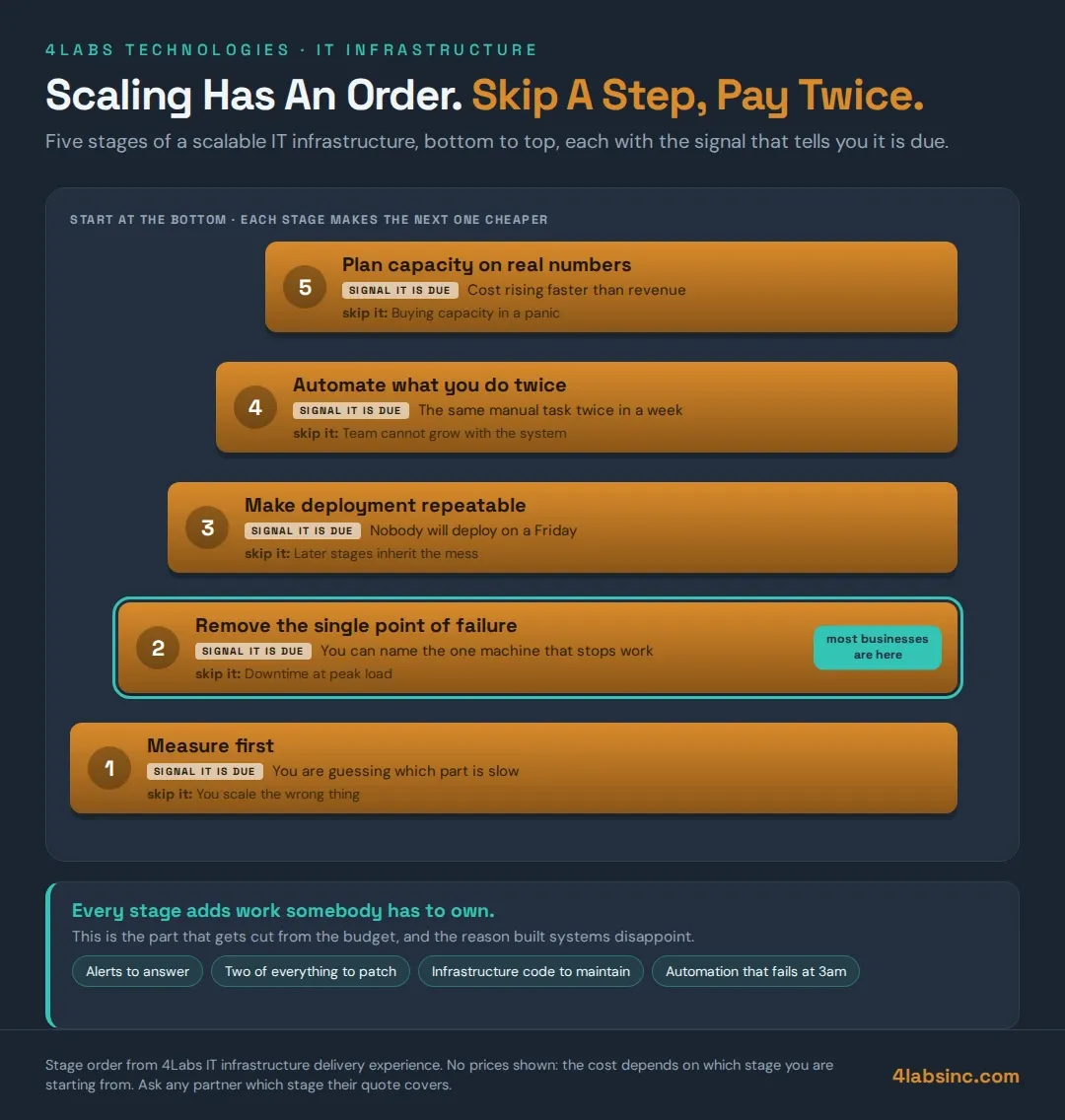
The five stages of a scalable IT infrastructure are stages rather than a checklist. Each one makes the next cheaper, and skipping one makes everything after it harder. Each stage below tells you what it is, the signal that it is due, and what to do about it.

  1. Measure before you buy anything.
  2. Remove the single point of failure.
  3. Make deployment repeatable.
  4. Automate what you now do the same way twice.
  5. Plan capacity against real numbers.

Most businesses we see are somewhere in stage two of building a scalable IT infrastructure, having already bought something from stage five.
five stages.webp

Stage one: measure before you buy anything

What it is. Monitoring on what matters, a baseline of normal, and one honest answer to where the bottleneck is.
The signal it is due. You are guessing. Somebody says the application is slow, the conversation moves straight to what to buy, and nobody can say whether the constraint is CPU, memory, disk, the database or the network.
What to do. Instrument the layers separately, because one alert saying the site is slow tells you nothing, and record a normal week before you change anything. Then find the single constraint: there is almost always exactly one at a time, and it moves once you fix it. Auditing what you already run applies the same discipline to your whole estate. Skip this stage and you scale the wrong thing, which is the most common expensive mistake in IT infrastructure, and the hardest to spot.

Stage two: remove the single point of failure

What it is. Redundancy and failover on the pieces whose absence stops the business. Not an architecture rewrite, just no single thing that takes everything down.
The signal it is due. You can name the one machine, service or person whose absence stops work. If you cannot name it, ask who reboots the server.
What to do. List what is genuinely single: a database with no replica, a load balancer with no partner, an internet connection with no backup, one person holding production credentials. Add a second of each, then test failover deliberately on a Tuesday morning with people watching, because untested redundancy is a belief rather than redundancy. Network security in your IT infrastructure covers the other half of this work. Skip this stage and you get downtime at the worst moment, since peak load is when a single point of failure fails. Downtime here is rarely brief, because nobody has practised the recovery.

Stage three: make deployment repeatable

What it is. The same change, applied the same way, by anyone on the team: infrastructure as code, standard builds, one documented path to production.**
The signal it is due.** Nobody will deploy on a Friday. That single fact tells you the deployment process is not trusted, and an untrusted process is one nobody runs often enough to keep small.
What to do. Write down how one service gets deployed, follow your own instructions, and fix whatever they got wrong. Then put it in code rather than a document so it cannot drift, and delete the manual path. Two servers built from the same definition beat two configured by hand, because only one of those pairs is actually identical. Our IT infrastructure management best practices go deeper on standardising this. Skip this stage and every later one inherits the mess, because automation built on an unrepeatable process only makes the mess faster.

Stage four: automate what you now do the same way twice

What it is. Automation of the work stage three made consistent: provisioning, deployments, scaling actions, backups, patching, alert response.
The signal it is due. Somebody does the same manual task twice in a week and both times it was correct. That second half matters: if two people do it two ways, you are still in stage three.
What to do. Automate in this order: things that happen often, things that happen at 2am, things that hurt when done wrong. Provisioning and deployments come first, and scaling actions once you trust your monitoring, because automation acting on a bad signal is worse than a human who hesitates. Automation in IT infrastructure covers the tooling choices. Skip this stage and your IT infrastructure scales while your team does not, since every new instance adds manual work.

Stage five: plan capacity against real numbers

What it is. Capacity planning on your own measurements rather than a vendor's, with autoscaling where it earns its place and a view of what next year costs at next year's volume.
The signal it is due. A cost line growing faster than the revenue it supports. Or the opposite: you hold three times the capacity you use, as insurance against an event nobody has quantified.
What to do. Take the baseline from stage one and project it against real growth rather than an ambition, then ask the useful question: what breaks first at ten times today's load? It is almost never what people expect, and the answer tells you where next year's work goes. Set autoscaling on signals you trust and give it a ceiling, because an unbounded scaling rule is an unbounded invoice. Skip capacity planning and you are back to buying capacity in a panic, which also brings downtime back with it.
That is the sequence. Where you sit in it is a more useful question than which technology to buy, and it is answerable this week.


Where the cloud fits, and where it does not

Cloud infrastructure makes several stages of a scalable IT infrastructure much easier. It does not make any of them unnecessary and it does not fix a design problem, because a badly designed system moved to the cloud scales its own inefficiency, on a meter.

What cloud infrastructure genuinely makes easier

Capacity with no lead time. You get another instance in minutes instead of ordering hardware and waiting weeks, and for a business with uneven load that is the whole argument.

Disaster recovery you can actually test. Rebuilding your environment elsewhere becomes a scripted exercise rather than a procurement project, and rehearsing a restore cheaply is worth more than most redundancy hardware.

Elasticity, once you have earned it. Scale up for the busy hours and back down after. This works properly only after stages one and four, since it needs a signal you trust and automation that acts on it.

What cloud infrastructure does not fix

Data gravity, which is the limit of cloud infrastructure that surprises people most. Large datasets are expensive and slow to move, and everything touching them wants to live nearby, which is why many businesses end up hybrid rather than all-in.
Compliance and residency. Some data has to stay in a specific place, and that is a legal question rather than a technical one.
A design that does not scale. Autoscaling a service that queues on one database gives you more clients waiting on the same queue, and the cloud will happily sell you that.
On-premises still wins for predictable heavy workloads, for hardware already paid for, and where residency rules are strict, so hybrid is the common answer. If you are weighing this up, choosing between cloud and on-premises infrastructure works through the decision properly.
The short version: cloud infrastructure changes how you get capacity, and it does not change the order in which you build the scalable IT infrastructure that uses it.

The part most guides leave out: who runs it

Every stage above adds operational surface. Monitoring produces alerts somebody answers, redundancy means two of everything to patch, infrastructure as code is a codebase to maintain, and automation fails at 3am.
A scalable IT infrastructure is a staffing decision as much as a technology decision, and the staffing half is the line item that gets cut. Downtime is what that omission costs. This is the most common reason infrastructure projects deliver on paper and disappoint in practice: the system was built and nobody was funded to run it.

The three roles a scaled infrastructure needs

Someone who owns the platform: provisioning, the deployment pipeline, the infrastructure code. This person makes the environment boring and predictable, and their success looks like nothing happening.
Someone who owns observability and response: monitoring, alerting, answering when something fires. At a certain size this becomes a rota, then a function, and a network operations center is what the role looks like once coverage has to be continuous.
Someone who owns security and access: who can reach what, patch levels, credentials, and the review that catches the storage bucket left open after a migration.
Early on these are one person wearing three hats, which is fine. What is not fine is leaving them as one person after stages three and four, because that person is now a single point of failure you spent stage two removing everywhere else.

Hire, train or augment

There are three ways to cover those roles, each right in different circumstances.
Hire when the work is permanent, the knowledge must stay in-house, and you can wait out a search. Platform ownership belongs here eventually, because it is the role with the deepest context.
Train when you have capable people and a runway. It is the cheapest option and the slowest, and it fails when those people must also keep delivering their current work at the same pace.
Augment when the need starts now, when the specialism is not needed permanently at full strength, or when you need coverage across hours your own team does not work. Monitoring and incident response are the clearest case, because they need somebody awake rather than somebody senior.
That last point matters, because on-call coverage is really a time zone problem. Our guide to offshore and nearshore coverage across time zones works out how many shared hours you need before choosing a region, so if you need to augment the team for one of these roles, read that first.
The honest summary: decide who runs the scalable IT infrastructure before you finish building it, because retrofitting an operations team onto a live system costs more than planning for one.

When to start, and when it is too early

This is the question most readers arrive with, and most guides answer it with "now", which helps nobody. Scalable IT infrastructure work has a right moment, and it is not always this quarter.

Four signals that say start this quarter

The same incident has happened twice. Not two different failures, the same one: a repeat incident means the cause is structural, and waiting for the third one is a choice.
Growth is visible in the numbers: users, transactions, data volume or traffic rising steadily rather than hoped for in a plan. Scaling work takes months, so it starts before the load arrives.
Nobody deploys on a Friday. Worth repeating, because it is the most reliable sign that your process is holding you back rather than your hardware.
Your IT infrastructure cost is rising faster than the revenue it supports. That gap does not close on its own, and stage one work usually closes it rather than stage five.

Two cases where this work is premature

You have not found product-market fit. Building for scale you may never need is the most expensive way to avoid talking to customers. Buy a bigger machine, keep a tested backup, and spend the rest on finding out whether people want the thing.
Your load is flat and modest. Some businesses have predictable, small IT infrastructure needs, and one well-maintained server with a tested restore is the correct answer for years. Scaling work here is a cost with no return.

Mistakes we see most often

These come from delivery rather than a list of best practices, and each has the same root: doing a later stage of a scalable IT infrastructure before an earlier one.
Automating before standardising, which is the most costly of the set. Automation applied to a process that two people run two different ways does not fix the inconsistency, it ships it faster and in more places.
Redundancy nobody has tested. A standby database that has never taken traffic is a hypothesis, and teams find out during a real outage that replication stopped six weeks ago.
Monitoring that alerts on everything. An alert channel with forty messages a day trains a team to ignore it, which is worse than no monitoring because it comes with a feeling of safety. Alert on what someone will act on, and delete the rest.
Treating a cloud migration as a scaling strategy. Moving the same architecture to rented hardware changes who owns the servers, and it does not change a design that cannot scale, so migrate for good reasons and do the scaling work separately.
Leaving operations unfunded. The build gets budget and the running of it does not, and six months later the monitoring is stale, the patches are behind and nobody owns the pipeline. This is the failure that makes everything else here look like it did not work.

A 90-day starting plan

Deliberately small, because a plan you can start on Monday beats a roadmap you file. Ninety days is long enough to finish stage one and make real progress on stage two.
Weeks 1 and 2: measure. Put monitoring on each layer separately, meaning application, database, storage and network, and record a normal week. By the end of week two you can name the single constraint in your IT infrastructure and point at the graph that proves it.
Weeks 3 to 6: remove the worst single point of failure. One, not all of them. Pick the one whose failure stops the business, add its pair, test failover with people watching, and write down what the test revealed, because it will reveal something.
Weeks 7 to 10: make one deployment repeatable. One service, not the whole estate. Document the path, follow your own documentation, fix what it got wrong, then put it in code and delete the manual route. That gives you a pattern the rest can copy.
Weeks 11 to 13: automate that one thing, then review. Automate the deployment you just made repeatable, then sit down with the baseline from week two and answer one question: what breaks first at ten times today's load? That answer is your next quarter.
What the plan leaves out: no migration, no re-architecture, no new platform, no autoscaling. Those are stage five decisions, and they are cheaper after the measurement that tells you which ones you need.

Getting help with this

If you want a second opinion on which stage you are in, that is a short conversation rather than a proposal.
Tell us what breaks, how often, and what you already monitor. We will tell you which stage you are in, what the next piece of work is, and whether it needs anyone from outside your team. If the answer is a database index and no purchase, we will say so.
Our IT infrastructure services cover the whole sequence on this page, from the first baseline through to capacity planning, autoscaling, and the operations that keep it running.
No obligation and no pitch deck.

Frequently asked questions

How much does a scalable IT infrastructure cost?

It depends which stage you start from, and the stages differ in cost by an order of magnitude. Monitoring and a baseline are the cheapest work here and often need no new spending, while redundancy roughly doubles the cost of whatever you make redundant. Infrastructure as code is people rather than licences, automation is a build cost that pays back in operations, and capacity planning may reduce your bill rather than raise it. Ask any partner which stage their quote covers, and what the running cost looks like twelve months later.

Can legacy systems be made scalable?

Usually yes, in part, and rarely by rewriting them. The usual route puts the scalable parts around the legacy core: caching in front of it, queues to smooth load, and a replica for reporting so the main system is not carrying analytics. That buys years. Full replacement becomes the answer when the legacy system blocks a change the business needs rather than merely running slowly.

Is a scalable IT infrastructure more secure or less?

Neither by default, and it changes what you watch. More instances means more to patch, and automation means a misconfiguration deploys everywhere at once. Against that, infrastructure as code makes your configuration reviewable and consistent, which is a real security gain over servers configured by hand. The risk is growth without ownership, where nobody tracks what exists.

How long does it take to build a scalable IT infrastructure?

Stage one takes two to four weeks, and stage two a few weeks per single point of failure. Stage three takes a month for the first service and much less after, stage four follows closely, and stage five is continuous rather than finished. Ninety days gets you through stage one with real progress on stage two.

Where does DevOps fit into infrastructure scalability?

DevOps is mostly stage three and stage four: making deployment repeatable, then automating it. The practices matter more than the job title. A team with a documented, coded, automated path to production is doing the work whether or not anyone holds the title, and a team with the title but a manual deployment process is not.

‹ PreviousNext ›