Logo
Logo
ServicesIndustriesCase StudiesBlogsCareersLet's Connect
blue-white-icon
black-image
Logo
ServicesIndustriesCase StudiesBlogsCareersLet's Connect
burger-icon
hamburger
blog-image
Blogs/ERP Trends in Emerging Tech

Future Trends in ERP: What AI, Machine Learning and IoT Actually Change, and the Dates That Force the Decision

January 6, 2026
Share Now

Table of Contents

  1. 1. The three trends, and what each one really does
  2. 2. The three dates behind your ERP roadmap
  3. 3. What has to be true before any of this pays back
  4. 4. Three things not to do
  5. 5. What this means for a roadmap, by year
  6. 6. Planning your ERP next step
  7. 7. Frequently asked questions

Most articles on the future trends in ERP give you a numbered list. AI, cloud, IoT, analytics, low-code, sustainability. Nothing on that list has a date, so nothing on it makes a plan.

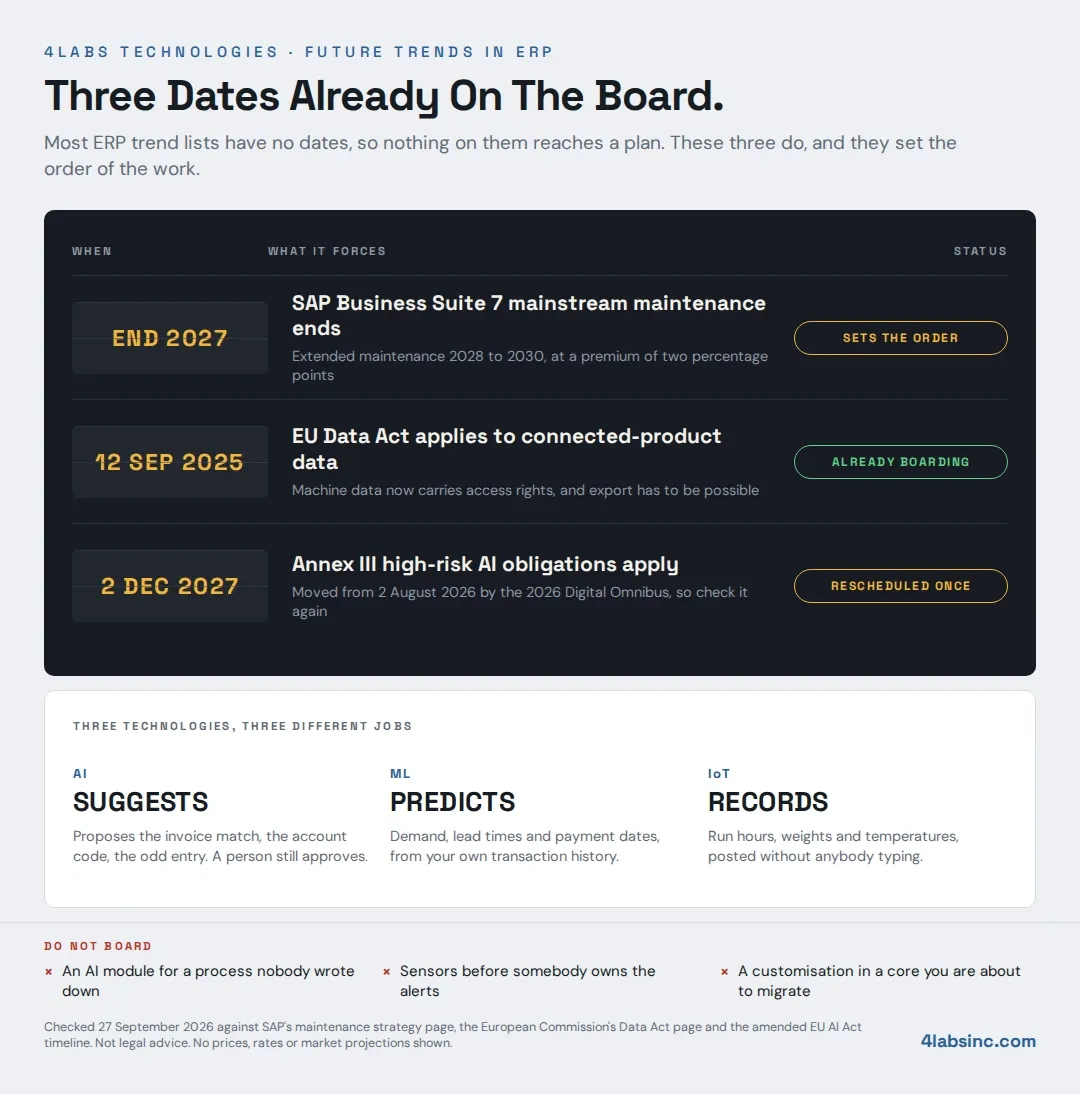
Three dates are already fixed, and the first is SAP's mainstream maintenance for Business Suite 7, which ends at the end of 2027. EU rules on data from connected products have applied since 12 September 2025. And under the amended AI Act timeline, obligations for high-risk AI systems land on 2 December 2027.

Those three dates are why AI, machine learning and IoT are being discussed in ERP steering meetings now rather than in 2030.

This guide explains what each of the three technologies actually does inside an ERP system, the dates behind them, what has to be true in your data before any of it pays back, and three things not to do. No market projections and no adoption percentages appear here, because the ones on this query cannot be checked.

If you want the ground floor first, our guide to what ERP already does well covers the basics.

Stay Ahead With 4Labs

Get expert insights, security briefings, and the latest innovations in your inbox.

  • Afghanistan+93
  • Albania+355
  • Algeria+213
  • Andorra+376
  • Angola+244
  • Antigua and Barbuda+1268
  • Argentina+54
  • Armenia+374
  • Aruba+297
  • Australia+61
  • Austria+43
  • Azerbaijan+994
  • Bahamas+1242
  • Bahrain+973
  • Bangladesh+880
  • Barbados+1246
  • Belarus+375
  • Belgium+32
  • Belize+501
  • Benin+229
  • Bhutan+975
  • Bolivia+591
  • Bosnia and Herzegovina+387
  • Botswana+267
  • Brazil+55
  • British Indian Ocean Territory+246
  • Brunei+673
  • Bulgaria+359
  • Burkina Faso+226
  • Burundi+257
  • Cambodia+855
  • Cameroon+237
  • Canada+1
  • Cape Verde+238
  • Caribbean Netherlands+599
  • Cayman Islands+1
  • Central African Republic+236
  • Chad+235
  • Chile+56
  • China+86
  • Colombia+57
  • Comoros+269
  • Congo+243
  • Congo+242
  • Costa Rica+506
  • Côte d'Ivoire+225
  • Croatia+385
  • Cuba+53
  • Curaçao+599
  • Cyprus+357
  • Czech Republic+420
  • Denmark+45
  • Djibouti+253
  • Dominica+1767
  • Dominican Republic+1
  • Ecuador+593
  • Egypt+20
  • El Salvador+503
  • Equatorial Guinea+240
  • Eritrea+291
  • Estonia+372
  • Ethiopia+251
  • Faroe Islands+298
  • Fiji+679
  • Finland+358
  • France+33
  • French Guiana+594
  • French Polynesia+689
  • Gabon+241
  • Gambia+220
  • Georgia+995
  • Germany+49
  • Ghana+233
  • Gibraltar+350
  • Greece+30
  • Greenland+299
  • Grenada+1473
  • Guadeloupe+590
  • Guam+1671
  • Guatemala+502
  • Guinea+224
  • Guinea-Bissau+245
  • Guyana+592
  • Haiti+509
  • Honduras+504
  • Hong Kong+852
  • Hungary+36
  • Iceland+354
  • India+91
  • Indonesia+62
  • Iran+98
  • Iraq+964
  • Ireland+353
  • Israel+972
  • Italy+39
  • Jamaica+1876
  • Japan+81
  • Jordan+962
  • Kazakhstan+7
  • Kenya+254
  • Kiribati+686
  • Kosovo+383
  • Kuwait+965
  • Kyrgyzstan+996
  • Laos+856
  • Latvia+371
  • Lebanon+961
  • Lesotho+266
  • Liberia+231
  • Libya+218
  • Liechtenstein+423
  • Lithuania+370
  • Luxembourg+352
  • Macau+853
  • Macedonia+389
  • Madagascar+261
  • Malawi+265
  • Malaysia+60
  • Maldives+960
  • Mali+223
  • Malta+356
  • Marshall Islands+692
  • Martinique+596
  • Mauritania+222
  • Mauritius+230
  • Mayotte+262
  • Mexico+52
  • Micronesia+691
  • Moldova+373
  • Monaco+377
  • Mongolia+976
  • Montenegro+382
  • Morocco+212
  • Mozambique+258
  • Myanmar+95
  • Namibia+264
  • Nauru+674
  • Nepal+977
  • Netherlands+31
  • New Caledonia+687
  • New Zealand+64
  • Nicaragua+505
  • Niger+227
  • Nigeria+234
  • North Korea+850
  • Norway+47
  • Oman+968
  • Pakistan+92
  • Palau+680
  • Palestine+970
  • Panama+507
  • Papua New Guinea+675
  • Paraguay+595
  • Peru+51
  • Philippines+63
  • Poland+48
  • Portugal+351
  • Puerto Rico+1
  • Qatar+974
  • Réunion+262
  • Romania+40
  • Russia+7
  • Rwanda+250
  • Saint Kitts and Nevis+1869
  • Saint Lucia+1758
  • Saint Pierre & Miquelon+508
  • Saint Vincent and the Grenadines+1784
  • Samoa+685
  • San Marino+378
  • São Tomé and Príncipe+239
  • Saudi Arabia+966
  • Senegal+221
  • Serbia+381
  • Seychelles+248
  • Sierra Leone+232
  • Singapore+65
  • Slovakia+421
  • Slovenia+386
  • Solomon Islands+677
  • Somalia+252
  • South Africa+27
  • South Korea+82
  • South Sudan+211
  • Spain+34
  • Sri Lanka+94
  • Sudan+249
  • Suriname+597
  • Swaziland+268
  • Sweden+46
  • Switzerland+41
  • Syria+963
  • Taiwan+886
  • Tajikistan+992
  • Tanzania+255
  • Thailand+66
  • Timor-Leste+670
  • Togo+228
  • Tonga+676
  • Trinidad and Tobago+1868
  • Tunisia+216
  • Turkey+90
  • Turkmenistan+993
  • Tuvalu+688
  • Uganda+256
  • Ukraine+380
  • United Arab Emirates+971
  • United Kingdom+44
  • United States+1
  • Uruguay+598
  • Uzbekistan+998
  • Vanuatu+678
  • Vatican City+39
  • Venezuela+58
  • Vietnam+84
  • Wallis & Futuna+681
  • Yemen+967
  • Zambia+260
  • Zimbabwe+263
Our Services
Digital Marketing
Staff Augmentation
IT Infrastructure
ERP Solutions
Software Development
Web & App Development
Industries
Cryptocurrency and Blockchain
Banking, Financial Services, and Insurance (BFSI)
Lending and FinTech
Oil and Gas
Energy and Utilities
Automotive and Manufacturing
Agriculture
Real Estate
E-commerce and Retail
Case Studies
Financial Services Test Automation
AI-Driven Customer Risk Profiling
Elevating Mobile Performance
Jewelry Client Transformation
AI Underwriting Revolution
Advanced Cybersecurity Solutions
Eyewear Retailer Transformation
Revolutionizing Manufacturing Operations
Offshore Development Excellence
Company

About Us

Careers

Let's Connect

Business Referral

Engagement Model

Partnership Programs

Resources

Blogs

footer1-iconfooter2-iconiso_iconiso_icon2

4labsicon

Copyright © 2026 4Labs Technologies. All Rights Reserved.

Privacy Policy

Terms & Conditions

Accessibility

fb-icon
twitter-icon
instagram-icon
linkedin-icon

The three trends, and what each one really does

Three technologies, three different jobs. Keeping them apart is the difference between a useful ERP roadmap and a wish list.

AI in ERP: systems that suggest

AI in ERP mostly means a system that proposes something a person then approves. It reads the transaction, compares it to a pattern, and puts a suggestion in front of somebody.

Where it is already useful

Invoice matching, where the system proposes which purchase order a supplier invoice belongs to. Coding suggestions in finance, where a cost is assigned to the right account. Anomaly flags at month end, where something looks unlike every other entry of its type, and natural-language queries, where a manager asks a question instead of building a report.

All four share a shape. The ERP system suggests, a person decides, and the decision is recorded. That is where intelligent ERP earns its money today, and our post on finance and reporting covers the month-end version in more depth.

Where it becomes a decision rather than a suggestion

AI in ERP crosses a line when nobody reviews the output, because an AI that screens job applicants, scores a customer's credit or decides which supplier gets approved is deciding, not suggesting.

That difference is not philosophical. It changes who is accountable, what you have to log, and, in the EU, which rules apply. Keep a person in the loop and you have a productivity feature. Remove the person and you have a compliance project, which the dates section covers.

Our overview of where AI is already working in business sets out the same distinction across other systems.

Machine learning: predictions from your own history

Machine learning is often used as a synonym for AI. It is narrower and more useful than that.

Machine learning finds patterns in data you already hold and predicts the next value. In an ERP system that means demand forecasting from your own sales history, lead-time prediction from your own supplier performance, payment-date prediction from your own receivables, and stock recommendations from your own movements.

The important word is "own", because these predictions are built on your transaction history and their quality depends entirely on the quality of that history. Predictive analytics on three years of clean data is useful. Predictive analytics on three years of data with four spellings of the same supplier is a confident guess.

That is why the preparation section below matters more than the feature list, and our guide to machine learning on your own history explains the data side.

IoT: machine data inside the transaction record

IoT integration means connecting sensors and equipment so that what happens on the floor appears in the ERP system without somebody typing it.

A machine reports its own run hours, so the maintenance schedule updates itself. A weighbridge posts an actual weight against a goods receipt. A temperature logger attaches a reading to a batch record, and a scanner confirms a pallet at a door instead of at a desk an hour later.

What IoT changes is the gap between an event and the record of it, and in most enterprises that gap is hours or days, so everything downstream inherits the delay. This is also where sensor and operational data at scale stops being an IT project and becomes an operations one.

What IoT does not change is whether anybody acts on it. A sensor that raises an alert nobody owns is a more expensive version of nothing.


The three dates behind your ERP roadmap

Each trend has a date attached. Positions below were checked on 27 September 2026.

End of 2027: the vendor maintenance deadline

SAP's maintenance strategy page states that SAP will provide mainstream maintenance until the end of 2027 for SAP Business Suite 7 core applications. Optional extended maintenance runs for three years from the beginning of 2028 until the end of 2030, at a premium of two percentage points on the maintenance basis. SAP has also committed to an innovation commitment for S/4HANA until the end of 2040.

This is the date that decides the order of everything else. If your ERP system is moving platform inside three years, then every AI, machine learning and IoT question becomes a question about timing: build it before the move, during it, or after.

The usual answer is after, with one exception: anything that depends on clean master data should start now, because that work transfers to the new platform and the migration goes better for it.

If the platform itself is still open, whether that is cloud ERP or on-premise, our guide to choosing between SAP, Odoo and Microsoft Dynamics sets out the comparison.

Since September 2025: connected-product data rules

The European Commission states that the EU Data Act was published in the Official Journal on 22 December 2023 and applies since 12 September 2025. It covers access to data generated by connected products and related services, alongside its cloud switching provisions.

For an ERP conversation about IoT, that is the story nobody is telling. Sensor and machine data is no longer only an integration question. It is data with access rights attached, and those rights can sit with the user of the equipment rather than only with whoever installed it.

Two practical consequences follow: your ERP integration needs to be able to export machine data in a usable form rather than locking it inside a proprietary loop. And your contracts with equipment suppliers should say who can access what, because the default is no longer obvious.

This is not legal advice, and it applies in the EU. If you manufacture or operate connected equipment there, it is worth a conversation with counsel before the next integration project.

2 December 2027: AI that makes decisions about people

The Digital Omnibus agreement was reached on 6 May 2026 and confirmed by member states on 13 May 2026. Under it, obligations for Annex III high-risk AI systems moved from 2 August 2026 to 2 December 2027. Annex I systems moved from 2 August 2027 to 2 August 2028. The Article 50 transparency obligations stay on the original schedule from 2 August 2026.

ERP vendors are shipping AI into modules that touch people: recruitment and HR, credit decisions and supplier approval, and Annex III is about exactly those areas.

The practical step is small and worth doing early: list every AI feature on your ERP roadmap, mark the ones that screen, score or rank people, and decide who signs that assessment off. It is not a decision for the implementation team.

Note that this timeline has already moved once, so check the current position before you build a plan on it.

future-trends-in-erp-departures-board.webp

What has to be true before any of this pays back

Three conditions. None of them is exciting, and all three decide whether the trends above produce anything.

Somebody owns the master data

Every prediction, suggestion and sensor reading lands against a record: a customer, a material, a supplier, a plant. If those records are inconsistent, everything built on them inherits the inconsistency.

The test is quick: pick a supplier and count how many versions of it exist across your ERP system. If the answer is more than one, machine learning will treat them as different suppliers and your forecast will be wrong in a way nobody notices.

Name an owner for each core record type, somebody who decides what the fields mean and who can create new ones. Our guide to master data ownership covers how that works in practice.

Owner: a business data owner per record type. Test: can somebody say who approves a new supplier record?

A clean core, not a customised one

Heavily customised ERP systems are hard to upgrade, and the newer AI features usually arrive as part of the vendor's release cycle. Every customisation in the core is a reason not to take the next release, and a reason each new capability arrives late.

This matters more than usual between now and 2027. A customisation added this year to a system you are about to migrate is paid for twice: once to build and once to rebuild or retire.

The rule that works: extend outside the core where the platform allows it, and keep the core close to standard. An ERP implementation that holds that line is the one that can absorb new features later.

Owner: the ERP architect. Test: how many core modifications would a version upgrade have to reconcile?

A route for machine data that is not a spreadsheet

IoT integration fails quietly when the data arrives somewhere other than the ERP system: a dashboard nobody opens, a file on a share, or a report emailed weekly.

Decide three things before connecting anything. Which events actually need to reach the ERP system, because most sensor readings do not. What the ERP integration route is, whether that is an API, a middleware layer or an event stream. And who acts on an alert when it arrives, by name.

The third is the one that gets skipped, and it is the one that decides whether an ERP integration is worth anything.

Owner: operations, with IT. Test: for each planned alert, who receives it and what do they do?

Three things not to do

Do not buy an AI module for a process nobody has documented. If three people describe the approval flow differently, an AI trained on it will learn all three and suggest the wrong one confidently. Write the process down first. It is cheaper than the licence.

Do not connect sensors before somebody owns the alerts. IoT projects rarely fail technically. They fail when the data arrives and nobody has been given the job of acting on it. Name the person before the hardware arrives.

Do not put an AI customisation in a core you are about to migrate. With mainstream maintenance ending in 2027, anything built into the core of an older ERP system is work you will pay for twice. Build it outside the core, or build it after the move.

The common thread is that each of these is a decision made too early in an ERP implementation, before the thing it depends on exists.

What this means for a roadmap, by year

The same three dates, arranged as work rather than news.

This year: master data ownership, because it transfers to whatever platform you end up on. The AI feature list with the people-affecting ones marked. A decision on the platform if your ERP system is on Business Suite 7 and you have not made one.

Next year: the migration itself, if that is the path, or the first machine learning use case if it is not. Demand forecasting on clean history is the usual first choice, because the data already exists and the result is checkable against what actually happened.

2027. Both deadlines land. Mainstream maintenance ends at the end of the year, and Annex III AI obligations apply from 2 December. A programme that did the preparation work in 2026 treats these as scheduled events. One that did not treats them as emergencies.

Afterwards: IoT integration for the processes that need it, AI features from the vendor's release cycle rather than as customisations, and predictive analytics that people trust because the data underneath it is owned.

For a company already running cloud ERP for a mid-sized business, the sequence is the same and the migration line usually disappears, which is most of the argument for cloud ERP in the first place.

Planning your ERP next step

Two conversations, depending on where you are.

A migration already scheduled: tell us the platform, the date and what has been customised. We will tell you which AI and IoT items belong before the move, which belong after, and which should be dropped. Most roadmaps we see have two or three features that will not survive the migration, and finding those early is the cheapest hour in the programme.

An ERP system that works, and a board asking for AI: the useful first step is the feature list with the people-affecting items marked, and an honest look at the master data underneath. Sometimes the answer is that the data work comes first and the AI arrives next year. We would rather say that than sell a module.

Our ERP software development team covers both, from the data work through to the integration that makes intelligent ERP more than a slide. If your constraint is SAP capacity rather than direction, the people who do SAP work can join your team for the phase that needs them.
No obligation and no pitch deck.

Frequently asked questions

What are the main future trends in ERP?

Three matter more than the rest because each has a date attached. AI in ERP, mostly as suggestions a person approves. Machine learning, which predicts from your own transaction history. And IoT integration, which puts machine data into the record without anyone typing it. The dates are the end of 2027 for SAP Business Suite 7 mainstream maintenance, 12 September 2025 for EU connected-product data rules, and 2 December 2027 for high-risk AI obligations.

What does AI actually do in an ERP system?

AI in ERP today mostly suggests, and it proposes which purchase order an invoice matches, codes a cost to an account, flags an entry that looks unlike its peers, and answers questions asked in plain language. A person approves the suggestion and the decision is recorded. The value comes from removing lookups and reconciliation, not from removing the person.

How is machine learning different from AI in ERP?

Machine learning is narrower. It finds patterns in data you already hold and predicts the next value: demand from your sales history, lead times from your supplier performance, payment dates from your receivables. Because the predictions come from your own records, their quality depends on the quality of those records. Clean master data is the requirement, not an optional improvement.

What does IoT integration add to ERP?

It closes the gap between something happening and the ERP system knowing about it. Machine run hours update the maintenance schedule, a weighbridge posts an actual weight to a goods receipt, a temperature reading attaches to a batch. In most enterprises that gap is hours or days, and every downstream process inherits the delay. The limit is that an alert nobody owns changes nothing.

What happens to SAP ERP customers in 2027?

SAP states that mainstream maintenance for SAP Business Suite 7 core applications runs until the end of 2027. Optional extended maintenance is available for three years, from the beginning of 2028 to the end of 2030, at a premium of two percentage points on the maintenance basis. SAP has committed to keeping at least one S/4HANA release in maintenance until the end of 2040. In practice the date sets the order of every other ERP decision.

Does the EU AI Act apply to our ERP?

It depends on what the AI does. A feature that suggests to a person who then decides sits outside the high-risk category. A feature that screens candidates, scores credit or decides access to services may fall under Annex III, where obligations apply from 2 December 2027 under the amended timeline agreed on 6 May 2026 and confirmed on 13 May 2026. List your planned AI features, mark the ones that touch decisions about people, and take legal advice on those.

Written by 4Labs Technologies. Reviewed by 4Labs Technologies. Positions checked on 27 September 2026 against SAP's maintenance strategy page, the European Commission's Data Act page and the amended EU AI Act timeline. Dates move, as the AI Act timeline already has, so confirm the current position before committing to a plan. Nothing here is legal advice.

‹ PreviousNext ›