Key takeaways
- Efficiency is the benefit that arrives most reliably, and it arrives first. Growth benefits are real but late.
- Breaking down data silos is the fastest-improving outcome in the research, up from 55.2% to 77.4% realisation year over year.
- Most benefit categories reach over half the companies that expected them. That is a decent hit rate, not a guarantee.
- More than a quarter of ERP projects run over budget and almost a quarter run over schedule. Plan for both.
- The benefits depend on decisions made before the software is chosen, not on which product you buy.
Every enterprise resource planning vendor publishes the same list. The benefits of implementing an ERP system are efficiency, integration, visibility, better decisions, growth. All true, and none of it tells you which ones you will get, or when.
There is data on that. Each year a study asks companies that finished an ERP project which benefits they expected and which ones they got. The answers are more useful than any brochure: efficiency lands early and lands often, silo removal has improved sharply, and the benefits people put in the business case last are the ones that take longest.
This guide ranks nine ERP system benefits by how reliably they arrive in practice, says when each one shows up, and includes the cost and overrun figures most benefits pages leave out.
What is an ERP system, and what does it actually change?
An ERP system, short for enterprise resource planning, is one piece of software, running on one database, that handles finance, inventory, purchasing, sales, production and often HR. Enterprise resource planning means every department reads and writes the same records instead of keeping its own copy.
That single sentence is the whole change. Not the features. The shared data. Every advantage of ERP systems described below traces back to it.
Most companies arrive at ERP the same way. Accounting runs one system, the warehouse runs another, sales lives in a CRM, and three spreadsheets hold the numbers nobody else can see. Everything works until you need one answer from two systems.
| What happens today | What happens with an ERP system |
|---|---|
| Sales promises a delivery date from a stock report exported last Thursday | Sales sees live stock, including what is on order |
| Month-end close takes two weeks of reconciling exports | Ledger updates as transactions post; close shortens |
| Purchasing reorders from memory and a spreadsheet | Reorder points fire from actual stock and demand |
| Three departments report three revenue numbers | One number, one definition, one source |
| A new site means new systems and new spreadsheets | A new site is configuration, not a rebuild |
The right-hand column is where the benefits come from. Efficiency, integration and growth are all downstream of one thing: everyone looking at the same data at the same moment.
Worth saying plainly — ERP is not accounting software with more screens. Accounting software records what happened. An ERP system runs the operation that makes it happen, which is why implementation touches process and people rather than only IT.
Do the benefits of implementing an ERP system actually arrive?
This is the question ERP system benefits pages skip, and it has an answer.
Panorama Consulting Group's 2026 ERP Report surveyed 170 organisations between January 2025 and January 2026. It asks which benefits companies expected and which ones they realised. Four findings matter here.
Most benefits do land, for most of the companies expecting them. Over half the respondents who anticipated a given benefit went on to realise it. Not every company, and not every benefit, but a majority — which is better than the reputation ERP carries and worse than the brochures imply.
Efficiency lands most reliably. Productivity and efficiency gains were the objectives most commonly achieved to the extent expected. If you build a business case, build it on this one. It is the benefit with the best track record.
Silo removal is improving fast. Realisation of the "removing data silos" benefit rose year over year from 55.2% to 77.4%. That is the largest single movement in the data, and it tracks the shift to cloud platforms where integration comes built in rather than bolted on.
The projects still overrun. More than a quarter of organisations reported going over budget, with additional technology needs the leading cause. Almost a quarter reported going over schedule, most often because of organisational issues. Median implementation duration was nine months.
Read those four together and the picture is honest. The benefits are real and measurable. They cost more and take longer than the plan says, for a quarter of companies. Anyone selling you an ERP system without mentioning the second half is selling, not advising.
One more thing the data shows. Operating-model benefits — better decisions, agility, a foundation for growth — are described as diffuse, hard to attribute and slower to land. They arrive. They just will not show up in a month-three review, which is why the timeline further down matters as much as the ranking.
Nine benefits of implementing an ERP system, ranked by how reliably they land
Ordered by evidence, not by how good they sound in a board paper. Each one covers what it means, how dependably it arrives, and the condition it depends on.
1. One set of numbers everyone trusts
This is the benefit every other benefit sits on. One database means finance, sales, operations and the warehouse read the same record at the same time. No exports, no reconciliation, no meeting spent arguing about whose figure is right.
It arrives at go-live, because it is a property of the design rather than something you build up to.
Depends on: actually retiring the old systems. Companies that keep a legacy database running "just for reporting" keep two versions of the truth and get none of this.
2. Efficiency: the hours that come back first
The most reliably realised benefit in the research. Work that used to mean rekeying data between systems stops existing. Orders flow from sale to picking to invoice without anyone retyping them. Approvals route themselves.
Most companies notice this within the first quarter after go-live, in specific places: order entry, invoice matching, stock counts, the month-end close.
Depends on: redesigning the process rather than recreating the old one inside new software. Automating a bad workflow gives you a faster bad workflow.
3. Integration: the silos really do come down
The fastest-improving outcome in the data, up from 55.2% to 77.4% realisation year over year. Departments stop keeping private spreadsheets because the shared system finally answers their questions.
Cloud platforms deserve much of the credit. Integration that used to be a custom project now ships as standard connectors.
Depends on: scope. Leave one department out of the implementation and you have preserved the exact silo you set out to remove.
4. Faster, cleaner financial close and reporting
When transactions post to one ledger as they happen, month-end stops being an archaeology project. Companies that closed in two weeks often close in days. Reports that took an analyst a morning become a saved view.
This is also where audit conversations get easier, because the trail is in the system rather than in somebody's inbox. Our post on how ERP systems improve financial management and reporting goes deeper on the finance side.
Depends on: a clean chart of accounts agreed before go-live. Migrating a messy one guarantees messy reporting in a new interface.
5. Inventory and supply chain visibility
Stock levels stop being a guess. You see what is on hand, what is committed, what is on order and what is late, in one place. Reorder points fire on real demand instead of instinct.
For distributors and manufacturers this is often the benefit with the clearest money attached: less capital sitting in overstock, fewer emergency orders, fewer stockouts costing a sale.
Depends on: accurate opening data. If your stock records are wrong on day one, the ERP system reports wrong numbers faster than before.
6. Better decisions, because the data is current
When the numbers are live, decisions stop waiting for a report. Which products earn money, which customers cost more than they pay, which site runs behind — these become dashboard questions rather than projects.
Business intelligence is the most widely deployed digital initiative among the organisations surveyed, with 55.3% reporting significant deployment. The ERP system is usually what makes it possible, because it is the thing that finally holds all the data in one shape.
Depends on: people trusting the dashboard enough to stop building their own. That is a management job, not a software setting.
7. Compliance and audit trails without the scramble
Every transaction carries a user, a timestamp and an approval path. Audit requests that meant a week of digging become a filtered query. Regulated industries get the segregation of duties and retention rules they need as configuration rather than policy documents.
Depends on: configuring the controls during implementation. Bolting them on after go-live means reworking permissions across the whole system.
8. Customer service that stops depending on who picks up
Anyone answering the phone can see the order, the stock, the shipment and the invoice history. No transfers, no callbacks, no "let me check with the warehouse."
This one shows up in customer-facing metrics slowly, because service quality is a habit as much as a system. The information is there from day one; the behaviour takes a quarter or two.
Depends on: training the people who face customers, not only the people who process transactions.
9. Growth: adding sites, entities and products without adding chaos
The benefit companies put first in the business case and receive last. A new warehouse, a second legal entity, a new country, a new product line — with an ERP system these are configuration changes on an existing structure rather than a fresh set of systems and spreadsheets.
It is genuine, and it is the hardest to attribute. The research describes operating-model benefits as diffuse and slower to land, which matches what we see. You notice it the first time you open a site and nobody asks how the numbers will be consolidated. Our guide to cloud-based ERP and business agility covers the platform side of scaling.
Depends on: resisting customisation during the first implementation. Heavy custom code is exactly what makes the second site expensive.
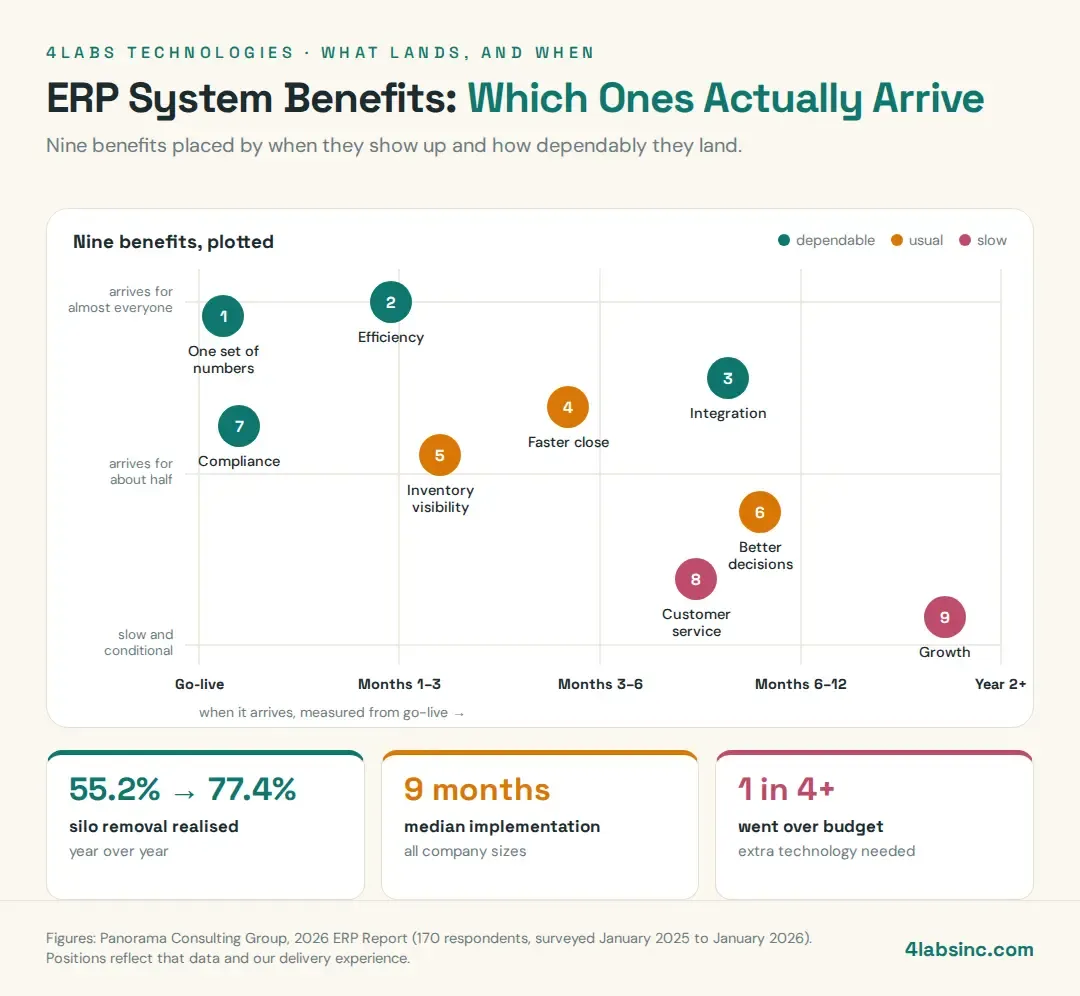
The chart above plots the same nine benefits against when they arrive and how dependably they land.
When each benefit shows up
Median implementation runs nine months. Everything below is measured from go-live, not from the day you sign.
| Window | What arrives | Why then |
|---|---|---|
| Go-live | One source of data, audit trails, live stock visibility | Properties of the system itself |
| Months 1 to 3 | Efficiency gains in order entry, invoice matching, stock counts | The manual steps stop existing |
| Months 3 to 6 | Faster month-end close, reliable standard reports | Needs one or two clean cycles first |
| Months 6 to 12 | Silo removal, better decisions, service improvements | Depends on habits changing, not only software |
| Year 2 onward | Growth benefits: new sites, entities, product lines | Only visible when you next expand |
Two things to take from this.
Do not promise the board a payback in month three. The benefits that arrive fastest are operational hours, not headline numbers. The financial case usually turns positive somewhere in the second half of year one, later if the project overran.
Watch for the dip. Productivity often drops for four to eight weeks after go-live while people learn the new system. It is normal, it is temporary, and companies that plan for it stop treating it as a failure. Our post on ERP implementation best practices covers how to shorten it.
Which benefits matter most: SMB or enterprise?
The nine benefits are the same. Which ones justify the project is not.
A 40-person distributor buys an ERP system to stop drowning in manual work. A 4,000-person manufacturer buys one to get a single answer out of eleven systems in six countries. Same software category, different reason, different order of value.
| Benefit | What it means for an SMB | What it means for an enterprise |
|---|---|---|
| One source of data | Ends the spreadsheet-versus-system argument | Ends the entity-versus-entity argument, and shortens consolidation |
| Efficiency | Usually the whole business case. Hours back for a small team | Real, but measured per process across thousands of transactions |
| Integration | Two or three systems stop being separate | Often the primary driver: dozens of systems, one model |
| Financial close | Close in days instead of weeks | Multi-entity, multi-currency consolidation without a project |
| Inventory | Frequently the fastest money back | Network-wide visibility across sites and channels |
| Better decisions | The owner sees margin by product for the first time | Governed reporting that regional teams cannot dispute |
| Compliance | Enough audit trail to satisfy an accountant | Segregation of duties, retention, regulator-ready evidence |
| Customer service | Everyone can answer any customer | Consistency across regions and support teams |
| Growth | Adding a second site without adding systems | Adding an acquired company onto an existing model |
ERP for small business is a real category now. For smaller companies, Odoo and similar all-in-one platforms usually make the arithmetic work, because the licence and implementation cost sit within reach of the efficiency gain. For large, multi-entity organisations the calculation runs through consolidation, governance and control, which is the ground our post on ERP for large enterprises covers.
One caution that applies to both. A company under about twenty people, running one product line from one location, often gets most of the benefit from good accounting software plus one integration. ERP earns its cost when the number of moving parts, not the number of people, becomes the problem.
What it costs, and what goes wrong
A benefits page that skips this part is advertising. Here is the other half.
More than a quarter of organisations went over budget. The leading cause in the research is additional technology needs — the integration nobody scoped, the module discovered mid-project, the extra environment. Not licence price rises. Scope that was always going to be needed and was not written down.
Almost a quarter went over schedule. The most common reason given is organisational issues: decisions waiting on people, process disputes surfacing late, key staff pulled onto other work. Again, not the software.
Median duration is nine months. Faster is possible for a single-site company on a cloud platform with standard processes. Longer is normal for multi-entity, multi-country, or heavy customisation.
The pattern is worth naming. Both overrun causes are decisions, not technology. That is good news, because decisions are the part you control. It is also why the section below matters more than the product comparison.
Three cost lines companies routinely forget:
- Data cleaning. Someone has to fix the customer records, the item master and the open balances. This is real work, and it happens before go-live or it happens painfully afterwards.
- Training time. Not the trainer's fee. The hours your own people spend learning while still doing their jobs.
- The post-go-live period. Budget for a hypercare window where things get fixed quickly. Skipping it converts small problems into permanent workarounds.
How to make the benefits actually materialise
The research says most benefits reach most companies that expect them. Here is what we see separating the projects that realise them from the ones that do not. These are our observations from delivery work, not survey findings.
1. Decide the process before you choose the software. Companies that map how they want to work, then select a system that fits, get their benefits. Companies that buy first and design later spend the project arguing. Our guide to selecting the right ERP system covers the comparison once the process question is settled.
2. Name a business owner, not an IT owner. The person accountable for the outcome should be the person whose numbers improve. IT runs the system; it cannot decide how finance should close the books.
3. Resist customisation. Every custom change buys a small convenience and costs you upgrade friction forever. Standard configuration wins in almost every case, and it is the difference between the second site being cheap and being another project.
4. Budget training as a line item. Adoption is where benefits live or die. A system nobody uses correctly produces worse data than the spreadsheets it replaced.
5. Measure a baseline before go-live. Record your close time, order cycle time, stock accuracy and error rates now. Without a baseline you cannot prove the benefit, and unproven benefits get argued away.
6. Keep a benefits register afterwards. List each expected benefit, its owner, its measure and its review date. This single habit turns diffuse operating-model gains into something you can actually check.
Not sure which of these you already meet? Send us your current setup and the three problems you want solved. We will tell you whether an ERP system is the answer, and what a realistic timeline looks like for a company your size.
How 4Labs Technologies approaches ERP
We start with your processes, not with a product name. What does an order do from the moment it arrives to the moment it is paid? Where does data get retyped? What breaks when volume doubles? The answers decide whether you need an ERP system at all, and which one fits if you do.
From there we handle selection, configuration, data migration, integration and training, through ERP software development and delivery across SAP, Odoo and Microsoft Dynamics. We keep customisation to what the business genuinely needs, because the second site is where that discipline pays.
What we do not do is quote a licence before we understand the operation. A benefits case built on somebody else's process is a guess.
Book an ERP readiness assessment. We map your processes, systems and data before anyone mentions a product, then give you a benefits case with numbers you can defend to a board — including the ones that argue against going ahead.
Frequently asked questions
What are the main benefits of implementing an ERP system, and what does enterprise resource planning software deliver?
One trusted set of data, efficiency gains from removing manual work, integration between departments, faster financial close, inventory visibility, better decisions, audit-ready compliance, consistent customer service, and easier growth. Efficiency is the benefit companies realise most reliably, and it arrives first.
How long before an ERP system pays for itself?
Operational gains usually show within the first quarter after go-live, but the financial case typically turns positive in the second half of year one. Projects that overrun take longer. Median implementation duration is nine months, so plan payback from go-live rather than from signing.
Do small businesses benefit from ERP, or is it only for enterprises?
Small businesses benefit, often more visibly, because efficiency gains land against a small team. Cloud platforms aimed at SMEs have made the cost workable. Below roughly twenty people with one product line and one location, good accounting software plus one integration often does the job.
What is the biggest risk in an ERP implementation?
Decisions, not technology. More than a quarter of projects go over budget, most often because of technology needs discovered mid-project. Almost a quarter go over schedule, most often because of organisational issues. Both trace back to process questions settled too late.
How long does an ERP implementation take?
Nine months is the median across company sizes. A single-site business on a cloud platform with standard processes can go faster. Multi-entity, multi-country or heavily customised programmes run longer, sometimes well beyond a year.
Does an ERP system replace accounting software and CRM?
It replaces accounting software in most cases, since finance is a core ERP module. CRM depends. Many ERP platforms include one that suits straightforward sales processes, while companies with sophisticated sales operations keep a specialist CRM and integrate it.
The benefits are real. The conditions are not optional.
The benefits of implementing an ERP system hold up under scrutiny. The published ERP system benefits are not marketing inventions. Most of them reach most of the companies that expect them. Efficiency lands first and lands hardest. Silo removal has improved sharply. Growth benefits are genuine and slow.
The same research says a quarter of projects overrun, for reasons that trace back to decisions rather than software. That is the real finding. Which product you buy matters far less than whether you settled the process, named an owner, kept customisation down and measured a baseline.
That is also why the benefits of ERP software depend more on your implementation than on your shortlist. Get those right and the list at the top of this page stops being marketing. It becomes a plan.