ERP Comparison FAQs
Which is better for a small business: SAP, Odoo or Microsoft Dynamics?
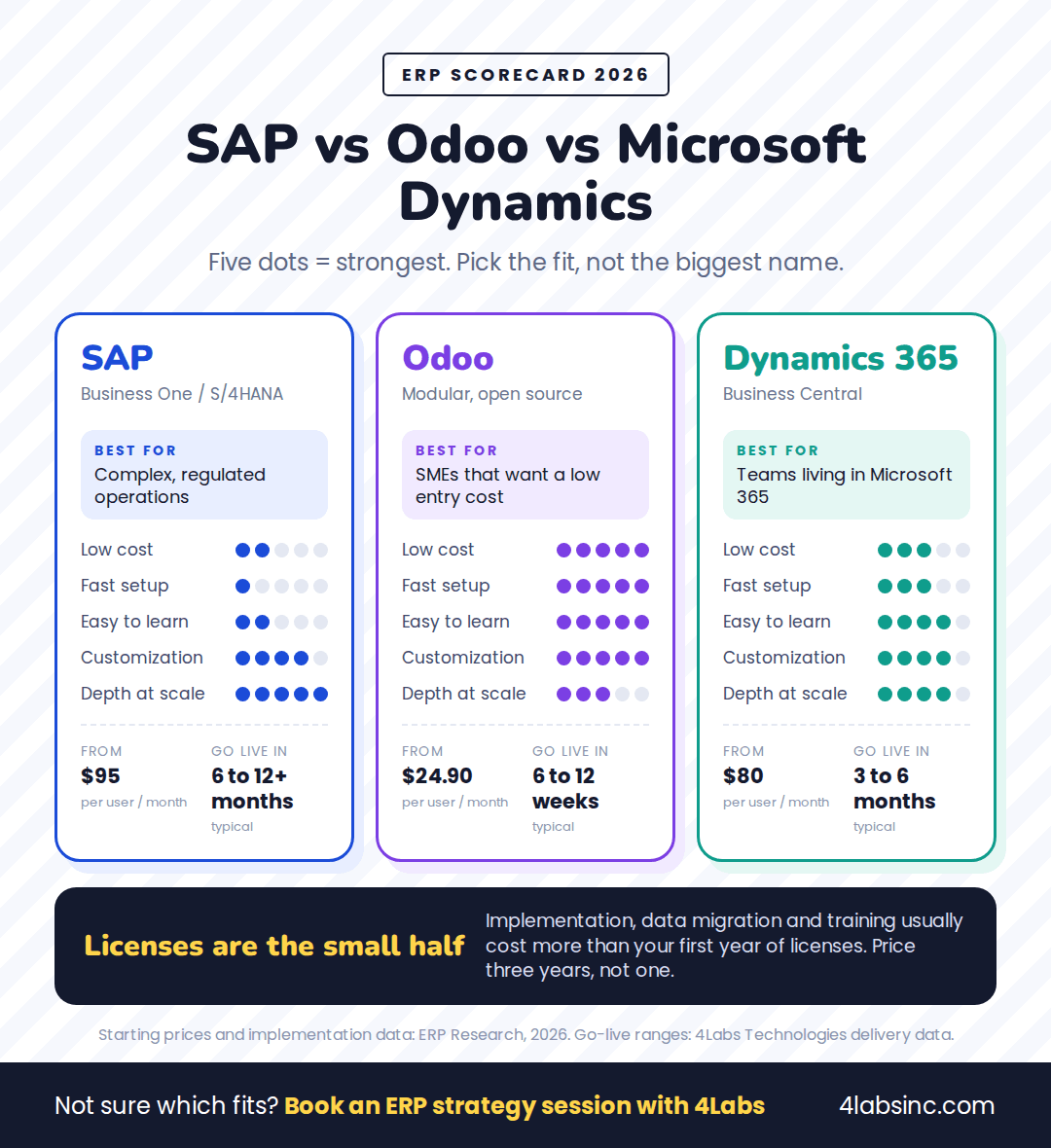
For most small businesses, Odoo fits best. It starts near $24.90 per user per month, goes live in 6 to 12 weeks and lets you add modules as you grow. Choose Business Central if your team lives in Microsoft 365, and SAP if compliance or manufacturing complexity is high.
How much does an ERP system cost per user?
ERP Research lists 2026 starting rates of $24.90 per user per month for Odoo and $80 for Microsoft Dynamics 365 Business Central. SAP Business One starts at $95, and SAP S/4HANA Public Cloud at $180. Implementation is charged separately and usually costs more than the first year of licenses.
Is Odoo powerful enough to replace SAP?
For many small and mid-sized companies, yes. Odoo covers finance, inventory, sales, purchasing, manufacturing and HR. SAP still leads on deep supply chains, multi-entity consolidation and heavy regulation. Match the tool to your complexity, not to the brand.
What is the difference between SAP Business One and SAP S/4HANA?
Business One is SAP's product for smaller companies, with lower cost and a shorter rollout. S/4HANA is the enterprise platform, built for large volumes, complex processes and multi-country operations. Business One suits growing firms; S/4HANA suits groups with serious scale.
Can Microsoft Dynamics 365 Business Central handle manufacturing?
Yes, for light to mid-level manufacturing: bills of materials, production orders and capacity planning. Complex shop-floor scheduling, quality management and deep traceability usually need SAP or a specialist add-on. Test your real production process during the demo.
When should a business build a custom ERP instead of buying one?
Build custom when your core process is your advantage, when standard demos need constant workarounds, or when per-user licensing punishes a large team. A hybrid setup, standard finance plus custom modules, often gives you control and speed together.
Pick the System You Can Run, Not the Biggest Name
SAP, Odoo and Microsoft Dynamics all work. The difference is fit: your complexity, your budget, your team and the tools you already use.
Answer the seven questions, price three years instead of one, and test each system against the processes that actually make you money. If nothing fits, build the parts that matter and buy the rest.
Not sure which way to go? Talk it through with our ERP team and leave with a clear recommendation. Book an ERP Strategy Session