Logo
Logo
ServicesIndustriesCase StudiesBlogsCareersLet's Connect
blue-white-icon
black-image
Logo
ServicesIndustriesCase StudiesBlogsCareersLet's Connect
burger-icon
hamburger
Microsoft Dynamics Cloud-Based ERP Solutions for Enhanced Business Agility
Blogs/Microsoft Dynamics ERP

Microsoft Dynamics: Cloud-Based ERP Solutions for Enhanced Business Agility

January 31, 2026
Share Now

Table of Contents

  1. 1. Microsoft Dynamics 365 Cloud ERP
  2. 2. Which Microsoft Dynamics
  3. 3. What business agility
  4. 4. The Microsoft ecosystem argument
  5. 5. The release cadence
  6. 6. Licensing, and the enforcement
  7. 7. What a Dynamics 365 implementation
  8. 8. When Microsoft Dynamics
  9. 9. Making the Dynamics decision
  10. 10. Frequently asked questions

Every page about Microsoft Dynamics 365 promises business agility. Almost none of them says what agility requires from you.
That gap matters, because the answer is not a feature. Agility in a cloud ERP system means one thing. Your organisation can absorb two platform releases a year without breaking. That is a capability you build, not something you switch on at go-live.
This page is written for an enterprise evaluator who has already read Microsoft's material and at least one partner brochure. It treats Microsoft Dynamics 365 as a cloud ERP system to be operated, not as a brochure claim. It covers four things those pages skip.
Which Dynamics product you actually need, because Business Central and Finance and Operations are different products and evaluations get this wrong regularly. What the release cadence demands in practice. What the Microsoft ecosystem argument is worth, and what it costs you in dependency. And the licence enforcement change that now has a date attached to it.
No prices, and no client percentage claims. Dynamics licensing varies by product, licence type, region and agreement, and improvement figures with no methodology behind them are not evidence.

Stay Ahead With 4Labs

Get expert insights, security briefings, and the latest innovations in your inbox.

  • Afghanistan+93
  • Albania+355
  • Algeria+213
  • Andorra+376
  • Angola+244
  • Antigua and Barbuda+1268
  • Argentina+54
  • Armenia+374
  • Aruba+297
  • Australia+61
  • Austria+43
  • Azerbaijan+994
  • Bahamas+1242
  • Bahrain+973
  • Bangladesh+880
  • Barbados+1246
  • Belarus+375
  • Belgium+32
  • Belize+501
  • Benin+229
  • Bhutan+975
  • Bolivia+591
  • Bosnia and Herzegovina+387
  • Botswana+267
  • Brazil+55
  • British Indian Ocean Territory+246
  • Brunei+673
  • Bulgaria+359
  • Burkina Faso+226
  • Burundi+257
  • Cambodia+855
  • Cameroon+237
  • Canada+1
  • Cape Verde+238
  • Caribbean Netherlands+599
  • Cayman Islands+1
  • Central African Republic+236
  • Chad+235
  • Chile+56
  • China+86
  • Colombia+57
  • Comoros+269
  • Congo+243
  • Congo+242
  • Costa Rica+506
  • Côte d'Ivoire+225
  • Croatia+385
  • Cuba+53
  • Curaçao+599
  • Cyprus+357
  • Czech Republic+420
  • Denmark+45
  • Djibouti+253
  • Dominica+1767
  • Dominican Republic+1
  • Ecuador+593
  • Egypt+20
  • El Salvador+503
  • Equatorial Guinea+240
  • Eritrea+291
  • Estonia+372
  • Ethiopia+251
  • Faroe Islands+298
  • Fiji+679
  • Finland+358
  • France+33
  • French Guiana+594
  • French Polynesia+689
  • Gabon+241
  • Gambia+220
  • Georgia+995
  • Germany+49
  • Ghana+233
  • Gibraltar+350
  • Greece+30
  • Greenland+299
  • Grenada+1473
  • Guadeloupe+590
  • Guam+1671
  • Guatemala+502
  • Guinea+224
  • Guinea-Bissau+245
  • Guyana+592
  • Haiti+509
  • Honduras+504
  • Hong Kong+852
  • Hungary+36
  • Iceland+354
  • India+91
  • Indonesia+62
  • Iran+98
  • Iraq+964
  • Ireland+353
  • Israel+972
  • Italy+39
  • Jamaica+1876
  • Japan+81
  • Jordan+962
  • Kazakhstan+7
  • Kenya+254
  • Kiribati+686
  • Kosovo+383
  • Kuwait+965
  • Kyrgyzstan+996
  • Laos+856
  • Latvia+371
  • Lebanon+961
  • Lesotho+266
  • Liberia+231
  • Libya+218
  • Liechtenstein+423
  • Lithuania+370
  • Luxembourg+352
  • Macau+853
  • Macedonia+389
  • Madagascar+261
  • Malawi+265
  • Malaysia+60
  • Maldives+960
  • Mali+223
  • Malta+356
  • Marshall Islands+692
  • Martinique+596
  • Mauritania+222
  • Mauritius+230
  • Mayotte+262
  • Mexico+52
  • Micronesia+691
  • Moldova+373
  • Monaco+377
  • Mongolia+976
  • Montenegro+382
  • Morocco+212
  • Mozambique+258
  • Myanmar+95
  • Namibia+264
  • Nauru+674
  • Nepal+977
  • Netherlands+31
  • New Caledonia+687
  • New Zealand+64
  • Nicaragua+505
  • Niger+227
  • Nigeria+234
  • North Korea+850
  • Norway+47
  • Oman+968
  • Pakistan+92
  • Palau+680
  • Palestine+970
  • Panama+507
  • Papua New Guinea+675
  • Paraguay+595
  • Peru+51
  • Philippines+63
  • Poland+48
  • Portugal+351
  • Puerto Rico+1
  • Qatar+974
  • Réunion+262
  • Romania+40
  • Russia+7
  • Rwanda+250
  • Saint Kitts and Nevis+1869
  • Saint Lucia+1758
  • Saint Pierre & Miquelon+508
  • Saint Vincent and the Grenadines+1784
  • Samoa+685
  • San Marino+378
  • São Tomé and Príncipe+239
  • Saudi Arabia+966
  • Senegal+221
  • Serbia+381
  • Seychelles+248
  • Sierra Leone+232
  • Singapore+65
  • Slovakia+421
  • Slovenia+386
  • Solomon Islands+677
  • Somalia+252
  • South Africa+27
  • South Korea+82
  • South Sudan+211
  • Spain+34
  • Sri Lanka+94
  • Sudan+249
  • Suriname+597
  • Swaziland+268
  • Sweden+46
  • Switzerland+41
  • Syria+963
  • Taiwan+886
  • Tajikistan+992
  • Tanzania+255
  • Thailand+66
  • Timor-Leste+670
  • Togo+228
  • Tonga+676
  • Trinidad and Tobago+1868
  • Tunisia+216
  • Turkey+90
  • Turkmenistan+993
  • Tuvalu+688
  • Uganda+256
  • Ukraine+380
  • United Arab Emirates+971
  • United Kingdom+44
  • United States+1
  • Uruguay+598
  • Uzbekistan+998
  • Vanuatu+678
  • Vatican City+39
  • Venezuela+58
  • Vietnam+84
  • Wallis & Futuna+681
  • Yemen+967
  • Zambia+260
  • Zimbabwe+263
Our Services
Digital Marketing
Staff Augmentation
IT Infrastructure
ERP Solutions
Software Development
Web & App Development
Industries
Cryptocurrency and Blockchain
Banking, Financial Services, and Insurance (BFSI)
Lending and FinTech
Oil and Gas
Energy and Utilities
Automotive and Manufacturing
Agriculture
Real Estate
E-commerce and Retail
Case Studies
Financial Services Test Automation
AI-Driven Customer Risk Profiling
Elevating Mobile Performance
Jewelry Client Transformation
AI Underwriting Revolution
Advanced Cybersecurity Solutions
Eyewear Retailer Transformation
Revolutionizing Manufacturing Operations
Offshore Development Excellence
Company

About Us

Careers

Let's Connect

Business Referral

Engagement Model

Partnership Programs

Resources

Blogs

footer1-iconfooter2-iconiso_iconiso_icon2

4labsicon

Copyright © 2026 4Labs Technologies. All Rights Reserved.

Privacy Policy

Terms & Conditions

Accessibility

fb-icon
twitter-icon
instagram-icon
linkedin-icon

Key takeaways
  • Dynamics 365 is a family of cloud ERP applications. The ERP decision is between Business Central and Finance and Operations, and the wrong choice costs more than the wrong platform.
  • Business agility here means absorbing two release waves a year without production surprises. That needs sandboxes, a regression suite and a standing test window.
  • The Microsoft ecosystem advantage is real when you already run Microsoft 365 and Azure. It also concentrates your ERP system, identity, data platform and cloud into one renewal conversation.
  • Microsoft is enforcing per-user licence assignment for Finance and Operations apps, with validation staged from 15 January 2026 against each customer's renewal date.
  • Customisations built as extensions survive upgrades. Anything built the old way becomes a cost every wave.

Which Microsoft Dynamics product you actually need

Dynamics 365 is a family of applications, not one product. The ERP decision is between Dynamics 365 Business Central and Dynamics 365 Finance and Operations, and they suit organisations of very different shapes.
Both are cloud ERP products and they are not interchangeable. Getting this wrong is expensive in both directions. A business that would have been live in five months on Business Central spends eighteen on Finance and Operations. A business that needed Finance and Operations outgrows Business Central in year two and pays for the move twice.
Four horizontal sliders.webp

Dynamics 365 Business Central

Built for small and mid-sized organisations. Faster to implement, lighter to run, and far more capable than enterprise buyers assume.
It handles financials, sales, purchasing, inventory, projects and light manufacturing well. For a single-country business with a handful of legal entities and steady transaction volumes, it is often the right answer even at a few hundred employees.
Where it runs out: complex multi-entity structures with heavy intercompany posting, multi-country tax and consolidation, very high transaction volumes, and deep production planning across sites.

Dynamics 365 Finance and Operations

The enterprise ERP system. Multi-company, multi-currency, multi-country, with deep manufacturing, supply chain and warehouse capability.
It does things Business Central cannot, and it asks for more in return: a longer ERP implementation, a heavier operating model, more environments to manage, and different licensing. The capability is real and so is the overhead.

How enterprises get this wrong

Two patterns, both common.
A partner leads with Business Central because it demos well and quotes low. The gap surfaces in month nine, when intercompany consolidation turns out to need workarounds nobody costed.
Or the organisation assumes that enterprise means Finance and Operations, buys the heavier product on reputation, and runs an eighteen-month programme for requirements the lighter product covered.

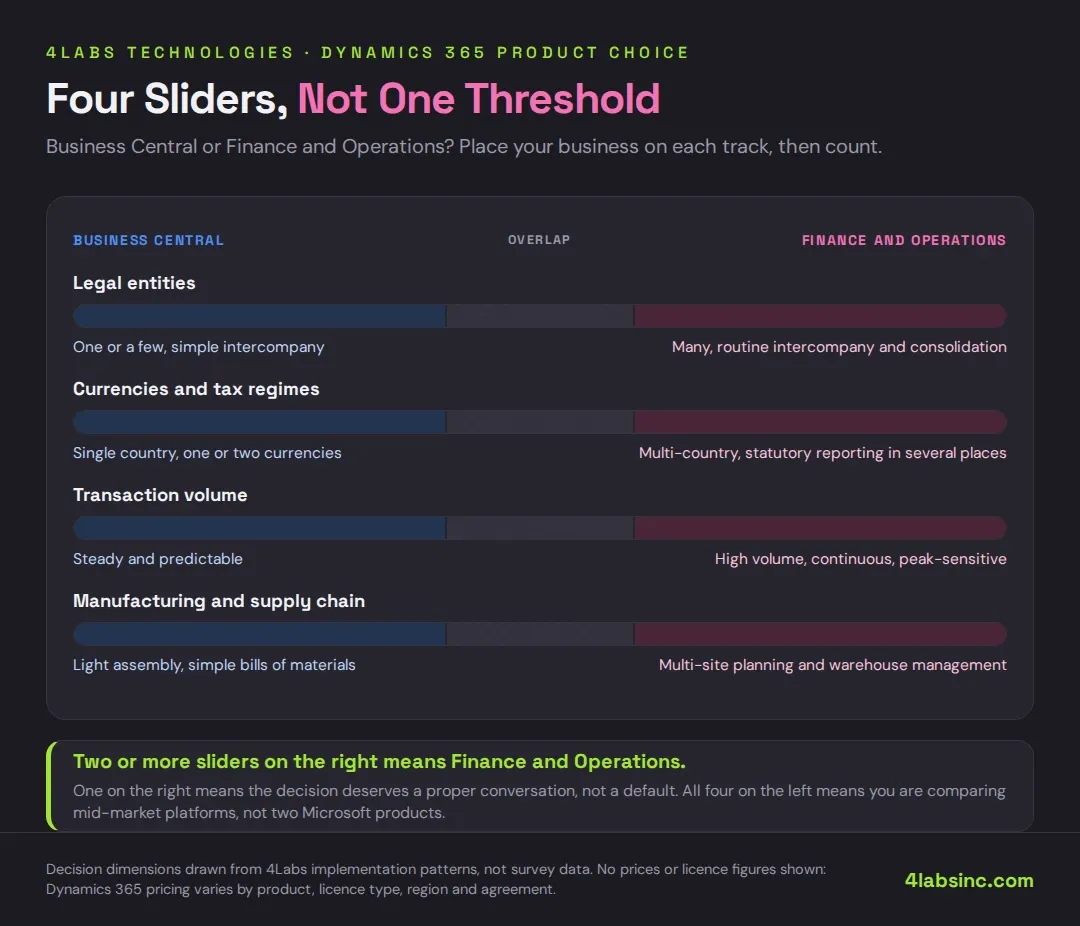
The four dimensions that decide it

It is not one threshold. Score your own business on each.

Dimension Business Central territory Finance and Operations territory
Legal entities One to a few, simple intercompany Many, with routine intercompany posting and consolidation
Currencies and tax regimes Single country, one or two currencies Multi-country, multi-regime, statutory reporting in several places
Transaction volume Steady, predictable High volume, continuous, peak-sensitive
Manufacturing and supply chain Light assembly, simple bills of materials Multi-site production planning, warehouse management, complex routing

Two or more rows sitting firmly on the right means Finance and Operations. One row means the decision deserves a proper conversation rather than a default.
If you land on the left of all four, the honest comparison is not between two Microsoft products at all. It is between Business Central and the other mid-market platforms, and our guide to Odoo for smaller organisations covers one of them.
Not sure which side you are on? Working through entity structure and volumes takes an hour and settles it, and it is worth doing before you see a demo rather than after.


What business agility actually means in a Dynamics deployment

Business agility here means you can absorb change twice a year without breaking. It is a capability you build, not a feature you buy. That distinction decides whether the cloud ERP system keeps improving or your team starts fighting it.
The phrase appears on every Microsoft Dynamics page in this category, vendor and partner alike. None of them unpack it. Here is what it is actually made of.

Two release waves a year, applied either way

Microsoft ships major feature updates on a published schedule. You get them. Some changes can be deferred briefly, and the direction of travel cannot.
That is genuinely better than the old model. Teams sat five versions behind on an on-premise ERP system and faced a migration project every six years. A cloud ERP system removes that, if you can keep up.

Extensions instead of the old overlay model

This is the most important technical point on the page.
In the older Dynamics AX world, customisation often meant changing the base application code. Upgrades then meant reconciling your changes against Microsoft's, which is why upgrades were projects.
The modern model keeps your code separate as extensions. Built properly, customisations survive release waves with little work. Built badly, or carried over from an older implementation, they become a recurring cost at every wave, forever.
When you review a proposal, ask which of the customisations are extensions and which are not. The answer tells you what the next five years cost.

Sandboxes and a regression suite that keeps pace

You need somewhere to see the next release before your users do. You also need tests covering the processes you cannot afford to break.
Not everything. The order-to-cash path, the month-end close, the integrations that move money, and whatever is specific to your business. If a release breaks one of those and nobody catches it before production, the organisation stops trusting updates it cannot actually decline.

Configuration over code, as a standing rule

Every line of custom code is a thing to retest twice a year. Configuration is not.
That makes "can we configure this instead?" a question worth asking on every requirement, and it makes the answer "no, but it would only be a small customisation" worth challenging.

The honest version

An organisation without a testing discipline does not get agility from Dynamics 365. It gets a stream of change it cannot absorb, and the eventual response is to resist updates, which is the position the cloud model was supposed to end.
Agility is available. It is bought with process, not with the licence.

The Microsoft ecosystem argument, and its flip side

If you already run Microsoft 365 and Azure, Dynamics 365 starts ahead on identity, integration and reporting. That advantage is real, and it is the strongest argument for the platform.

What genuinely integrates

Identity and access. Your existing directory governs who gets into the ERP system. One joiner-mover-leaver process instead of two, and conditional access policies apply to the ERP as they do to everything else. Security teams value this more than anything else on the list.
Teams. Records, approvals and conversations in the place people already work, rather than a separate portal nobody opens.
Power BI. Reporting across ERP data and the rest of the business without building an integration layer first.
Dataverse. A shared data layer between Dynamics applications and anything you build on Power Apps, which is what makes the next point possible.
Power Automate and Power Apps. The work around the edges of the ERP system — approvals, small internal tools, departmental workflows — built by people who are not developers. This is where a lot of the practical agility actually shows up.
**Copilot capabilities, **as they land. Treat these as improving rather than finished, and evaluate what exists today rather than what is announced.

The flip side nobody puts on a partner page

The same integration deepens a single-vendor dependency.
Work through what you end up with once Dynamics 365 joins the stack. Your ERP system, productivity suite, identity provider, data platform and reporting layer all come from one supplier. Often your cloud infrastructure too, on agreements that increasingly renew together.
That is a defensible position. Concentration buys real integration, simpler procurement and one support relationship. What it costs is leverage. When the agreement renews, you are negotiating everything at once, and the alternative to accepting the terms is a programme rather than a decision.
Make it a conscious choice rather than an accumulated one. And if your organisation deliberately keeps a second cloud or a non-Microsoft identity provider, say so during the evaluation, because it changes how much of the ecosystem argument applies to you.
At enterprise scale these questions compound. Our post on ERP at large-enterprise scale covers what changes when the organisation is big enough that platform decisions outlive the people who make them.

The release cadence is a commitment, not a benefit

Two Dynamics 365 feature releases a year means continuous change is something you have subscribed to. Vendor pages frame that as agility. It is only agility if you have built the capacity to handle it.

What it demands

A maintained sandbox. Not one somebody spun up during implementation and abandoned. An environment that gets refreshed, that carries representative data, and that shows you the next release before your users meet it.
A regression suite covering what matters. The processes where a silent failure costs real money. Order to cash. The month-end close. Any integration that moves money or stock. Whatever is unique to your business.
**Someone who reads the release plans. **Microsoft publishes what is coming ahead of each wave. That is a couple of hours of reading for one named person, and it converts surprises into decisions.
A standing window in the calendar. Validation time booked in advance, twice a year, before anyone asks what else that team could be doing.
None of this is heavy. It is a few days of work per wave, from people who have it in their objectives. What makes it fail is that nobody owns it.

What happens without it

A predictable sequence. A release lands. Something changes that nobody expected. A team discovers it in production, on a busy day. Confidence drops. The next wave gets treated as a threat rather than an update, and people start asking whether they can decline it.
They cannot, not really. Which is how an organisation ends up with a cloud ERP system it experiences as something being done to it.

Where the extension model pays

This is also where the earlier point about extensions earns its money.
Customisations built as extensions mostly survive a wave untouched. Anything built the old way, or carried across from an older Dynamics implementation without being rebuilt, needs attention every single time.
So the question to ask about any proposed customisation is not only what it costs to build. It is what it costs twice a year, for as long as you keep it.

Licensing, and the enforcement change to plan for

Microsoft is enforcing per-user licence assignment for Dynamics 365 Finance and Operations applications technically, rather than reconciling it at an audit. That changes who has to act, and when.
This is the section most partner pages have not caught up with, and it is the one worth reading twice if you already run Finance and Operations.

The licence types, in outline

No prices here, because they vary by product, agreement, region and negotiation, and Microsoft changes them. What is stable is the shape.
Full user licences are assigned by function. Somebody working in finance, supply chain or commerce needs the licence that covers the work they do.
Team member licences cover light use: reading data, entering time or expenses, approving within limits. Cheaper, and genuinely limited. Most over-licensing and under-licensing problems start with someone being given a team member licence for work that needs a full one.
Attach licences let a user who already holds one qualifying full licence take on additional workloads at a lower rate. This is where a careful review usually finds savings.
The practical point: licences follow security roles. If your role design has drifted, your licence position has drifted with it.

What is changing

Microsoft's own IT-professional post on simplifying licence management for Finance and Operations describes staged licence validation. Validation begins 15 January 2026 for customers whose contract renewal or anniversary falls after that date, and the rollout follows individual contract milestones rather than one global cutoff. Users without an appropriate licence assigned are prompted to request one from an administrator, and lose access until it is assigned.
MSDynamicsWorld reported the enforcement earlier, quoting Microsoft vice president Georg Glantschnig that from 30 August users would require an assigned licence to access the Finance and Operations applications.
Because the rollout is staged by contract anniversary, the accurate answer to "when does this affect us" is: check your own renewal date.

Why it matters more than it sounds

The old pattern was reconciliation after the fact. You ran slightly over, a true-up or an audit caught it, and you settled up. Uncomfortable, occasionally expensive, never disruptive.
The new pattern is different in kind. An under-licensed user does not generate an invoice. They lose access. If that happens to a warehouse team or an accounts payable clerk during month end, the problem is operational rather than commercial.

What to do before your renewal date

Four steps, and none of them take long.

  1. Pull the licence usage reporting in the Power Platform admin center, which shows usage against security roles.
  2. Map every active user to the licence their role actually requires.
  3. Remove permissions nobody needs. This is where the savings are, and it improves your security position at the same time.
  4. Assign the right licences before your renewal or anniversary date, rather than after somebody is locked out.
    Verify the current position against Microsoft's documentation before you act, because this area is moving.
    Want a second pair of eyes on the user and role audit? It is small and time-bound. Do it before your renewal date rather than after.

What a Dynamics 365 implementation actually involves

A Dynamics 365 implementation runs the same phases as any ERP implementation: process mapping, configuration, data migration, testing, training, go-live, then the first ninety days. Three things are specific to Dynamics and worth planning for early.
**Data migration into the entity model. **Dynamics has opinions about how data is structured, and your legacy system had different ones. Mapping customers, suppliers, products and open transactions into Dataverse and the application entities is where the schedule usually moves. Start it early, and clean the data before it moves rather than after.
**The extension-versus-configuration decision, made early and held. **Agree the rule at the start: configuration unless there is a reason, extensions when there is, and nothing that touches base code. Write it into the project's definition of done. If this decision is left to individual requirements as they arise, it drifts, and you inherit an upgrade cost nobody chose.
Environment strategy. How many sandboxes, what data they carry, who refreshes them and how often. This looks like an infrastructure detail during planning and turns out to be the thing that determines whether you can test a release wave two years later.
Everything else follows the standard sequence, and our post on ERP implementation best practices covers that in depth rather than repeating it here.
One addition specific to the cloud model. Budget for the first ninety days after go-live as part of the programme, not as a contingency. That window is where adoption is won, and on a platform that updates twice a year it is also where your team learns the rhythm they will live with.

When Microsoft Dynamics is not the right answer

Dynamics 365 suits a lot of enterprises. Four situations where the honest recommendation is something else.
You are not a Microsoft organisation. If your identity provider, productivity suite and cloud are not Microsoft, the ecosystem argument largely evaporates, and it is the strongest argument for the platform. Microsoft Dynamics still competes on its own merits as an ERP system. It just competes on a level field rather than a favourable one, and the evaluation should reflect that.
Your industry has requirements a specialist system already solves. In some sectors the real capability sits in an ISV solution layered on top, and the platform underneath matters less than the vendor of that layer. Evaluate the specialist product directly, on its own roadmap and support, rather than assuming the platform choice settles it.
You have no capacity to absorb two releases a year. A thinly staffed IT function with no testing discipline and no appetite to build one will not enjoy this platform. That is a legitimate constraint rather than a failure, and a slower-moving system may genuinely serve the business better than one that improves faster than the organisation can follow.
You would be live in half the time on a lighter product. If you scored left on all four dimensions in the first section, an enterprise-grade ERP implementation is buying capability you will not use, on a timeline you do not need.
If one of these describes you, the useful next step is a proper comparison rather than a deeper evaluation of one platform. Our guide to choosing between SAP, Odoo and Microsoft Dynamics covers that decision.
We would rather tell you this now than nine months into a programme.

Making the Dynamics decision

Four decisions carry the Microsoft Dynamics 365 choice. Score your entity structure, currencies, volume and manufacturing depth to pick between Business Central and Finance and Operations. Build the testing capacity the release cadence assumes. Decide consciously how much of your stack sits with one supplier. And get your licence position right before your own renewal date.
The platform is strong, and the Microsoft ecosystem argument is the real one. Business agility is available on Dynamics 365. It arrives with a sandbox, a regression suite and a named owner, not with the licence.

Talk to our ERP team
A first conversation covers three things. Which Dynamics 365 product fits your entity structure and volumes. What the release cadence will ask of your team. And where your licence position stands today.
If the answer is that Dynamics is the wrong platform for your organisation, we will say so. That is a cheaper conversation than month nine of an ERP implementation.
Talk to our ERP team

Frequently asked questions

What is the difference between Dynamics 365 Business Central and Finance and Operations?

Business Central is built for small and mid-sized organisations: faster to implement, lighter to run, capable across financials, sales, inventory and light manufacturing. Finance and Operations is the enterprise ERP system, built for many legal entities, multi-country tax and consolidation, high transaction volumes and deep manufacturing. Score your entity structure, currencies, volume and production complexity to decide.

Is Microsoft Dynamics 365 a true cloud ERP system?

Yes. Both applications run as cloud services, with feature updates on a published schedule. Customisations are built as extensions rather than changes to base code. On-premise options exist for specific cases, and they give up most of what makes the cloud model worth having.

How often does Dynamics 365 update, and can we skip a release?

Dynamics 365 ships major feature updates twice a year. Some changes can be deferred briefly, but the direction of travel cannot be declined. Plan for a maintained sandbox, a regression suite covering your critical processes, and a standing validation window twice a year.

What is changing with Dynamics 365 Finance and Operations licensing?

Microsoft is validating licence assignment technically rather than reconciling at audit. Its own guidance describes staged validation beginning 15 January 2026, rolled out against each customer's contract renewal or anniversary. Users without an assigned licence are prompted to request one and lose access until it is assigned. Check your renewal date and audit users against security roles before it.

Does Dynamics 365 work if we are not a Microsoft shop?

It works, and the strongest argument for it weakens. Much of the value comes from identity, Teams, Power BI and Dataverse integration with a stack you already run. Without that, Dynamics competes as an ERP system on equal terms with the alternatives, and your evaluation should treat it that way.

‹ PreviousNext ›