Logo
Logo
ServicesIndustriesCase StudiesBlogsCareersLet's Connect
blue-white-icon
black-image
Logo
ServicesIndustriesCase StudiesBlogsCareersLet's Connect
burger-icon
hamburger
SAP BTP Staff Augmentation: Which Roles to Hire, What to Check, and What to Put in the Contract
Blogs/SAP BTP Staff Augmentation: Which Roles to Hire, What to Check, and What to Put in the Contract

SAP BTP Staff Augmentation: Which Roles to Hire, What to Check, and What to Put in the Contract

December 17, 2025
Share Now

Table of Contents

  1. 1. What SAP BTP staff augmentation is, and what it is not
  2. 2. Why one BTP developer is not a thing
  3. 3. The SAP BTP roles worth augmenting, by what they actually touch
  4. 4. How to check an SAP BTP consultant is what the CV says
  5. 5. What to put in the SAP BTP statement of work
  6. 6. The first two weeks inside your subaccount
  7. 7. Getting SAP BTP staffed
  8. 8. Frequently asked questions

Every page about SAP BTP staff augmentation says the same three things. SAP talent for BTP is scarce, augmentation is faster than hiring, and their consultants are certified.

All three are true, and none of them helps you choose. You still have to decide which roles you need, how to hire SAP BTP consultants rather than CVs with the right words on them, and what the contract has to say.

This guide covers those three. It names BTP services rather than job titles, it explains what certified means and how to check it in a minute, and it prints the contract clauses that are specific to SAP BTP.

No rates appear here. A BTP day rate depends on the service, the seniority, the region and your own entitlements, and a number without those is a sales tool. How to compare vendors without rates is in the contract section.

Stay Ahead With 4Labs

Get expert insights, security briefings, and the latest innovations in your inbox.

  • Afghanistan+93
  • Albania+355
  • Algeria+213
  • Andorra+376
  • Angola+244
  • Antigua and Barbuda+1268
  • Argentina+54
  • Armenia+374
  • Aruba+297
  • Australia+61
  • Austria+43
  • Azerbaijan+994
  • Bahamas+1242
  • Bahrain+973
  • Bangladesh+880
  • Barbados+1246
  • Belarus+375
  • Belgium+32
  • Belize+501
  • Benin+229
  • Bhutan+975
  • Bolivia+591
  • Bosnia and Herzegovina+387
  • Botswana+267
  • Brazil+55
  • British Indian Ocean Territory+246
  • Brunei+673
  • Bulgaria+359
  • Burkina Faso+226
  • Burundi+257
  • Cambodia+855
  • Cameroon+237
  • Canada+1
  • Cape Verde+238
  • Caribbean Netherlands+599
  • Cayman Islands+1
  • Central African Republic+236
  • Chad+235
  • Chile+56
  • China+86
  • Colombia+57
  • Comoros+269
  • Congo+243
  • Congo+242
  • Costa Rica+506
  • Côte d'Ivoire+225
  • Croatia+385
  • Cuba+53
  • Curaçao+599
  • Cyprus+357
  • Czech Republic+420
  • Denmark+45
  • Djibouti+253
  • Dominica+1767
  • Dominican Republic+1
  • Ecuador+593
  • Egypt+20
  • El Salvador+503
  • Equatorial Guinea+240
  • Eritrea+291
  • Estonia+372
  • Ethiopia+251
  • Faroe Islands+298
  • Fiji+679
  • Finland+358
  • France+33
  • French Guiana+594
  • French Polynesia+689
  • Gabon+241
  • Gambia+220
  • Georgia+995
  • Germany+49
  • Ghana+233
  • Gibraltar+350
  • Greece+30
  • Greenland+299
  • Grenada+1473
  • Guadeloupe+590
  • Guam+1671
  • Guatemala+502
  • Guinea+224
  • Guinea-Bissau+245
  • Guyana+592
  • Haiti+509
  • Honduras+504
  • Hong Kong+852
  • Hungary+36
  • Iceland+354
  • India+91
  • Indonesia+62
  • Iran+98
  • Iraq+964
  • Ireland+353
  • Israel+972
  • Italy+39
  • Jamaica+1876
  • Japan+81
  • Jordan+962
  • Kazakhstan+7
  • Kenya+254
  • Kiribati+686
  • Kosovo+383
  • Kuwait+965
  • Kyrgyzstan+996
  • Laos+856
  • Latvia+371
  • Lebanon+961
  • Lesotho+266
  • Liberia+231
  • Libya+218
  • Liechtenstein+423
  • Lithuania+370
  • Luxembourg+352
  • Macau+853
  • Macedonia+389
  • Madagascar+261
  • Malawi+265
  • Malaysia+60
  • Maldives+960
  • Mali+223
  • Malta+356
  • Marshall Islands+692
  • Martinique+596
  • Mauritania+222
  • Mauritius+230
  • Mayotte+262
  • Mexico+52
  • Micronesia+691
  • Moldova+373
  • Monaco+377
  • Mongolia+976
  • Montenegro+382
  • Morocco+212
  • Mozambique+258
  • Myanmar+95
  • Namibia+264
  • Nauru+674
  • Nepal+977
  • Netherlands+31
  • New Caledonia+687
  • New Zealand+64
  • Nicaragua+505
  • Niger+227
  • Nigeria+234
  • North Korea+850
  • Norway+47
  • Oman+968
  • Pakistan+92
  • Palau+680
  • Palestine+970
  • Panama+507
  • Papua New Guinea+675
  • Paraguay+595
  • Peru+51
  • Philippines+63
  • Poland+48
  • Portugal+351
  • Puerto Rico+1
  • Qatar+974
  • Réunion+262
  • Romania+40
  • Russia+7
  • Rwanda+250
  • Saint Kitts and Nevis+1869
  • Saint Lucia+1758
  • Saint Pierre & Miquelon+508
  • Saint Vincent and the Grenadines+1784
  • Samoa+685
  • San Marino+378
  • São Tomé and Príncipe+239
  • Saudi Arabia+966
  • Senegal+221
  • Serbia+381
  • Seychelles+248
  • Sierra Leone+232
  • Singapore+65
  • Slovakia+421
  • Slovenia+386
  • Solomon Islands+677
  • Somalia+252
  • South Africa+27
  • South Korea+82
  • South Sudan+211
  • Spain+34
  • Sri Lanka+94
  • Sudan+249
  • Suriname+597
  • Swaziland+268
  • Sweden+46
  • Switzerland+41
  • Syria+963
  • Taiwan+886
  • Tajikistan+992
  • Tanzania+255
  • Thailand+66
  • Timor-Leste+670
  • Togo+228
  • Tonga+676
  • Trinidad and Tobago+1868
  • Tunisia+216
  • Turkey+90
  • Turkmenistan+993
  • Tuvalu+688
  • Uganda+256
  • Ukraine+380
  • United Arab Emirates+971
  • United Kingdom+44
  • United States+1
  • Uruguay+598
  • Uzbekistan+998
  • Vanuatu+678
  • Vatican City+39
  • Venezuela+58
  • Vietnam+84
  • Wallis & Futuna+681
  • Yemen+967
  • Zambia+260
  • Zimbabwe+263
Our Services
Digital Marketing
Staff Augmentation
IT Infrastructure
ERP Solutions
Software Development
Web & App Development
Industries
Cryptocurrency and Blockchain
Banking, Financial Services, and Insurance (BFSI)
Lending and FinTech
Oil and Gas
Energy and Utilities
Automotive and Manufacturing
Agriculture
Real Estate
E-commerce and Retail
Case Studies
Financial Services Test Automation
AI-Driven Customer Risk Profiling
Elevating Mobile Performance
Jewelry Client Transformation
AI Underwriting Revolution
Advanced Cybersecurity Solutions
Eyewear Retailer Transformation
Revolutionizing Manufacturing Operations
Offshore Development Excellence
Company

About Us

Careers

Let's Connect

Business Referral

Engagement Model

Partnership Programs

Resources

Blogs

footer1-iconfooter2-iconiso_iconiso_icon2

4labsicon

Copyright © 2026 4Labs Technologies. All Rights Reserved.

Privacy Policy

Terms & Conditions

Accessibility

fb-icon
twitter-icon
instagram-icon
linkedin-icon

What SAP BTP staff augmentation is, and what it is not

SAP BTP staff augmentation means external BTP specialists join your SAP team. They work in your subaccounts, through your transport path, under your security model and your governance. You keep the architecture, the entitlements and the decisions. The vendor keeps the employment relationship.

That is the whole model. Everything else is detail.

Who keeps the architecture and the entitlements

This matters more on SAP BTP than anywhere else, because entitlements are money. Your global account holds the budget, your subaccount holds the entitlements, and enabling a service spends from that budget.

So the rule is simple. Augmented SAP BTP developers build. Somebody on your payroll decides what gets enabled. Skip that line and you find out at the quarterly review.

Where it sits next to a fixed-price BTP implementation

The real alternative is not traditional hiring, whatever the comparison tables say. It is handing a BTP workstream to an implementation partner on a fixed price.

Both are valid. A fixed price suits a bounded build with a stable specification, such as one integration scenario with a signed design. SAP BTP staff augmentation suits work that will change while you do it, which describes most SAP extension and migration work. With augmentation you keep control and carry the delivery risk. With a fixed price you hand over both.

Our comparison of staff augmentation versus traditional hiring covers the third option in detail, and the table below sets the three side by side.
Keep the existing table here and add a third column. The live table compares hiring speed, cost, flexibility, access to niche BTP skills, scalability and best fit across staff augmentation and traditional hiring. Add a column for a fixed-price implementation partner, and a row for who carries the delivery risk.

Why one BTP developer is not a thing

SAP Business Technology Platform is not a product. It is a platform of loosely related services, and the skills behind them are as different as a plumber and an electrician.

An SAP Integration Suite consultant who has migrated PI/PO content cannot necessarily build a CAP application. A Fiori developer is not an Event Mesh engineer. Hiring one person called an SAP BTP developer and expecting all of it is the most common mistake in SAP BTP staff augmentation.
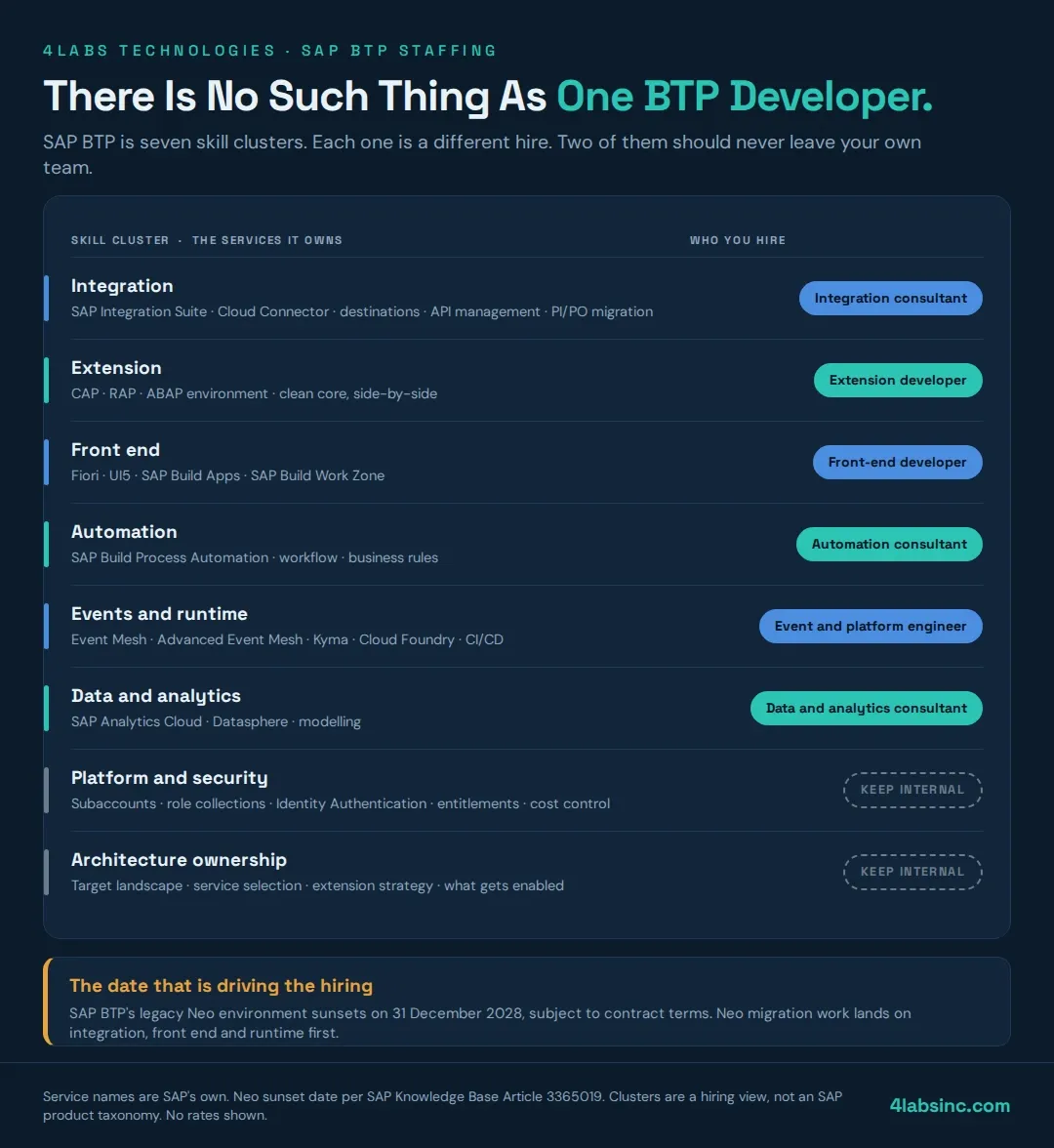
A map of SAP BTP.webp

The seven skill clusters inside BTP

Integration. SAP Integration Suite, Cloud Connector, destinations, API management, PI/PO migration.

Extension. CAP, RAP, the ABAP environment, and the clean core discipline that keeps your upgrades cheap.

Front end. Fiori, UI5, SAP Build Apps, SAP Build Work Zone.

Automation. SAP Build Process Automation, workflow, business rules.

Events and runtime. Event Mesh, Advanced Event Mesh, Kyma, Cloud Foundry, and the CI/CD around them.

Data and analytics. SAP Analytics Cloud, Datasphere, and the modelling work underneath.

Platform and security. Subaccount design, role collections, Identity Authentication, Identity Provisioning, entitlements and cost control.

Nobody is senior in all seven. Ask any vendor which two a candidate is genuinely strong in, and treat the third as learning.

What the Neo sunset put on your roadmap

SAP has published a date. The legacy Neo environment of SAP Business Technology Platform will sunset on 31 December 2028, subject to customer and partner contract terms, according to SAP's own knowledge base.

Everything still running on Neo has to move to the multi-cloud environment, which for most SAP teams means Cloud Foundry. Java applications need rebuilding against different runtimes and services. Portal sites need rebuilding in SAP Build Work Zone. Integration content needs reworking.

Two years sounds comfortable. It is not, because the work is not evenly spread. Every SAP customer with a Neo estate is doing this in the same window, and SAP talent that has done a Neo migration before is the SAP talent everyone else wants.

So the planning question is short. How much is still on Neo, what does it do, and who is going to move it. If the answer to the last part is nobody in particular, that is a staffing decision you are making by default.


The SAP BTP roles worth augmenting, by what they actually touch

Six roles carry most SAP BTP staff augmentation work. Each one is defined by the services it owns, because SAP BTP developer as a job title tells you nothing.

Integration consultant

SAP Integration Suite, Cloud Connector, destination configuration, API management, and PI/PO migration where you still have it. This is the most requested SAP BTP role and the one with the widest gap between people who have configured an iFlow and people who have run a migration.

Ask what they migrated from, how many interfaces, and what broke.

Extension developer

CAP, RAP, the ABAP environment, and side-by-side SAP extension patterns. This is where clean core lives. An extension developer who understands why you keep custom logic out of the core saves you money at every upgrade. One who does not will hand you the same problem your ECC system had before S/4HANA.

Ask them to explain side-by-side versus in-app extension, and when they would still choose in-app.

Front-end developer

Fiori, UI5, SAP Build Apps and SAP Build Work Zone. Three different tools with three different audiences: pro-code UI5, low-code Build Apps, and Work Zone for the launchpad experience. Our guide to SAP BTP data and analytics services covers the reporting layer these front ends usually sit over.

Ask which of the three they have shipped to production, not which they have seen.

Automation consultant

SAP Build Process Automation, workflow and business rules. Good ones think about the process before the tool, and they will ask who owns the exception path. Weak ones build the happy path and leave the rest to support.

Event and platform engineer

Event Mesh, Advanced Event Mesh, Kyma, Cloud Foundry, and the CI/CD pipeline that moves your work through the landscape. This role is invisible in every competing feature list and it is the one that decides whether your BTP estate is maintainable in year two.

Data and analytics consultant

SAP Analytics Cloud, Datasphere, and the modelling underneath. Often the role that is bought last and needed earliest, because the reporting question surfaces the moment the first extension goes live.

Two roles to keep internal

Architecture ownership and entitlement management. An augmented SAP BTP architect can design well, and somebody who stays has to be accountable for that design in year three. Entitlements are budget, and budget decisions belong to your team.

Saying this costs us two placements per engagement. It is still the right answer, and any vendor who tells you otherwise is selling headcount.

How to check an SAP BTP consultant is what the CV says

Three checks, none of which takes longer than a coffee.

Read the CV by service, not by job title

Ignore SAP BTP Developer at the top. Look for the service names: Integration Suite, CAP, RAP, Build Apps, Work Zone, Event Mesh, Kyma, SAP Analytics Cloud. Then look for what they did with each one, and for how long.

A CV that lists every BTP service in one bullet is telling you the person has seen a slide, not a subaccount.

What SAP certified means, and how to verify it

This is the phrase every vendor uses and almost nobody defines. SAP certifications are not permanent.
Under SAP's certification policy, a certification has to be revalidated every year. The holder gets a 90-day window before expiry to take a Stay Certified assessment, and passing it extends validity by 12 months. Miss the window and the certification expires. Without an SAP Learning Hub subscription, the full exam has to be taken again.

So certified is not a yes or no question. It is a date.

Before you hire SAP BTP consultants, ask for the exact certification name, the holder's SAP ID and the current validity date, then ask when the last Stay Certified assessment was passed. A vendor who staffs SAP work properly answers in a sentence. A vendor who uses certified as a marketing word will need to come back to you.

Three questions that separate experience from exposure

What did you do when a transport failed between subaccounts, and how did you find out?

How do you handle a destination that works in development and fails in production?

Which services did you enable on your last project, and who approved them?

The third one matters more than it looks. It tells you whether the person has ever worked inside somebody else's cost model, which is the thing that goes wrong quietly on SAP BTP. If you are still shortlisting vendors, our guide to how to choose the right staff augmentation company turns these checks into questions for the vendor rather than the candidate.

What to put in the SAP BTP statement of work

Eight clauses for an SAP BTP staff augmentation contract. Four are specific to SAP BTP and appear on no competing page.

Who may enable services, and who watches the consumption

SAP documents two commercial models for BTP. The consumption-based model comes in three flavours, SAP BTP Enterprise Agreement, Cloud Platform Enterprise Agreement, and Pay-As-You-Go for SAP BTP, and gives your organisation access to all eligible services, which you enable or disable during the term. The subscription model is the opposite: you subscribe to named services at a fixed cost. SAP also documents that you cannot mix more than one flavour of the consumption model in the same global account.

The staffing consequence is direct. Under a consumption model, an augmented developer who enables a service has spent your money, from a browser tab, in about four clicks.

So name it in the contract. Who may enable services. Who approves. Who reviews consumption, and how often. And the plain rule that no service goes live in production without that approval.

Subaccount, role collection and transport access

List the subaccounts the engineer works in, the role collections they hold, and the transport path they may use. Then write down what gets removed on the last day, because BTP access is spread across the cockpit, the identity provider and your own systems, and it is easy to leave a door open.

Clean core and SAP extension standards

State the standard rather than assuming it. Side-by-side by default, in-app only with written agreement, naming conventions, and the repository the code lives in. Clean core is not a preference, it is what decides your next S/4HANA upgrade cost, and a contractor with no standard will pick their own.

Handover: what counts as documentation on SAP BTP

Be specific, because BTP documentation is scattered by nature. Name what is owed: the integration flows and their configuration, the destinations and what they point at, the CAP or RAP services and their data model, the role collections, the enabled services and why, and the pipeline. Plus a recorded session with a named internal engineer receiving it.

The four clauses people miss anyway

Named people, not headcount, with seniority and allocation written down.

A ramp expectation in weeks, so a slow start is a conversation rather than an argument.

Substitution rules: no swapping a named engineer without your written approval.

Exit and transition: a paid overlap, a list of what returns, and who switches off access.

How you pay sits across these clauses, and our guide to staff augmentation engagement models sets out what hourly, monthly and dedicated models do to your flexibility and your invoice. The full nine-clause version, written for any technology, is in our guide to staff augmentation for digital transformation projects.
None of this is licensing or legal advice. Check your own agreement and take advice for your market.

The first two weeks inside your subaccount

SAP BTP engagements fail slowly and start badly, and the two are connected.

Day one access, and why it is slower on BTP than anywhere else

On most platforms, day-one access means an account and a repository. On SAP BTP it means an SAP user ID, an identity provider entry, role collections on each subaccount, Cloud Connector visibility, transport path permissions and sometimes an S-user request that takes days.

Start it before the contract is signed, not after. Nothing burns a first week faster, and you are paying for that week.

The first deliverable that proves the hire

Give them one real thing in week one. A small iFlow, a working destination, one CAP entity exposed and tested. Small enough to finish, real enough to touch your landscape.

You learn three things from it: whether they ask the right questions, whether they respect your standards, and whether your access actually works. Expect two slow weeks and a normal week four. If week four still looks like week one, the problem is usually your context rather than their skill, and it is cheap to fix while it is small.

Case study slot — not for publication yet

The Recommended Action is a niche SAP BTP staffing piece. I have shipped the guide without a client story rather than invent one, and held the slot open here. It goes after the first-two-weeks H2 and before the CTA, sized for 250 to 350 words, under an H2 such as What an SAP BTP engagement looks like in practice.
To write it as an anonymised engagement pattern, send me six sentences: sector, which BTP services the work touched, the roles and mix placed, engagement length, how long access and ramp actually took, and what the handover produced. No client name, no invented percentages, labelled as a typical engagement.
A real named case study is a separate page with its own URL, linked from this guide's CTA and from the roles section. Nothing in the published body changes either way.

Getting SAP BTP staffed

Two staff augmentation conversations, depending on where you are.

Still scoping. Tell us which BTP services the work touches, what is still on Neo, whether it runs beside an S/4HANA programme, and when the phase has to land. We will tell you which of the six roles you need, which should stay internal including your SAP BTP architect, and what the statement of work should say about enablement and clean core. If you need two people rather than five, we will say so.

Already running and slipping. The usual version: the SAP Integration Suite flow works in development, the transport fails, the consumption is higher than the plan and nobody can explain what is enabled. All three are fixable, and none means the BTP decision was wrong.

Our staff augmentation services cover both: scoping the roles, helping you hire SAP BTP consultants, and running the review structure that keeps the work honest. For the S/4HANA and wider ERP work that sits beside BTP, our ERP software development services and our guide to ERP implementation best practices cover the wider programme. Location matters for SAP work because of transport windows and cutover weekends, and our guide to offshore and nearshore staff augmentation models works through the overlap question.

No obligation and no pitch deck.

Frequently asked questions

What is SAP BTP staff augmentation?

It is bringing external SAP BTP specialists into your own SAP team for defined work. They build inside your subaccounts, through your transport path and under your security model, while the vendor holds the employment relationship. You keep the architecture, the entitlements and the delivery risk, which is what separates SAP BTP staff augmentation from a fixed-price implementation.

Which SAP BTP roles can be augmented?

Six cover most programmes: integration consultant for SAP Integration Suite and PI/PO migration, extension developer for CAP, RAP and the ABAP environment, front-end developer for Fiori, UI5 and SAP Build, automation consultant for SAP Build Process Automation, event and platform engineer for Event Mesh, Kyma and Cloud Foundry, and data and analytics consultant for SAP Analytics Cloud and Datasphere. Keep your SAP BTP architect and entitlement management internal.

How do I verify an SAP BTP consultant's certification?

Ask for the exact certification name, the holder's SAP ID and the current validity date, then ask when the last Stay Certified assessment was passed. SAP certifications expire: a holder has a 90-day window before expiry to take the annual assessment, which extends validity by 12 months, and without an SAP Learning Hub subscription the full exam must be retaken. Certified is a date, not a badge.

How much does SAP BTP staff augmentation cost?

It depends on the service, the seniority, the region and the engagement model, and any figure quoted without those four is marketing. What you can compare is structure: which named people, what ramp expectation, what notice period, who may enable services, and what the exit costs. Ask two vendors those five questions and the cheaper quote often stops being cheaper.

Can augmented BTP consultants work inside our SAP landscape and security model?

Yes, and the contract has to say how. Name the subaccounts, the role collections and the transport path, use named accounts through your identity provider, keep access least privilege, and write the offboarding steps down at the start. BTP access is spread across the cockpit, the identity provider and your own systems, so removal needs a list rather than a memory.

What does the SAP BTP Neo sunset mean for our staffing plan?

SAP has stated that the legacy Neo environment sunsets on 31 December 2028, subject to contract terms. Anything still on Neo has to move to the multi-cloud environment, usually Cloud Foundry, which means rebuilding Java applications, portal sites and integration content. Every SAP customer with a Neo estate is doing this in the same window, so the people who have done one are in demand. Count what is left on Neo now and plan the hands for it.

‹ PreviousNext ›