Logo
Logo
ServicesIndustriesCase StudiesBlogsCareersLet's Connect
blue-white-icon
black-image
Logo
ServicesIndustriesCase StudiesBlogsCareersLet's Connect
burger-icon
hamburger
Cloud Engineers on Demand: Which Roles to Hire, What to Check, and Who Holds the Keys
Blogs/Cloud Engineers on Demand: Which Roles to Hire, What to Check, and Who Holds the Keys

Cloud Engineers on Demand: Which Roles to Hire, What to Check, and Who Holds the Keys

December 17, 2025
Share Now

Table of Contents

  1. 1. What cloud engineers on demand actually means
  2. 2. Why enterprises buy cloud engineers on demand
  3. 3. The six cloud roles worth hiring on demand
  4. 4. How to check a cloud engineer is what the CV says
  5. 5. Access: what to grant, and how to take it back
  6. 6. What changes in January 2027
  7. 7. Getting cloud engineers on demand
  8. 8. Frequently asked questions

Search for cloud engineers on demand and every page says the same thing. Cloud talent is scarce, hiring takes months, our engineers are certified, here is a form.
None of that helps you hire cloud engineers. You still have to pick which roles you need, work out whether a certification on a CV still means anything, and decide what an outside engineer may touch in your production account.
This guide covers those three, from a cloud staff augmentation buyer's point of view. It names six roles by the work they own, it explains what certified means on AWS and on Azure, and it sets out the access model that keeps your auditors calm.
No rates appear here. Several pages on this query publish an hourly figure with no scope attached, which tells you nothing about what you will spend. What moves your number when you hire cloud engineers is in the roles section and the contract lines near the end.

Stay Ahead With 4Labs

Get expert insights, security briefings, and the latest innovations in your inbox.

  • Afghanistan+93
  • Albania+355
  • Algeria+213
  • Andorra+376
  • Angola+244
  • Antigua and Barbuda+1268
  • Argentina+54
  • Armenia+374
  • Aruba+297
  • Australia+61
  • Austria+43
  • Azerbaijan+994
  • Bahamas+1242
  • Bahrain+973
  • Bangladesh+880
  • Barbados+1246
  • Belarus+375
  • Belgium+32
  • Belize+501
  • Benin+229
  • Bhutan+975
  • Bolivia+591
  • Bosnia and Herzegovina+387
  • Botswana+267
  • Brazil+55
  • British Indian Ocean Territory+246
  • Brunei+673
  • Bulgaria+359
  • Burkina Faso+226
  • Burundi+257
  • Cambodia+855
  • Cameroon+237
  • Canada+1
  • Cape Verde+238
  • Caribbean Netherlands+599
  • Cayman Islands+1
  • Central African Republic+236
  • Chad+235
  • Chile+56
  • China+86
  • Colombia+57
  • Comoros+269
  • Congo+243
  • Congo+242
  • Costa Rica+506
  • Côte d'Ivoire+225
  • Croatia+385
  • Cuba+53
  • Curaçao+599
  • Cyprus+357
  • Czech Republic+420
  • Denmark+45
  • Djibouti+253
  • Dominica+1767
  • Dominican Republic+1
  • Ecuador+593
  • Egypt+20
  • El Salvador+503
  • Equatorial Guinea+240
  • Eritrea+291
  • Estonia+372
  • Ethiopia+251
  • Faroe Islands+298
  • Fiji+679
  • Finland+358
  • France+33
  • French Guiana+594
  • French Polynesia+689
  • Gabon+241
  • Gambia+220
  • Georgia+995
  • Germany+49
  • Ghana+233
  • Gibraltar+350
  • Greece+30
  • Greenland+299
  • Grenada+1473
  • Guadeloupe+590
  • Guam+1671
  • Guatemala+502
  • Guinea+224
  • Guinea-Bissau+245
  • Guyana+592
  • Haiti+509
  • Honduras+504
  • Hong Kong+852
  • Hungary+36
  • Iceland+354
  • India+91
  • Indonesia+62
  • Iran+98
  • Iraq+964
  • Ireland+353
  • Israel+972
  • Italy+39
  • Jamaica+1876
  • Japan+81
  • Jordan+962
  • Kazakhstan+7
  • Kenya+254
  • Kiribati+686
  • Kosovo+383
  • Kuwait+965
  • Kyrgyzstan+996
  • Laos+856
  • Latvia+371
  • Lebanon+961
  • Lesotho+266
  • Liberia+231
  • Libya+218
  • Liechtenstein+423
  • Lithuania+370
  • Luxembourg+352
  • Macau+853
  • Macedonia+389
  • Madagascar+261
  • Malawi+265
  • Malaysia+60
  • Maldives+960
  • Mali+223
  • Malta+356
  • Marshall Islands+692
  • Martinique+596
  • Mauritania+222
  • Mauritius+230
  • Mayotte+262
  • Mexico+52
  • Micronesia+691
  • Moldova+373
  • Monaco+377
  • Mongolia+976
  • Montenegro+382
  • Morocco+212
  • Mozambique+258
  • Myanmar+95
  • Namibia+264
  • Nauru+674
  • Nepal+977
  • Netherlands+31
  • New Caledonia+687
  • New Zealand+64
  • Nicaragua+505
  • Niger+227
  • Nigeria+234
  • North Korea+850
  • Norway+47
  • Oman+968
  • Pakistan+92
  • Palau+680
  • Palestine+970
  • Panama+507
  • Papua New Guinea+675
  • Paraguay+595
  • Peru+51
  • Philippines+63
  • Poland+48
  • Portugal+351
  • Puerto Rico+1
  • Qatar+974
  • Réunion+262
  • Romania+40
  • Russia+7
  • Rwanda+250
  • Saint Kitts and Nevis+1869
  • Saint Lucia+1758
  • Saint Pierre & Miquelon+508
  • Saint Vincent and the Grenadines+1784
  • Samoa+685
  • San Marino+378
  • São Tomé and Príncipe+239
  • Saudi Arabia+966
  • Senegal+221
  • Serbia+381
  • Seychelles+248
  • Sierra Leone+232
  • Singapore+65
  • Slovakia+421
  • Slovenia+386
  • Solomon Islands+677
  • Somalia+252
  • South Africa+27
  • South Korea+82
  • South Sudan+211
  • Spain+34
  • Sri Lanka+94
  • Sudan+249
  • Suriname+597
  • Swaziland+268
  • Sweden+46
  • Switzerland+41
  • Syria+963
  • Taiwan+886
  • Tajikistan+992
  • Tanzania+255
  • Thailand+66
  • Timor-Leste+670
  • Togo+228
  • Tonga+676
  • Trinidad and Tobago+1868
  • Tunisia+216
  • Turkey+90
  • Turkmenistan+993
  • Tuvalu+688
  • Uganda+256
  • Ukraine+380
  • United Arab Emirates+971
  • United Kingdom+44
  • United States+1
  • Uruguay+598
  • Uzbekistan+998
  • Vanuatu+678
  • Vatican City+39
  • Venezuela+58
  • Vietnam+84
  • Wallis & Futuna+681
  • Yemen+967
  • Zambia+260
  • Zimbabwe+263
Our Services
Digital Marketing
Staff Augmentation
IT Infrastructure
ERP Solutions
Software Development
Web & App Development
Industries
Cryptocurrency and Blockchain
Banking, Financial Services, and Insurance (BFSI)
Lending and FinTech
Oil and Gas
Energy and Utilities
Automotive and Manufacturing
Agriculture
Real Estate
E-commerce and Retail
Case Studies
Financial Services Test Automation
AI-Driven Customer Risk Profiling
Elevating Mobile Performance
Jewelry Client Transformation
AI Underwriting Revolution
Advanced Cybersecurity Solutions
Eyewear Retailer Transformation
Revolutionizing Manufacturing Operations
Offshore Development Excellence
Company

About Us

Careers

Let's Connect

Business Referral

Engagement Model

Partnership Programs

Resources

Blogs

footer1-iconfooter2-iconiso_iconiso_icon2

4labsicon

Copyright © 2026 4Labs Technologies. All Rights Reserved.

Privacy Policy

Terms & Conditions

Accessibility

fb-icon
twitter-icon
instagram-icon
linkedin-icon

What cloud engineers on demand actually means

Cloud engineers on demand means experienced engineers join your team for defined work. They work inside your accounts, your pipelines, your change process and often your on-call rota. You keep the architecture, the billing account and the IAM roles.
That last sentence is the one every competing page skips, and it is the one your security team will ask about first.

You keep the accounts, the billing and the IAM

Three things stay on your side, whatever the engagement looks like.

The cloud accounts themselves, in your organisation, under your payer account. The billing relationship with AWS, Azure or Google Cloud. And the IAM roles that decide who can do what.

Augmented cloud engineers work inside all three. They do not own any of them.

Where it sits next to a managed cloud service

The real choice for an enterprise is not on demand against full-time hiring. It is on demand against handing the platform to a managed service provider.

A managed service gives you an outcome and a support contract. You stop running the platform, and you stop learning from it. Cloud staff augmentation gives you engineers inside your own team, so the knowledge stays with your people and you keep day to day control. You carry more management load in exchange.

Our comparison of staff augmentation versus managed services works through where the handover points sit, and the table below sets the three models side by side.

Keep the existing table and add a third column. The live table compares hiring speed, cost, flexibility, skills access and scalability across on-demand engineers and full-time hiring. Add a managed service column, and a row for who holds the accounts and the IAM.

Why enterprises buy cloud engineers on demand

Two honest reasons, and neither of them is the talent shortage line.

Cloud work arrives in bursts, hiring does not

A cloud migration has a shape and an end. So does a cost programme, a DevOps and Kubernetes rebuild, or a security remediation after an audit. Each needs you to hire cloud engineers for three to six months, then scale back to two.

A permanent hire does not match that shape. By the time a senior cloud architect has been found, served notice and ramped, the phase they were hired for has finished or slipped. That is why cloud engineers on demand exist, and it is a timing argument rather than a cost one.

What the 2026 cloud cost numbers actually say

Cloud cost is the part every page lists as a benefit and nobody staffs, so here are the figures.

Flexera's 2026 State of the Cloud Report, published on 18 March 2026 from a survey of more than 750 cloud decision-makers, puts self-estimated wasted cloud spend at 29 percent. The report notes this as the first rise in five years. It also finds 85 percent of organisations naming cloud spend management as a challenge, 63 percent with an established FinOps team, and more than three quarters of large enterprises spending over five million dollars a month on cloud.

Put those together. At five million a month, a 29 percent waste estimate is over a million dollars a month of spend nobody has claimed. That is the business case for hiring a cost engineer, and you can check the number yourself rather than taking it from a vendor deck.

If you are still building the internal case for the move itself, our guide to what moving to the cloud gives you covers the argument before the staffing question arrives.

The six cloud roles worth hiring on demand

Six roles carry most enterprise cloud staff augmentation work. Each is defined by what it owns, because cloud engineer as a job title covers six different jobs.

Cloud architect

Landing zones, account structure, network design, the target state. This is the person who decides what good looks like before anyone builds it. Our guide to building a scalable IT infrastructure covers the measure-first approach this role should bring.
Ask what account structure they last designed and why they split it the way they did.

Migration engineer

The cloud migration itself, and everything it breaks. Database migrations, cutover plans, rollback plans, the application changes nobody scoped. This is a distinct skill from architecture and it is the most commonly underestimated hire on any cloud migration.
Ask about the last cutover that went wrong and what they did at two in the morning.

DevOps and platform engineer

Pipelines, infrastructure as code, golden paths, the self-service platform your teams build on. Terraform, CI/CD, and the boring discipline of making the same thing happen the same way every time.
Ask how they structure Terraform state, and listen for whether they have run it at scale or only written it.

Site reliability engineer

On-call, incident response, error budgets, the monitoring that tells you something is wrong before your customers do. If you have a 24/7 platform and a two-person site reliability rota, this hire is the one that stops people resigning.
Ask what their last three incidents were and what changed afterwards.

Cloud security engineer

IAM design, boundaries, key management, and the evidence your auditors ask for. Not a compliance form filler. Somebody who can say why a role has the permissions it has. Our notes on securing the applications customers touch cover the controls this role implements.
Ask how they would give a contractor production access safely, which is a question this page answers below.

FinOps or cost engineer

The role every competing page lists as a benefit and nobody staffs. Tagging, rightsizing, commitment coverage, waste reporting, and the weekly habit of looking at what changed.
This is the role the 29 percent number pays for. Ask what they cut, by how much, and what broke when they cut it.

The two roles to keep internal

Architecture ownership and the billing account. An augmented cloud architect can design well, and somebody who stays has to own that design in year three. The billing account is a financial relationship, not a technical one.
Saying this costs us two placements per engagement. It is still the right answer.

How to check a cloud engineer is what the CV says

Three checks, none of which takes longer than a coffee.

Read the CV by what they ran, not by the logo

AWS, Azure and Google Cloud on a CV tells you nothing. Look for scale and responsibility: how many accounts, how many workloads, whether they were on call for it, and what the biggest incident was.

Someone who has run a platform talks about failure without prompting. Someone who has only built one talks about features.

What AWS certified and Azure certified actually mean

Every vendor says certified cloud engineers. Almost nobody defines it, and the two big providers use different calendars.

Microsoft states that role-based and specialty certifications are renewed through a free, unproctored online assessment on Microsoft Learn, taken during a six-month window before expiry, with unlimited attempts, and passing extends the certification one year from the expiry date. Fundamentals certifications do not expire.

AWS states that its certifications are valid for three years. Recertification means either passing the current exam version, which extends three years, or completing maintenance activities on AWS Skill Builder within 90 days of expiry, which extends one year.

So an Azure certification means the holder was reassessed within the last twelve months. An AWS certification can be up to three years old. Neither is better. They are different claims, and knowing the difference is the point.

Ask for the certification name, the holder's ID and the expiry date. A supplier who staffs cloud work properly answers in one message.

Three questions that separate operators from builders

What did your last on-call week look like, and what woke you up?

How do you decide what to tag, and who enforces it?

What is in your account when you leave, and how does it get removed?

The third question is the one that matters most for augmentation, and it leads straight into the next section.

Access: what to grant, and how to take it back

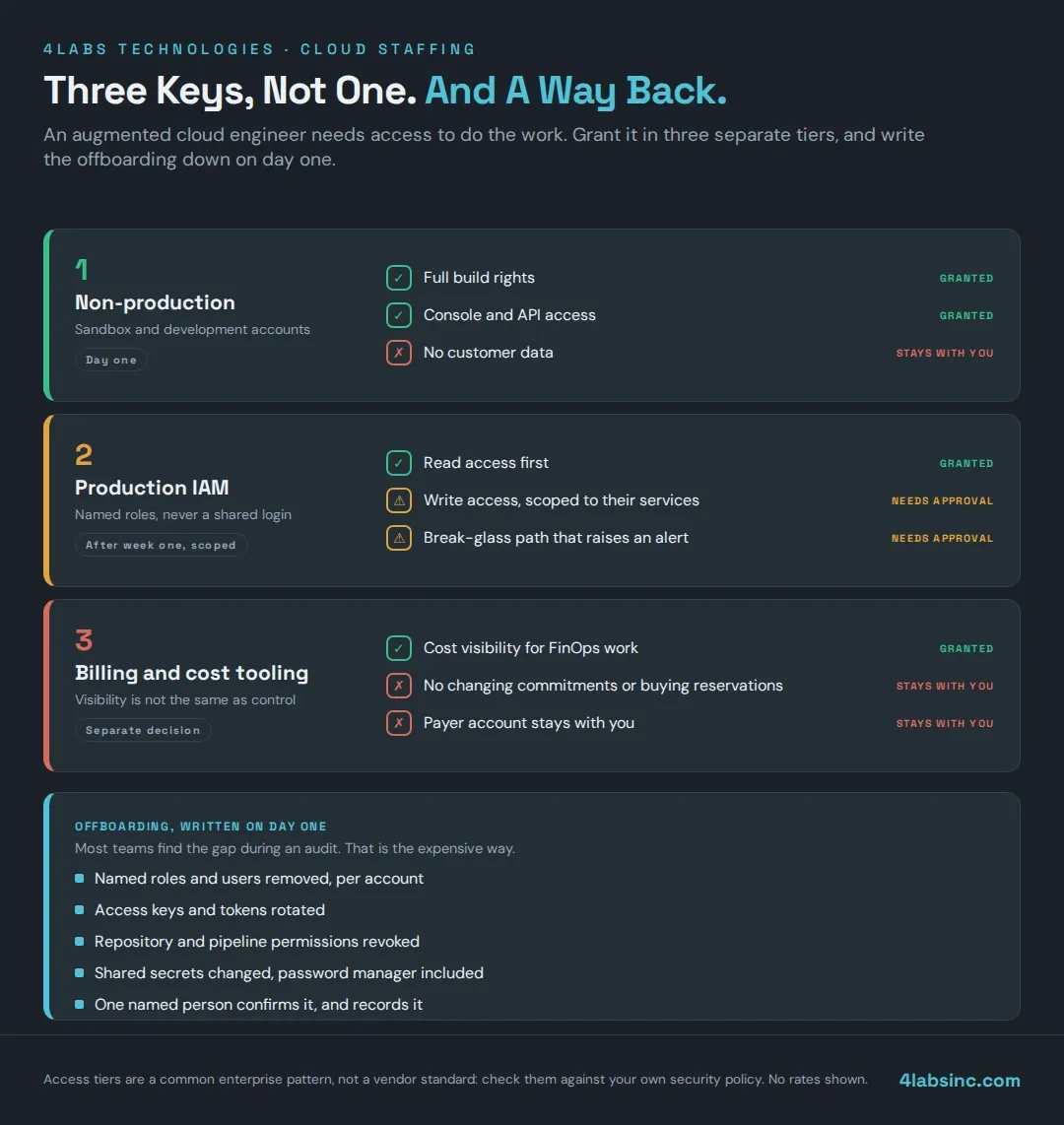
An augmented cloud engineer with unrestricted production access is a cloud security problem as much as a staffing decision, and it becomes an audit finding. Split it into three grants and the problem goes away.
Three access tiers.webp

Three grants people treat as one

Console and API access to non-production

Sandbox and development accounts, full build rights, no customer data. Most cloud engineers on demand can work here from day one, and most of the first two weeks happens here.

Production IAM

Read access first. Write access scoped to the services they own, through a named role rather than a shared login, with a break-glass path that raises an alert when it is used. Time-bound where your tooling supports it.

Billing and cloud cost tooling

A separate decision again. A FinOps engineer needs cost visibility, and visibility is not the same as the ability to change commitments or buy reservations.
Grant them in that order, and never grant the third because you granted the first.

The offboarding list nobody writes on day one

Write this at the start of the engagement, because nobody writes it on the last day.

Which named roles and users get removed, in which accounts.

Which access keys and tokens get rotated.

Which repository and pipeline permissions get revoked.

Which shared secrets get changed, including anything in a password manager.

Who confirms it is done, and where that confirmation is recorded.

Most organisations find their offboarding gap during an audit, which is the expensive way to find it. The full contract checklist, written for any technology, is in our guide to staff augmentation for digital transformation projects.

What changes in January 2027, and why it is a staffing question

This section is on no competing page, and it carries a date about fifteen weeks out.
Article 29 of the EU Data Act states that from 12 January 2027, providers of data processing services shall not impose any switching charges on the customer for the switching process. Between 11 January 2024 and that date, providers may impose reduced charges, capped at the costs directly linked to the switching process.

Read as a technical brief rather than a legal one, that puts four things in your backlog.

An exit plan that exists as a document, naming what moves, in what order, and how long it takes.

A data extraction path that has been tested, not assumed, including the large datasets everybody forgets.

Infrastructure as code that is genuinely portable, which usually means knowing precisely where you depend on one provider and having decided that on purpose.

Contract terms that match the new position, which is a conversation for your legal team rather than this page.

None of that is free, and all of it is engineering work. If you are in the EU, this is the clearest new source of cloud engineering demand between now and next spring. If you are not, the same four items are what you will want the first time your provider changes its pricing, so the deadline gives you a reason to do work that was always sensible. Our comparison of cloud versus on-premises infrastructure covers the related question of what should move back.
This is not legal advice. Check your own contracts and take advice for each market.

Case study slot — not for publication yet

Recommended Action is a niche cloud talent augmentation piece. I have shipped the guide without a client story rather than invent one, and held the slot open here. It goes after the access H2 and before the January 2027 section, 250 to 350 words, under an H2 such as What a cloud engagement looks like in practice.

This page is the one where a measured number would be worth most. The Flexera figure gives readers a benchmark, so a real cost reduction stated as a percentage of monthly spend, with no client name and no absolute figure, is both credible and safe to publish.

Six sentences from you and I will write it: sector, cloud platform, the roles and mix placed, engagement length, what the access model was, and the measurable outcome. Labelled as a typical engagement, no invented numbers.


Getting cloud engineers on demand

Two conversations, depending on where you are.

A programme with a date. A cloud migration, a cloud cost reduction target, a cloud security remediation. Tell us the date, whether you are on AWS, Azure or Google Cloud, and what exists today. We will tell you which of the six roles it needs, in what order, and what access the work requires. If it needs three people rather than seven, we will say so.

A platform that runs but feels fragile. The usual version: two people on call, a cloud cost nobody can explain, Terraform that only one person dares run. All three are fixable, and none of them needs a platform rebuild.

Our staff augmentation services cover both: the roles, the access model, and the review structure that keeps the work honest. Cloud engineers on demand often means round-the-clock cover, so our guide to offshore and nearshore staff augmentation models works through the time-zone question that on-call raises.

No obligation and no pitch deck.

Frequently asked questions

What does cloud engineers on demand mean?

It means hiring experienced cloud engineers for defined work, without a permanent contract. They work inside your accounts, DevOps pipelines and change process while the staff augmentation vendor holds the employment relationship. You keep the architecture, the billing account and the IAM roles, which is what separates cloud engineers on demand from a managed service, where the provider runs the platform for you.

Which cloud roles should we hire on demand first?

Hire cloud engineers for the role the work actually needs. A cloud migration needs a migration engineer before it needs an architect if the design already exists. A rising cloud cost needs a FinOps engineer. A fragile platform needs a site reliability engineer. The six roles worth hiring are architect, migration engineer, DevOps and platform engineer, SRE, cloud security engineer and FinOps engineer. Keep architecture ownership and the billing account internal.

How do we verify an AWS or Azure certification?

Ask for the certification name, the holder's ID and the expiry date. Microsoft role-based certifications are renewed each year through a free, unproctored assessment on Microsoft Learn during a six-month window before expiry. AWS certifications are valid for three years, with recertification by exam or by maintenance activities within 90 days of expiry. An Azure certification means recent reassessment. An AWS one can be three years old.

How much do cloud engineers on demand cost?

Cloud staff augmentation pricing depends on role, seniority, region and engagement model, so any hourly figure quoted without those four is marketing. Compare structure instead: which named people, what ramp you are promised, what notice period applies, what access is included, and what the exit looks like. Our guide to staff augmentation engagement models sets out what hourly, monthly and dedicated arrangements do to your flexibility.

What access should an on-demand cloud engineer have to production?

Treat it as three separate grants. Non-production build access on day one. Production read access next, then write access scoped to the services they own through a named role with a break-glass path that raises an alert. Billing and cost tooling is a third decision. Write the offboarding steps down at the start, including which keys get rotated and who confirms it.

What does the EU Data Act change for cloud contracts in 2027?

Article 29 states that from 12 January 2027, providers of data processing services may not impose switching charges for the switching process, with reduced cost-linked charges allowed until then. For engineering teams that turns portability into work: a written exit plan, a tested data extraction path, infrastructure as code that is genuinely portable, and contract terms to match. Take legal advice for your own contracts.

‹ PreviousNext ›