How to Choose the Right Staff Augmentation Company: 8-Point Scorecard
To choose the right staff augmentation company, score every provider on the same eight points instead of comparing sales decks. Give each one a mark out of five, weight the points that matter most to you, and the shortlist sorts itself.
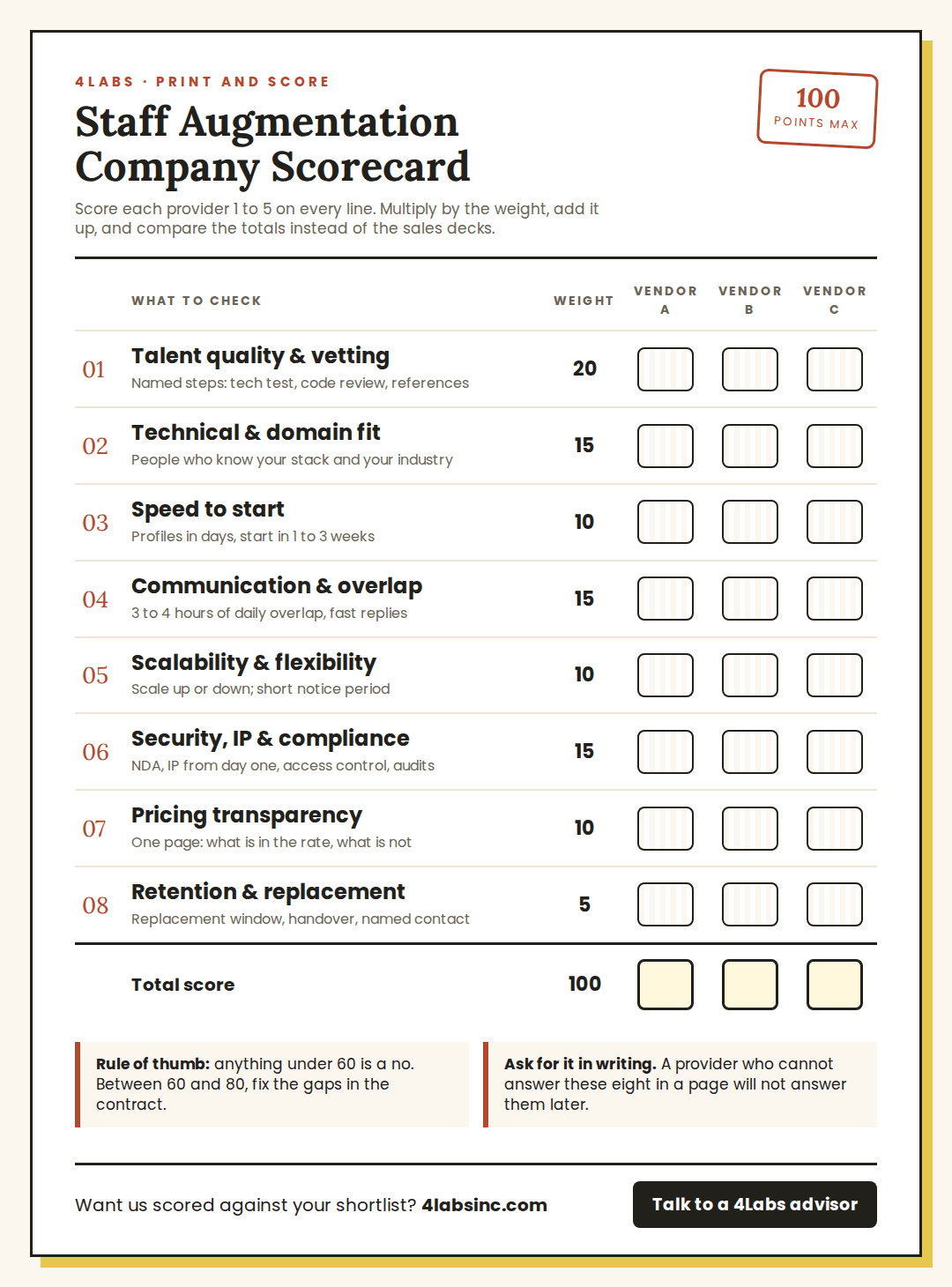
Print it, score three providers, compare the totals.
1. Talent Quality and Vetting
Ask exactly how candidates are screened. You want a real process: technical assessment, code review or live problem solving, a communication check and reference checks. "We only hire the top 1%" is a slogan, not a process.
Ask to see two anonymized profiles at the seniority you need. If the CVs read like keyword lists, the vetting is thin.
2. Technical and Domain Fit
A provider that knows your stack ships faster. A provider that knows your industry argues less about requirements.
Ask which of their people have worked on your kind of system, in your kind of business. Fintech, healthcare and logistics all carry rules that a general developer learns the slow way, on your budget.
3. Speed to Start and Bench Strength
Two numbers matter: how fast you get profiles, and how fast the person starts. Good providers send a shortlist in days, not weeks, because they keep a bench.
Ask what happens if your first choice is unavailable. A staff augmentation provider with depth offers an alternative the same week. One without depth goes quiet, then recruits from scratch against your deadline.
4. Communication and Time-Zone Overlap
Skill fails without overlap. Aim for at least three to four hours a day with your core team, enough for stand-ups and same-day answers.
Test communication during the process itself. How fast do they reply? Do they ask sharp questions about your project or only about the rate? Ask which tools their people use daily, and insist on meeting the candidate, not an account manager.
5. Scalability and Flexibility
Your needs will change. Ask how fast one developer becomes four, and what happens when the project ends.
Check the small print: minimum engagement length, notice period and whether you can pause. A partner who only sells 12-month blocks is selling their convenience, not your flexibility.
6. Security, IP and Compliance
Augmented staff get access to your code, your systems and often your customer data. Treat them like employees for security purposes.
Confirm four things in writing. A signed NDA. Clear IP ownership of everything they produce. Controlled access with offboarding steps. Compliance with the rules you answer to, such as GDPR, HIPAA or SOC 2. Ask how they handle devices and where code is stored. If you build software, the same habits matter inside the work itself, as our post on security testing in the SDLC explains.
7. Pricing Transparency
You are not looking for the cheapest rate. You are looking for a rate you can predict.
Ask what the rate includes: management time, holiday cover, overtime, equipment, tools and licenses. Ask how rates change if you extend, scale or swap a role. A clear provider answers in one page. A vague one sends a quote that grows quietly each quarter.
8. Retention, Replacement and Support
The person you interview should be the person who stays. Ask about the provider's own attrition, and what happens if your developer leaves mid-project.
A solid staff augmentation partner offers a replacement guarantee, a short handover overlap and a named account contact. Ask how many clients each account manager handles. Ten is attention. Fifty is a ticket queue.
Score us against your shortlist. We will answer all eight points in writing, including vetting, security terms and replacement cover. Talk to an Advisor