Change three: the data outlives the platform
The big data decision with the longest tail, and the one nobody on page one writes about. Positions below were checked on 27 September 2026.
Who is allowed to use the data you generate
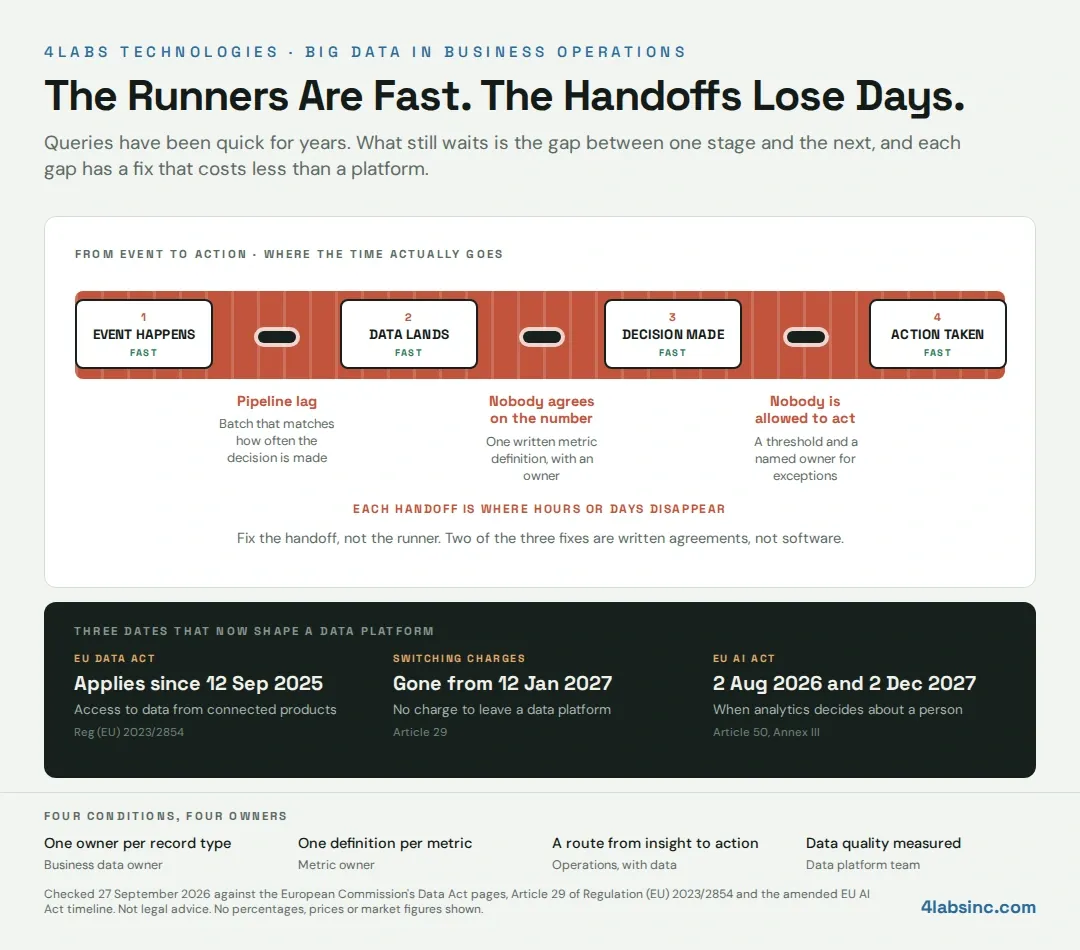
The European Commission states that the EU Data Act, Regulation (EU) 2023/2854, entered into force on 11 January 2024 and applies since 12 September 2025. It covers access to data generated by connected products and related services.
For an enterprise with machines, vehicles, meters or connected equipment, that changes what the data is before it changes what you do with it. The rights can sit with the user of the equipment rather than only with whoever built or installed it.
Two practical consequences follow. Your data integration work needs to be able to export machine data in a usable form rather than trapping it in a vendor's loop. And your equipment contracts should say who may access what, which is a data governance question as much as a legal one, because the default is no longer obvious. Our guide to data privacy and security covers the controls side, and GDPR and CCPA obligations sit on top of all of this wherever personal data is involved.
This is not legal advice, and scope depends on your sector and where you operate, so take advice before you build a process on it.
What it costs to leave
Article 29 of the same regulation is short and worth quoting: "From 12 January 2027, providers of data processing services shall not impose any switching charges on the customer for the switching process." Until then, Article 29(2) allows reduced switching charges.
Read that as a procurement fact. The cost of leaving a data platform is on a schedule to reach zero, in the EU, on a known date. A platform choice you would have called irreversible in 2023 is a different kind of decision now, and any contract signed this year should be read with that date in mind.
It does not make migration free, because rewriting data integration pipelines, retraining people and re-testing reports still costs what it always did, and our guide to data migration covers that work. What changes is that the provider can no longer charge you for the exit itself. If you are choosing now, our post on choosing a cloud service provider covers the rest of the criteria.
Open table formats, in one paragraph
An open table format stores your tables in a published specification rather than a vendor's private one, so more than one engine can read them, and Apache Iceberg is the common example. AWS announced on 26 November 2025 that it supports Iceberg format version 3 features, deletion vectors and row lineage, across Apache Spark on Amazon EMR 7.12, AWS Glue, Amazon SageMaker notebooks, Amazon S3 Tables and the Glue Data Catalog. The point for a reader is not the feature list, but that the format your data sits in is no longer the vendor's private business, which is the technical half of the same portability argument.
Where analytics crosses into a regulated decision
Segmenting customers is analytics, but scoring a person's credit, screening a job applicant or deciding access to a service is a decision about a person, and the rules are different.
Under the EU AI Act, Article 50 transparency obligations apply from 2 August 2026, and under the 2026 Digital Omnibus, obligations for Annex III high-risk systems apply from 2 December 2027.
The practical step is small. List the models on your data roadmap, mark the ones that screen, score or rank people, and decide who signs that assessment off. It is not a decision for the analytics team. Our post on machine learning on your own data covers what the model needs underneath it.