Logo
Logo
ServicesIndustriesCase StudiesBlogsCareersLet's Connect
blue-white-icon
black-image
Logo
ServicesIndustriesCase StudiesBlogsCareersLet's Connect
burger-icon
hamburger
Ensuring Data Privacy and Security in the Digital Age
Blogs/ Data Privacy and Security

Data Privacy and Security: What to Fix First, and in What Order

January 19, 2026
Share Now

Table of Contents

  1. 1. Data Privacy And Security Are Not Same
  2. 2. What Changed For Data Privacy And Security
  3. 3. What Counts As Sensitive Data
  4. 4. Five Things To Fix
  5. 5. What The Law Asks Of You
  6. 6. Where It Usually Fail
  7. 7. How To Tell It Is Working
  8. 8. Frequently Asked Questions

Most businesses do not have a data privacy problem. They do not have a data security problem either. They have an order problem.
We see it on nearly every engagement. A company buys an encryption tool before anyone can say where the customer records live. It writes a privacy notice promising things the systems cannot deliver. It runs an annual training module and calls the job done. The spending is real. The protection is not.
Ensuring data privacy and security in the digital age is less about which tools you own and more about the order you do the work in. Get the order right and cheap steps do most of the heavy lifting. Get it wrong and expensive steps protect data you have already lost track of.
This page gives you three things. A clear split between data privacy and data security. An honest picture of what changed in 2026, with every number tied to a named report. And a five-step sequence you can start this week.

Key takeaways

  • Data privacy is the promises you made about personal data. Data security is the controls that stop someone taking it. You can fail at either one while doing the other well.

Stay Ahead With 4Labs

Get expert insights, security briefings, and the latest innovations in your inbox.

  • Afghanistan+93
  • Albania+355
  • Algeria+213
  • Andorra+376
  • Angola+244
  • Antigua and Barbuda+1268
  • Argentina+54
  • Armenia+374
  • Aruba+297
  • Australia+61
  • Austria+43
  • Azerbaijan+994
  • Bahamas+1242
  • Bahrain+973
  • Bangladesh+880
  • Barbados+1246
  • Belarus+375
  • Belgium+32
  • Belize+501
  • Benin+229
  • Bhutan+975
  • Bolivia+591
  • Bosnia and Herzegovina+387
  • Botswana+267
  • Brazil+55
  • British Indian Ocean Territory+246
  • Brunei+673
  • Bulgaria+359
  • Burkina Faso+226
  • Burundi+257
  • Cambodia+855
  • Cameroon+237
  • Canada+1
  • Cape Verde+238
  • Caribbean Netherlands+599
  • Cayman Islands+1
  • Central African Republic+236
  • Chad+235
  • Chile+56
  • China+86
  • Colombia+57
  • Comoros+269
  • Congo+243
  • Congo+242
  • Costa Rica+506
  • Côte d'Ivoire+225
  • Croatia+385
  • Cuba+53
  • Curaçao+599
  • Cyprus+357
  • Czech Republic+420
  • Denmark+45
  • Djibouti+253
  • Dominica+1767
  • Dominican Republic+1
  • Ecuador+593
  • Egypt+20
  • El Salvador+503
  • Equatorial Guinea+240
  • Eritrea+291
  • Estonia+372
  • Ethiopia+251
  • Faroe Islands+298
  • Fiji+679
  • Finland+358
  • France+33
  • French Guiana+594
  • French Polynesia+689
  • Gabon+241
  • Gambia+220
  • Georgia+995
  • Germany+49
  • Ghana+233
  • Gibraltar+350
  • Greece+30
  • Greenland+299
  • Grenada+1473
  • Guadeloupe+590
  • Guam+1671
  • Guatemala+502
  • Guinea+224
  • Guinea-Bissau+245
  • Guyana+592
  • Haiti+509
  • Honduras+504
  • Hong Kong+852
  • Hungary+36
  • Iceland+354
  • India+91
  • Indonesia+62
  • Iran+98
  • Iraq+964
  • Ireland+353
  • Israel+972
  • Italy+39
  • Jamaica+1876
  • Japan+81
  • Jordan+962
  • Kazakhstan+7
  • Kenya+254
  • Kiribati+686
  • Kosovo+383
  • Kuwait+965
  • Kyrgyzstan+996
  • Laos+856
  • Latvia+371
  • Lebanon+961
  • Lesotho+266
  • Liberia+231
  • Libya+218
  • Liechtenstein+423
  • Lithuania+370
  • Luxembourg+352
  • Macau+853
  • Macedonia+389
  • Madagascar+261
  • Malawi+265
  • Malaysia+60
  • Maldives+960
  • Mali+223
  • Malta+356
  • Marshall Islands+692
  • Martinique+596
  • Mauritania+222
  • Mauritius+230
  • Mayotte+262
  • Mexico+52
  • Micronesia+691
  • Moldova+373
  • Monaco+377
  • Mongolia+976
  • Montenegro+382
  • Morocco+212
  • Mozambique+258
  • Myanmar+95
  • Namibia+264
  • Nauru+674
  • Nepal+977
  • Netherlands+31
  • New Caledonia+687
  • New Zealand+64
  • Nicaragua+505
  • Niger+227
  • Nigeria+234
  • North Korea+850
  • Norway+47
  • Oman+968
  • Pakistan+92
  • Palau+680
  • Palestine+970
  • Panama+507
  • Papua New Guinea+675
  • Paraguay+595
  • Peru+51
  • Philippines+63
  • Poland+48
  • Portugal+351
  • Puerto Rico+1
  • Qatar+974
  • Réunion+262
  • Romania+40
  • Russia+7
  • Rwanda+250
  • Saint Kitts and Nevis+1869
  • Saint Lucia+1758
  • Saint Pierre & Miquelon+508
  • Saint Vincent and the Grenadines+1784
  • Samoa+685
  • San Marino+378
  • São Tomé and Príncipe+239
  • Saudi Arabia+966
  • Senegal+221
  • Serbia+381
  • Seychelles+248
  • Sierra Leone+232
  • Singapore+65
  • Slovakia+421
  • Slovenia+386
  • Solomon Islands+677
  • Somalia+252
  • South Africa+27
  • South Korea+82
  • South Sudan+211
  • Spain+34
  • Sri Lanka+94
  • Sudan+249
  • Suriname+597
  • Swaziland+268
  • Sweden+46
  • Switzerland+41
  • Syria+963
  • Taiwan+886
  • Tajikistan+992
  • Tanzania+255
  • Thailand+66
  • Timor-Leste+670
  • Togo+228
  • Tonga+676
  • Trinidad and Tobago+1868
  • Tunisia+216
  • Turkey+90
  • Turkmenistan+993
  • Tuvalu+688
  • Uganda+256
  • Ukraine+380
  • United Arab Emirates+971
  • United Kingdom+44
  • United States+1
  • Uruguay+598
  • Uzbekistan+998
  • Vanuatu+678
  • Vatican City+39
  • Venezuela+58
  • Vietnam+84
  • Wallis & Futuna+681
  • Yemen+967
  • Zambia+260
  • Zimbabwe+263
Our Services
Digital Marketing
Staff Augmentation
IT Infrastructure
ERP Solutions
Software Development
Web & App Development
Industries
Cryptocurrency and Blockchain
Banking, Financial Services, and Insurance (BFSI)
Lending and FinTech
Oil and Gas
Energy and Utilities
Automotive and Manufacturing
Agriculture
Real Estate
E-commerce and Retail
Case Studies
Financial Services Test Automation
AI-Driven Customer Risk Profiling
Elevating Mobile Performance
Jewelry Client Transformation
AI Underwriting Revolution
Advanced Cybersecurity Solutions
Eyewear Retailer Transformation
Revolutionizing Manufacturing Operations
Offshore Development Excellence
Company

About Us

Careers

Let's Connect

Business Referral

Engagement Model

Partnership Programs

Resources

Blogs

footer1-iconfooter2-iconiso_iconiso_icon2

4labsicon

Copyright © 2026 4Labs Technologies. All Rights Reserved.

Privacy Policy

Terms & Conditions

Accessibility

fb-icon
twitter-icon
instagram-icon
linkedin-icon
  • The IBM Cost of a Data Breach Report 2026, built on 602 organisations studied between March 2025 and February 2026, puts the global average cost of a breach near $4.99 million.
  • The Verizon Data Breach Investigations Report 2026 found that software vulnerability exploitation has passed stolen credentials as the top way attackers get in, at 31% of breaches.
  • The first step is not a purchase. It is an inventory. You cannot protect sensitive data you have not found.
  • Encryption protects the copy. It does not protect the account. Access control has to come first.
  • Data privacy and data security are not the same thing

    Data privacy is about what you are allowed to do with personal data. Data security is about stopping anyone who is not allowed to touch it. Privacy sets the rules. Security enforces them.
    The words get used together so often that most teams treat them as one job with one owner. They are two jobs. They fail in different ways, they need different fixes, and confusing them is why so much data protection spending buys so little.

    What data privacy means

    Data privacy is the set of promises you made about personal data, and whether you keep them.
    You promised to collect only what you need. You promised to use it for the reason you gave. You promised to keep it for a stated period and no longer. You promised to say who else sees it. Those promises live in your privacy notice, your consent flows, your contracts and your retention policy.

    The working parts are purpose limitation, data minimisation, consent and retention. None of them is a technology. All of them are decisions, made once and then honoured every day by people who may never read the notice.

    What data security means

    Data security is the set of controls that stop anyone taking the data, whatever your promises say.
    Access control decides who may open a record. Encryption makes a stolen copy useless. Logging and monitoring tell you when something odd happens. Patching closes the holes attackers walk through. Backups let you recover when the worst happens anyway.

    These are engineering problems with engineering answers. They can be bought, configured and tested. That is exactly why teams start here: it feels like progress.

    How you can have one without the other

    Two pictures make the split obvious.

    A company encrypts everything. Keys are managed properly. Access control is tight. It then sells customer contact records to a partner, because nobody checked whether the privacy notice allowed it. Security was excellent. Privacy failed, and the regulator will care about the second one.

    Now the reverse. A company writes a careful privacy notice, collects only what it needs and deletes on schedule. One database sits on a cloud server with no authentication because a contractor opened it for a migration and never closed it. Privacy was thoughtful. Data security failed, and the outcome is the same breach notification either way.

    So you cannot fix one and assume the other followed. The rest of this page treats them as two tracks that share a sequence.

    What changed for data privacy and security in 2026

    Attackers stopped needing your password. That is the short version of this year, and it moves the work you should be doing.

    For most of the last decade the advice was the same: train people, stop them clicking, turn on multi-factor authentication. That advice is still right. It is no longer enough. Data privacy and data security both sit inside your wider cybersecurity posture, and the cybersecurity picture moved this year.

    The numbers, with their sources attached

    The IBM Cost of a Data Breach Report 2026, researched by the Ponemon Institute across 602 organisations between March 2025 and February 2026, puts the global average cost of a data breach at roughly $4.99 million.

    The same study found that one in four malicious breaches were AI-enabled, and those cost about $6 million each. More than 20% of the organisations studied reported a breach that targeted an AI model or application directly. Organisations using AI and automation in their own security operations cut breach costs by nearly $2 million on average.

    The Verizon Data Breach Investigations Report 2026 reports that 31% of breaches now start with a software vulnerability, which puts vulnerability exploitation ahead of stolen credentials as the top way in. Ransomware is involved in 48% of breaches, though payouts are falling as more companies decline to pay.

    I have named the report and the sample beside every figure on purpose. Most pages on this topic quote a percentage with no year, no report and no sample size. You cannot check those, so do not plan around them.

    What this means if you are not a bank

    Three practical shifts follow.

    Patching moved up the list. When the top way in is an unpatched component, a slow update cycle is a data security problem, not an IT housekeeping chore. Know what software you run and how fast you can update it.

    Your AI tools are part of your attack surface. Any tool holding customer text, support tickets or contracts is holding sensitive data. If a team adopted it on a company card, your data protection obligations followed the data there.

    Speed matters more than perfection. The gap between a contained incident and a reportable data breach is usually hours. That gap is won by monitoring and a rehearsed plan, not by a better tool.

    What counts as sensitive data in your business

    Sensitive data is any record that would hurt someone if it leaked, or hurt you if a regulator read it. That is more than most teams assume and far less than everything.

    This matters because programmes stall when every file is treated as precious. Nobody can protect all of it equally, so nothing gets protected properly. Classification is how you decide where the effort goes. It sits right beside data governance and ownership, which decides who is accountable for each set once you have found it.

    Run this table against your own business. The last column is the uncomfortable one, and it is the point of the exercise.

    What you holdWho touches it todayWhat happens if it leaksHow fast would you know
    Customer records: names, emails, addresses, order historySales, support, marketing, plus every tool they connectedNotification duty, lost trust, a story your competitors repeatUsually when a customer tells you
    Payment and identity data: card details, bank details, government IDsFinance, and whichever processor you choseDirect financial harm to real people, contractual penalties, card scheme consequencesDays, if your processor tells you
    Employee and HR data: salaries, health notes, performance records, home addressesHR, senior managers, sometimes a shared driveLegal exposure and a trust problem inside the building that lasts yearsOften never
    Internal operational data: pricing, roadmaps, supplier terms, source codeNearly everyoneCompetitive damage, rarely a reporting dutyWhen you see it somewhere else

    Most teams fill this in and find the same two things. Far more people can reach customer records than anyone expected. And the honest answer in the last column is almost always slower than the answer they would have given out loud.

    That is your starting position. Write it down before you buy anything.

    Five things to fix, in the order that works

    You cannot protect what you have not found, so classification comes before any purchase. Every other step in this list gets cheaper and more effective once step one is done.
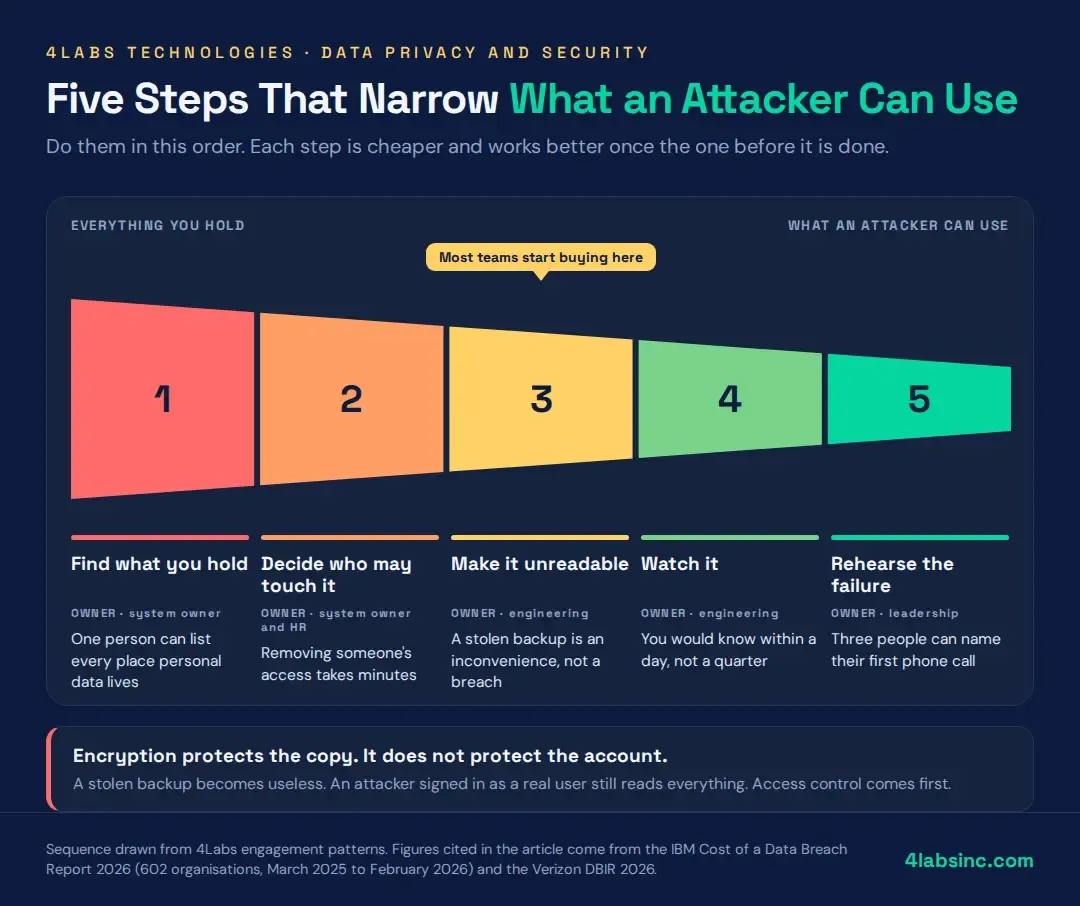
    Funnel diagram showing five steps that narrow data exposure.webp

    Each step below has the same three parts: what it is, who owns it, and how you know it worked. If you cannot answer the third part, the step is not finished.

    1. Find out what you hold

    Build a list of every place personal data lives. Databases, spreadsheets, shared drives, support tools, marketing platforms, the analytics product someone connected three years ago, the AI assistant a team started using last month.

    For each one, record what data it holds, who can reach it, which country it sits in, and why you still have it. Half the value of this exercise sits in that last question. Most businesses find data they no longer need, and deleting it is the
    cheapest data security win available.

    Owner: whoever owns the systems. In a small company that is the person who pays the bills.

    Done when: one named person can list every place personal data lives without asking around.

    2. Decide who may touch it

    Give each person the least access their job needs, and no more. This is where the biggest risk reduction per pound sits, and in most businesses it needs no new product at all.

    There are three jobs here. Review who can reach the systems from step one and remove what is not needed. Fix the joiner, mover and leaver process so access changes when roles change. Turn on multi-factor authentication everywhere, starting with email and admin accounts.

    Access control is also the honest answer to shared logins. If four people use one account, you have no audit trail and no way to remove one of them.

    Owner: the system owner, with HR involved in the leaver half.

    Done when: removing someone's access takes minutes, not a ticket queue.

    3. Make it unreadable to everyone else

    Encrypt sensitive data at rest and in transit, and manage the keys somewhere other than the server holding the data.

    Most platforms now offer this as a setting rather than a project. Turn it on, then check it is actually on, because defaults change and nobody announces it.

    One honest note that vendors rarely offer. Encryption protects the copy, not the account. If an attacker signs in as a real user, the data decrypts for them exactly as it does for that user. That is why access control comes first in this order. Encryption is the second lock, not the first.

    Owner: engineering, or your platform provider if you have no engineers.

    Done when: a stolen backup or a lost laptop is an inconvenience rather than a data breach.

    4. Watch it

    Turn on logging, send the logs somewhere they survive, and set alerts on the handful of events that matter.

    You do not need a security operations centre to start. Alert on new admin accounts, on logins from places you do not operate, on large exports, and on changes to access rules. Four alerts that someone reads beat four hundred that nobody does.

    Owner: engineering, with a named person who reads the alerts.

    Done when: you would know within a day, not a quarter.

    5. Rehearse the failure

    Write a short incident response plan and practise it once. Not a binder. Two pages.

    The plan needs four things: who decides it is an incident, who talks to customers, who talks to the regulator, and where the backups are. Then run it as a tabletop exercise over lunch. The first rehearsal always finds something broken, which is the point.

    Breach notification clocks are short and they start when you become aware, not when you finish investigating. A team that has practised once moves at a completely different speed.

    Owner: a named person in leadership. Not a committee.

    Done when: three people can name their first phone call without looking it up.

    Stuck at step one? That is the normal place to stall, because the inventory has no obvious owner and everyone assumes someone else has it. A short cybersecurity review can map what you hold and who can reach it in a couple of weeks.


    What the law asks of you, and when it starts

    Your obligation starts the moment you hold a record about a person. It does not wait for a revenue threshold, a headcount or a funding round.

    That surprises people. A ten-person company with a mailing list is already handling personal data, and most modern
    privacy law applies to the activity rather than the size of the business. Compliance is therefore a question of what you do, not how big you are.

    The regimes most businesses meet first

    The GDPR covers personal data belonging to people in the European Union and the United Kingdom, wherever your company sits. The CCPA and its successor the CPRA cover California residents, with other US states following their own versions. India's Digital Personal Data Protection Act applies to personal data processed in India and to processing aimed at people there.

    Others will apply depending on where you sell, who you employ and what contracts you have signed.

    The four duties that repeat everywhere

    The detail differs. The spine does not. Nearly every regime asks for the same four things.

    Tell people what you collect. In language they can read, before or when you collect it.

    Collect only what you need. Data minimisation is a legal duty in most regimes, not a nice habit. It is also the cheapest way to cut your data security exposure.

    Keep it only as long as you need it. A retention policy that nobody enforces is a stack of old records waiting to appear in a breach notification.

    Be able to answer when someone asks. People can ask what you hold about them, and ask you to correct or delete it. If step one of the sequence is undone, you cannot answer honestly inside the deadline.

    Notice what the fourth duty depends on. Compliance is not a separate track from the work in the last section. It is what the work makes possible. Most data protection compliance questions are answered by the inventory, the access list and the retention policy. Buy a compliance tool before those three exist and you have bought a dashboard over empty data.

    This section is orientation, not legal advice. Thresholds, exemptions and notification deadlines differ by jurisdiction and by the contracts you have signed, so confirm your own position with a qualified adviser before you rely on it.

    Where data privacy and security programmes usually fail

    Data protection programmes rarely fail at the technical controls. They fail at the edges, in the places nobody owns.

    What follows is drawn from what we see on engagements, not from survey data. Treat it as a list of places to look first.

    The data nobody owns

    Someone exports a customer list to a spreadsheet for a report. That spreadsheet is a copy of your database with none of your controls. No access rules, no logging, no retention, no deletion. It sits in a personal drive for four years.

    Every business has these. They are invisible to security tooling because they are not a system, they are a file. The fix is dull and it works: make exports harder, give reporting people a proper view of the data instead, and include personal drives in the inventory from step one. Bulk moves deserve the same care, because moving data between systems is where uncontrolled copies multiply fastest.

    The vendor you never assessed

    You sent personal data to a processor, a platform or an agency. Your data protection obligations went with it. Their controls are now your exposure.

    Most teams have no list of who holds their data. Start with the finance system: anything billing you monthly that touches customer records belongs on that list. Then ask each one three questions. Where is our data stored? Who on your side can read it? What happens to it when we leave?

    An answer that takes a vendor two weeks to produce tells you something on its own.

    Shadow AI

    A team adopts a useful tool. They pay on a company card. They paste in support tickets, contracts, customer emails. Nobody told procurement, so nobody assessed it, and your sensitive data is now sitting in a service you have no agreement with.

    This is the newest failure on the list and the fastest growing. The IBM study found more than 20% of the organisations it examined reported a breach touching AI models or applications, so this has moved past a theoretical worry.

    Banning the tools does not work. People use them because they help. Give them an approved option, say clearly what may and may not be pasted into it, and check the card statements.

    Training as a ritual

    An annual module, a completion certificate, no behaviour change. Worse, a culture where reporting a mistake feels risky.

    The breach that hurts is usually the one somebody noticed and did not mention for three days. Short, frequent, specific beats annual and comprehensive. And the person who reports their own mistake quickly should be thanked in public, every time.

    If two of those four sound familiar, the vendor list and the shadow AI check are the fastest data protection wins available to you. Both take days rather than months.

    How to tell whether it is working

    A certificate tells you a control existed on the day of the audit. It does not tell you the control works today.

    Here are five checks any owner can run without a security team. Each one has a good answer beside it.

    Can you name every place customer data lives? A good answer is a list someone updated this quarter. A bad answer is a pause.

    How long does it take to remove a leaver's access? A good answer is under an hour, across every system. A bad answer is that it depends who is around.

    When did someone last read your alerts? A good answer is this week. A bad answer is that the alerts go to a shared inbox.

    What did your last restore test prove? A good answer names a date and what broke. A bad answer is that backups run nightly, which is not the same thing.

    Who would you call first, and do they know? A good answer is a name, a number and a conversation that has already happened.

    Five honest answers tell you more about your data privacy and security posture than any questionnaire. If four of them are uncomfortable, that is useful. It means you now know the order to fix them in.

    Ensuring data privacy and security in the digital age is a habit, not a project

    Find what you hold. Decide who may touch it. Make it unreadable to everyone else. Watch it. Rehearse the failure. That is the order, and it does not change with the size of your company.

    If you have no security team and no idea where to start, start with the inventory. One person, one spreadsheet, one week. It costs nothing and it makes every decision after it cheaper, including the decision about what to buy.

    The cybersecurity threat picture will keep moving. The sequence will not.

    Talk to our cybersecurity team

    Most teams stall at step one, because nobody owns the inventory and everyone assumes someone else has it. If you want a second pair of eyes on what your business actually holds, that is where we start too.

    A first conversation is a conversation about the sequence: where your data privacy and data security gaps sit, and which two things are worth doing before anything else. No tooling pitch, and no work starts until you know what you are buying.

    Talk to our cybersecurity team

    Frequently asked questions

    What is the difference between data privacy and data security?

    Data privacy is about what you are allowed to do with personal data: what you collect, why, how long you keep it and who you share it with. Data security is about the controls that stop anyone taking it, such as access control, encryption and monitoring. Privacy sets the rules and security enforces them.

    Do small businesses really get targeted?

    Yes, and usually not on purpose. Most attacks are automated scans looking for an unpatched component or an exposed service, and they do not check your headcount first. The Verizon Data Breach Investigations Report 2026 found 31% of breaches now begin with a software vulnerability, which is a route that does not care how big you are.

    What is the first step to ensuring data privacy and security?

    An inventory. List every place personal data lives, who can reach it, where it sits and why you still have it. You cannot protect sensitive data you have not found, and this step usually turns up data you can delete, which is the cheapest risk reduction available.

    Does encryption make my data compliant?

    No. Encryption is one data security control among several, and compliance also asks about consent, purpose, retention and your ability to answer a data subject request. Encryption also protects the copy rather than the account, so an attacker signed in as a real user still reads the data.

    How often should we review our data privacy and security controls?

    Review access quarterly, review the data inventory twice a year, and rehearse the incident response plan once a year. Review any of them immediately after a change: a new system, a new vendor, a restructure or a leaver with wide access.

    ‹ PreviousNext ›
    author_icon
    About the Author

    Jithesh Rajasekharan

    CTO

    A technology-focused Chief Technology Officer driving innovation, scalable solutions, and digital transformation. Experienced in leading technical teams, shaping technology strategies, and building reliable solutions aligned with business goals.