4Labs logo
4Labs logo
ServicesIndustriesCase StudiesBlogsCareersLet's Connect
Open navigation menu
4labs Technologies Logo
ServicesIndustriesCase StudiesBlogsCareersLet's Connect
Open navigation menu
Cybersecurity services cost in 2026: assessment, VAPT and SOC price breakdown
Blogs/Cybersecurity Services Cost in 2026: What You'll Really Pay for Assessment, VAPT and SOC Breakbown

Cybersecurity Services Cost in 2026: What You'll Really Pay for Assessment, VAPT and SOC Breakbown

November 3, 2026
Share Now
Table of Contents
  1. 1. How Much Do Cybersecurity Services Cost in 2026?
  2. 2. How Much Does a Cybersecurity Risk Assessment Cost, and Do You Need One First?
  3. 3. VAPT Cost in 2026: What a $3,000 vs $30,000 Pentest Buys You
  4. 4. Build Your Own SOC or Rent One? The $1.2 Million Question
  5. 5. What Should a Company Your Size Spend on Cybersecurity?
  6. 6. Why Do Two Cybersecurity Quotes for the Same Job Differ by 3x?
  7. 7. Will Better Security Lower Your Cyber Insurance Premium?
  8. 8. Are You Overpaying? 7 Questions to Ask Before You Sign a Cybersecurity Contract
  9. 9. How to Get Maximum Protection From a Limited Cybersecurity Budget
  10. 10. Why Enterprises Choose 4Labs to Cut Cybersecurity Costs Without Cutting Corners
  11. 11. Cybersecurity Services Cost: Your Questions Answered

A data breach now costs $4.99 million on average, according to IBM's 2026 Cost of a Data Breach Report. In the US, the average is $11.5 million. Your security budget will be a small slice of that. The hard part is knowing what each service should cost, so you neither overpay nor leave gaps.
This guide breaks down cybersecurity services cost line by line: assessments, VAPT, SOC, vCISO and incident response. You'll get price ranges in US dollars and Indian rupees, plus sample budgets for 50, 250 and 1,000+ employees. You'll also get seven questions that expose a padded quote. Every range comes from published 2026 pricing, listed in the sources at the end.

Stay Ahead With 4Labs

Get expert insights, security briefings, and the latest innovations in your inbox.

  • Afghanistan+93
  • Albania+355
  • Algeria+213
  • Andorra+376
  • Angola+244
  • Antigua and Barbuda+1268
  • Argentina+54
  • Armenia+374
  • Aruba+297
  • Australia+61
  • Austria+43
  • Azerbaijan+994
  • Bahamas+1242
  • Bahrain+973
  • Bangladesh+880
  • Barbados+1246
  • Belarus+375
  • Belgium+32
  • Belize+501
  • Benin+229
  • Bhutan+975
  • Bolivia+591
  • Bosnia and Herzegovina+387
  • Botswana+267
  • Brazil+55
  • British Indian Ocean Territory+246
  • Brunei+673
  • Bulgaria+359
  • Burkina Faso+226
  • Burundi+257
  • Cambodia+855
  • Cameroon+237
  • Canada+1
  • Cape Verde+238
  • Caribbean Netherlands+599
  • Cayman Islands+1
  • Central African Republic+236
  • Chad+235
  • Chile+56
  • China+86
  • Colombia+57
  • Comoros+269
  • Congo+243
  • Congo+242
  • Costa Rica+506
  • Côte d'Ivoire+225
  • Croatia+385
  • Cuba+53
  • Curaçao+599
  • Cyprus+357
  • Czech Republic+420
  • Denmark+45
  • Djibouti+253
  • Dominica+1767
  • Dominican Republic+1
  • Ecuador+593
  • Egypt+20
  • El Salvador+503
  • Equatorial Guinea+240
  • Eritrea+291
  • Estonia+372
  • Ethiopia+251
  • Faroe Islands+298
  • Fiji+679
  • Finland+358
  • France+33
  • French Guiana+594
  • French Polynesia+689
  • Gabon+241
  • Gambia+220
  • Georgia+995
  • Germany+49
  • Ghana+233
  • Gibraltar+350
  • Greece+30
  • Greenland+299
  • Grenada+1473
  • Guadeloupe+590
  • Guam+1671
  • Guatemala+502
  • Guinea+224
  • Guinea-Bissau+245
  • Guyana+592
  • Haiti+509
  • Honduras+504
  • Hong Kong+852
  • Hungary+36
  • Iceland+354
  • India+91
  • Indonesia+62
  • Iran+98
  • Iraq+964
  • Ireland+353
  • Israel+972
  • Italy+39
  • Jamaica+1876
  • Japan+81
  • Jordan+962
  • Kazakhstan+7
  • Kenya+254
  • Kiribati+686
  • Kosovo+383
  • Kuwait+965
  • Kyrgyzstan+996
  • Laos+856
  • Latvia+371
  • Lebanon+961
  • Lesotho+266
  • Liberia+231
  • Libya+218
  • Liechtenstein+423
  • Lithuania+370
  • Luxembourg+352
  • Macau+853
  • Macedonia+389
  • Madagascar+261
  • Malawi+265
  • Malaysia+60
  • Maldives+960
  • Mali+223
  • Malta+356
  • Marshall Islands+692
  • Martinique+596
  • Mauritania+222
  • Mauritius+230
  • Mayotte+262
  • Mexico+52
  • Micronesia+691
  • Moldova+373
  • Monaco+377
  • Mongolia+976
  • Montenegro+382
  • Morocco+212
  • Mozambique+258
  • Myanmar+95
  • Namibia+264
  • Nauru+674
  • Nepal+977
  • Netherlands+31
  • New Caledonia+687
  • New Zealand+64
  • Nicaragua+505
  • Niger+227
  • Nigeria+234
  • North Korea+850
  • Norway+47
  • Oman+968
  • Pakistan+92
  • Palau+680
  • Palestine+970
  • Panama+507
  • Papua New Guinea+675
  • Paraguay+595
  • Peru+51
  • Philippines+63
  • Poland+48
  • Portugal+351
  • Puerto Rico+1
  • Qatar+974
  • Réunion+262
  • Romania+40
  • Russia+7
  • Rwanda+250
  • Saint Kitts and Nevis+1869
  • Saint Lucia+1758
  • Saint Pierre & Miquelon+508
  • Saint Vincent and the Grenadines+1784
  • Samoa+685
  • San Marino+378
  • São Tomé and Príncipe+239
  • Saudi Arabia+966
  • Senegal+221
  • Serbia+381
  • Seychelles+248
  • Sierra Leone+232
  • Singapore+65
  • Slovakia+421
  • Slovenia+386
  • Solomon Islands+677
  • Somalia+252
  • South Africa+27
  • South Korea+82
  • South Sudan+211
  • Spain+34
  • Sri Lanka+94
  • Sudan+249
  • Suriname+597
  • Swaziland+268
  • Sweden+46
  • Switzerland+41
  • Syria+963
  • Taiwan+886
  • Tajikistan+992
  • Tanzania+255
  • Thailand+66
  • Timor-Leste+670
  • Togo+228
  • Tonga+676
  • Trinidad and Tobago+1868
  • Tunisia+216
  • Turkey+90
  • Turkmenistan+993
  • Tuvalu+688
  • Uganda+256
  • Ukraine+380
  • United Arab Emirates+971
  • United Kingdom+44
  • United States+1
  • Uruguay+598
  • Uzbekistan+998
  • Vanuatu+678
  • Vatican City+39
  • Venezuela+58
  • Vietnam+84
  • Wallis & Futuna+681
  • Yemen+967
  • Zambia+260
  • Zimbabwe+263
Our Services
Software Development
Web & App Development
ERP Software Development
Data Analytics & Business Intelligence
QA & Software Testing Services
Digital Marketing Services
Staff Augmentation Services
IT Infrastructure Services
IT Consulting & Technology Strategy
View AllView all services
Industries
Cryptocurrency and Blockchain
Banking, Financial Services, and Insurance (BFSI)
Lending and FinTech
Oil and Gas
Energy and Utilities
Automotive and Manufacturing
Agriculture
Real Estate
E-commerce and Retail
Case Studies
Financial Services Test Automation
AI-Driven Customer Risk Profiling
Elevating Mobile Performance
Jewelry Client Transformation
AI Underwriting Revolution
Advanced Cybersecurity Solutions
Eyewear Retailer Transformation
Revolutionizing Manufacturing Operations
Offshore Development Excellence
Company

About Us

Careers

Let's Connect

Business Referral

Engagement Model

Partnership Programs

Resources

Blogs

4Labs Technologies industry recognition badge4Labs Technologies top-rated IT services badgeISO certified company badge – 4Labs TechnologiesISO information security certified badge – 4Labs Technologies

4Labs Technologies logo

Copyright © 2026 4Labs Technologies. All Rights Reserved.

Privacy Policy

Terms & Conditions

Accessibility

4Labs Technologies on Facebook
4Labs Technologies on X (Twitter)
4Labs Technologies on Instagram
4Labs Technologies on LinkedIn

Already know what you need? Our cybersecurity consulting services team can scope it with you in one call.

How Much Do Cybersecurity Services Cost in 2026?

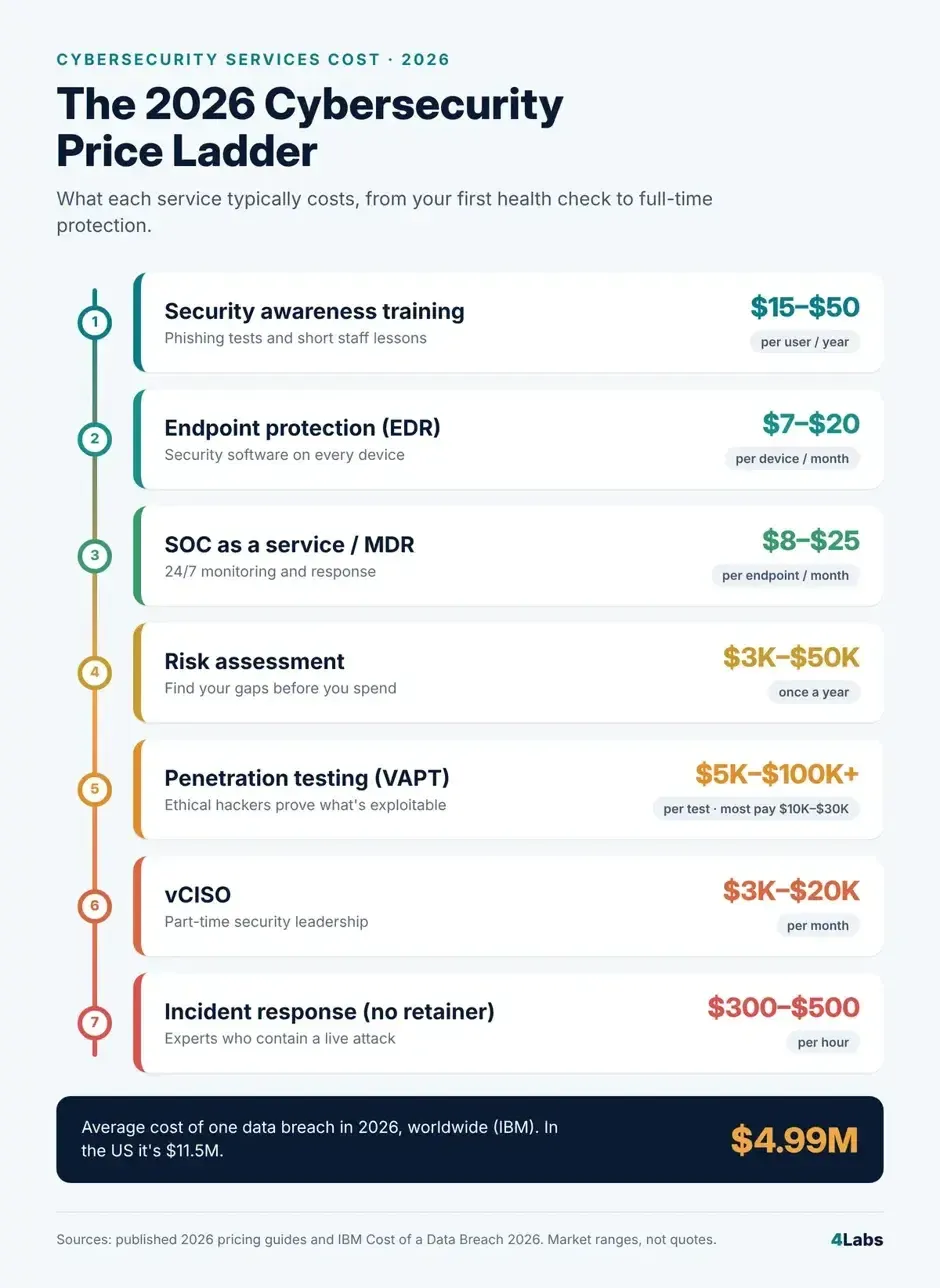
Cybersecurity services cost a typical small business $1,500 to $5,000 a month. A company with 100 to 250 staff pays $10,000 to $30,000 a month. Providers bill one-off projects, such as a penetration test or a compliance audit, on top. The table shows what each service costs on its own.

Cybersecurity Services Price Table: Assessment, VAPT, SOC, vCISO

ServiceWhat you getTypical 2026 cost (USD)How it's billed
Risk assessment / security auditA health check of your systems, data and policies, with a ranked fix list$3,000 – $50,000Once a year
Penetration testing (VAPT)Ethical hackers try to break in and prove which gaps are real$5,000 – $100,000+ (most pay $10,000 – $30,000)Per test, once or twice a year
SOC as a service / MDR24/7 monitoring, threat hunting and response$8 – $25 per endpoint per monthMonthly
Endpoint protection (EDR)Security software on every laptop and server$7 – $20 per device per monthMonthly
vCISOPart-time security leadership and compliance planning$3,000 – $20,000 per monthMonthly retainer
Incident response (no retainer)Experts who contain a live attack$300 – $500 per hourPer incident
Security awareness trainingPhishing tests and short staff lessons$15 – $50 per user per yearYearly
Compliance readiness (SOC 2, ISO 27001, HIPAA)Gap analysis, policies and audit support$15,000 – $100,000+One-time, plus a yearly audit
Cyber insuranceCover for breach costs and downtime$1,500 – $15,000+ per yearYearly premium

How We Sourced These Prices

These are market ranges, not 4Labs quotes. We took them from 2026 pricing guides by managed security providers, penetration testing firms and SOC vendors. Breach figures come from IBM's 2026 Cost of a Data Breach Report. We reviewed all figures in November 2026. Your own price depends on scope, which the rest of this guide explains.
Cybersecurity services cost 2026 price ladder showing assessment, VAPT, SOC, vCISO and incident response prices.webp

How Much Does a Cybersecurity Risk Assessment Cost, and Do You Need One First?

A cybersecurity risk assessment costs $3,000 to $50,000. For most companies, it should be the first thing you buy. It shows where your real gaps are, so you stop paying for tools that protect the wrong things.
Need help with governance as well? Our IT risk assessment and compliance team maps your controls to the standards your clients ask for.

Risk Assessment Cost by Scope

The price moves with how much there is to check:

  • Lower end: one office, one cloud tenant, a few dozen staff. Expect a questionnaire, a vulnerability scan and a short report.
  • Middle: several sites, a mix of cloud and on-premises systems, interviews with IT and leadership, and a policy review.
  • Upper end: an assessment mapped to a framework such as ISO 27001 or SOC 2, many business units, and a review of your third-party vendors.

Ask for a fixed price tied to a written scope. An open-ended day rate is how a $10,000 assessment becomes a $25,000 one.

5 Signs It's Time to Book a Security Assessment

  1. You have never had one, or your last one is more than a year old.
  2. A large customer sent you a security questionnaire, and you struggled to answer it.
  3. Your cyber insurer asked for proof of controls at renewal.
  4. You moved to the cloud, merged with another company or launched a new app.
  5. You are preparing for ISO 27001, SOC 2 or a client audit, or the same common IT audit findings keep coming back.

If two or more of these sound familiar, start with a security assessment before you buy anything else.

VAPT Cost in 2026: What a $3,000 vs $30,000 Pentest Buys You

Penetration testing costs $5,000 to over $100,000 per engagement in 2026. Most organizations spend $10,000 to $30,000, and the all-types average is about $18,300. The gap between a cheap quote and an expensive one is rarely profit. It is usually how much work a human tester does.

VAPT stands for vulnerability assessment and penetration testing. The vulnerability assessment is a scan that lists known weaknesses. The penetration test is a person trying to exploit them, the way an attacker would. You need both, because a scan can't tell you which flaws an attacker can use.

Penetration Testing Cost by Asset

Web Application Pentest Cost

A web application test typically costs $5,000 to $30,000. The price rises with the number of user roles, pages, integrations and business logic to test. A simple brochure site sits at the low end. A customer portal with payments sits near the top. Fix the basics first with our website security best practices, so testers spend their hours on the hard flaws.

Network and Cloud Pentest Cost

An external or internal network test runs $5,000 to $40,000. A cloud test (AWS, Azure or GCP) runs $10,000 to $50,000, because testers must review identity settings, storage access and misconfigurations across many services. Our cloud security best practices cover the settings testers check first.

Mobile App and API Pentest Cost

API testing costs $6,000 to $30,000. A mobile app test costs $7,000 to $35,000 per platform, so iOS and Android together can nearly double the bill.

In India, a full penetration testing engagement typically costs ₹2 lakh to ₹8 lakh, and a vulnerability scan alone costs ₹25,000 to ₹1 lakh.

Automated Scan vs Manual Pentest: Which One Is Worth Paying For?

Automated tests are cheaper but less detailed. Manual testing costs more and goes deeper. Hybrid testing sits in the middle and is the best value for most companies. Some vendors sell automated web app tests from about $3,000 a year, which is useful for frequent checks. It is not a substitute for a manual test before an audit or a major release.

A useful rule: automate the routine checks every month, and pay for a human tester when the stakes are high.

Our guide to automated vs manual testing shows how to split the work test by test.

Fixed Price, Day Rate or Subscription: How Pentests Are Priced

The pricing model changes your penetration testing cost as much as the scope does.

  • Fixed price: one price for one written scope. Most fixed-price VAPT projects cost $3,000 to $20,000+. This suits teams that need a predictable budget.
  • Day rate: you pay per tester day. It is common for red team work, where UK rate cards run £980 to £1,600 per day. Watch for scope creep.
  • Subscription (PTaaS): penetration testing as a service carries a higher sticker price than one test. In return, it covers retests, continuous checks and more of your attack surface. It suits teams that ship code every week.

How Often Should You Run VAPT?

Run VAPT at least once a year, and again after any major change. PCI DSS guidance and the FTC Safeguards Rule both point to an annual test. Many teams also test after a new product launch, a cloud migration or a large code release. If you ship software every week, a yearly test leaves long blind spots, which is why continuous testing programs exist. Our guide to security testing in the software development lifecycle shows how to build checks into every release.

Small businesses (up to 150 staff) typically budget $8,000 to $20,000 a year for penetration testing. Mid-market firms budget $20,000 to $50,000, and enterprises $50,000 to $150,000+.

Build Your Own SOC or Rent One? The $1.2 Million Question

For almost every company under 1,000 staff, renting wins. A minimum viable 24/7 security operations center (SOC) costs $1.2 million to $3 million a year to build in-house. Staff make up 65–70% of that. SOC as a service starts at about $8 per endpoint per month. New to the topic? Read what a security operations center does.

SOC as a Service Pricing: Per Endpoint, Per User or Flat Fee?

Providers use four pricing models:

  • Per endpoint: $8 to $25 per device per month for real detection and response. Volume brings the rate down. A 100-endpoint company often pays $15 to $25, while a 1,000-endpoint estate can negotiate $8 to $12.
  • Per user: about $8 to $15 per user per month for companies with 200 to 1,000 users. This suits teams where each person carries a laptop, a phone and a tablet.
  • Per GB of logs: you pay for the data you send to the SIEM. It can be cheap for quiet networks and expensive for noisy ones.
  • Flat retainer: mid-market companies with 100 to 1,000 employees mostly pay $5,000 to $25,000 a month.

Be careful with the cheapest tier. Services at $3 to $9 per endpoint usually forward alerts with limited response. The label says SOC, but someone on your team still has to act at 2 a.m.
In India, managed SOC pricing typically runs ₹300 to ₹800 per endpoint per month and ₹1,500 to ₹4,000 per server per month.

In-House SOC vs Managed SOC: Side-by-Side Cost Comparison

In-house SOCManaged SOC (SOC as a service)
Total cost of ownership (yearly)$1.2M – $3M$60,000 – $300,000 for a typical mid-market retainer
Biggest costAnalyst salaries (65–70% of spend)Per-endpoint, per-user or flat monthly fee
24/7 coverageNeeds several shifts of analystsIncluded in the fee
Tools (SIEM, EDR, threat intel)You buy and run themUsually bundled
Best fitLarge enterprises with strict data residency rulesSMBs and mid-market companies

Already run a network operations center? Plan the NOC and SOC handoff before you outsource monitoring.

Hidden SOC Fees Most Providers Won't Mention

The headline rate is rarely the full bill. Check the contract for these:

  • Data ingestion overages. Some providers charge $200 to $500 per GB of data processed each month once you pass your allowance.
  • Servers and cloud workloads. These are often priced higher than laptops, so your blended rate can sit above the advertised one.
  • Incident response. Active breach response is often billed separately, at hourly rates.
  • Onboarding and tuning. Ask whether setup, log onboarding and alert tuning are included or quoted on top.

Not sure which of these you need first? Tell us what you run. We'll tell you what to test, what to watch and what can wait. Get my free scoping call →

What Should a Company Your Size Spend on Cybersecurity?

A common benchmark is 10–15% of your total IT budget, with regulated industries at the higher end. The sample budgets below turn cybersecurity services cost into monthly numbers you can take to finance.

Managed Security Services Cost Per User: The All-In Monthly Number

A managed security services provider (MSSP) typically charges $50 to $350 per user per month in 2026. In practice, companies with 26 to 100 employees pay about $2,500 to $10,000 a month. Companies with 101 to 250 employees pay $10,000 to $30,000. Managed security services cost more as the bundle grows. Basic monitoring sits at the bottom, while a full SOC, a vCISO and incident response push you to the top.

What You Get at $2K, $5K and $15K a Month

Monthly budgetWhat it typically coversWho it fits
About $2,000EDR on every device, email security, MFA, backups, basic monitoring, yearly staff trainingUp to 50 staff with light compliance needs
About $5,000Everything above, plus 24/7 managed detection and response, a yearly pentest and quarterly vulnerability scans50 to 150 staff who answer customer security questionnaires
About $15,000Everything above, plus a vCISO, an ISO 27001 or SOC 2 program, an incident response retainer and more than one pentest a year150 to 500 staff in regulated or enterprise supply chains

50 Employees: The Lean Security Budget

For a 50-person firm, cybersecurity costs for a small business usually land between $1,880 and $4,210 a month.

Line itemMonthly estimate
Managed SOC / MDR (about 60 devices at $15–$25)$900 – $1,500
Penetration testing ($8,000–$20,000 a year)$670 – $1,670
Risk assessment ($3,000–$10,000 a year)$250 – $830
Security awareness training$60 – $210
Total$1,880 – $4,210

250 Employees: The Growth-Stage Budget

Line itemMonthly estimate
Managed SOC / MDR (about 300 devices at $12–$18)$3,600 – $5,400
Penetration testing ($20,000–$50,000 a year)$1,670 – $4,170
vCISO (light to standard retainer)$3,000 – $8,000
Security awareness training$310 – $1,040
Total$8,580 – $18,610

1,000+ Employees: The Enterprise Budget

Line itemMonthly estimate
Managed SOC / MDR (about 1,200 devices at $8–$12)$9,600 – $14,400
Penetration testing program ($50,000–$150,000 a year)$4,170 – $12,500
vCISO or security leadership retainer$8,000 – $20,000
Security awareness training$1,250 – $4,170
Compliance program (SOC 2, ISO 27001)$1,250 – $8,330
Total$24,270 – $59,400

These are estimates built from the 2026 unit prices in this guide. Device counts assume about 1.2 devices per employee. Your real number depends on your systems and your compliance load.

Want these numbers for your setup? Send us your device count and compliance goals. We'll send back a line-by-line estimate within 48 hours. Get my cost estimate →

Why Do Two Cybersecurity Quotes for the Same Job Differ by 3x?

Two providers can quote the same job and land far apart because they are not pricing the same work. Four things explain most of the gap.

Your Attack Surface Sets the Base Price

Every app, server, cloud account, office and remote worker is something to test or monitor. More assets mean more hours. Before you compare quotes, write down your asset list and send the same list to every provider.

Compliance Adds Cost (SOC 2, ISO 27001, PCI DSS, DPDP Act)

Frameworks add evidence, documentation and audit time. A company selling to US enterprises may need SOC 2. A card-handling business needs PCI DSS. An Indian company processing personal data has duties under the Digital Personal Data Protection (DPDP) Act. Each one shapes what gets tested and how it's reported. Our post on IT audits for compliance explains what auditors ask to see.

Cybersecurity Services Cost in the US vs UK vs India

Where your provider's team sits changes the rate, not the work. Senior testers in India use the same tools and methods as testers in the US. The difference is mostly labor cost.

ServiceUSUKIndia
Managed SOC, per endpoint per month$8 – $25—₹300 – ₹800
Managed SOC, small company per month$1,000 – $3,000£1,000 – £3,000₹1.2 – 3.5 lakh (about 200 endpoints plus servers)
Penetration test, one engagement$10,000 – $30,000 (typical)—₹2 – 8 lakh
vCISO retainer, per month$3,000 – $20,000£3,000 – £15,000—

This is why many US, UK and Middle East companies work with an offshore security team for testing and monitoring. Compare offshore and nearshore models before you choose.

Retests and Report Quality: Where Cheap Quotes Cut Corners

A low quote often leaves out the retest, so you pay again to prove your fixes work. It may also deliver a raw scanner export instead of a report your developers can act on. Ask for a sample report before you sign.

MSSP, Specialist Firm or Big Consultancy: Who Should You Buy From?

The type of provider you pick shapes both the price and the work you get.

Provider typeWhat they do bestHow they chargeBest fit
MSSP (managed security services provider)24/7 monitoring, EDR and day-to-day managementMonthly, per user or per endpointCompanies that want one predictable monthly bill
Specialist testing firmDeep manual VAPT and red teamingPer project or per tester dayCompanies that need audit-ready pentests
Large consultancyBoard-level risk and compliance programs

Will Better Security Lower Your Cyber Insurance Premium?

It often decides whether you get cover at all. Insurers commonly ask for MFA, EDR on every device and tested backups before they quote. For mid-market policies, many carriers also want a documented risk assessment, an incident response plan and proof of security controls. A company that can show all of this is in a far stronger position at renewal than one that can't.

Are You Overpaying? 7 Questions to Ask Before You Sign a Cybersecurity Contract

Use these questions on every quote from a cybersecurity service provider. A good provider will answer them quickly and in writing.

  1. What exactly is in scope, and what is out? Ask for the list of apps, IP ranges, cloud accounts and offices.
  2. How much of the work is manual, and who does it? Ask about tester certifications such as OSCP, CEH or CREST.
  3. Is a retest included after we fix the findings?
  4. Can we see a sample report? It should rank risks and explain fixes in plain language.
  5. For monitoring: who responds at 2 a.m., and what can they do without calling us? Get the response time in the contract.
  6. What costs sit outside this quote? Think data overages, incident response hours and onboarding fees.
  7. How do you protect our data, and where is it stored? Ask about NDAs, access controls, and DPDP Act or GDPR compliance.

How to Get Maximum Protection From a Limited Cybersecurity Budget

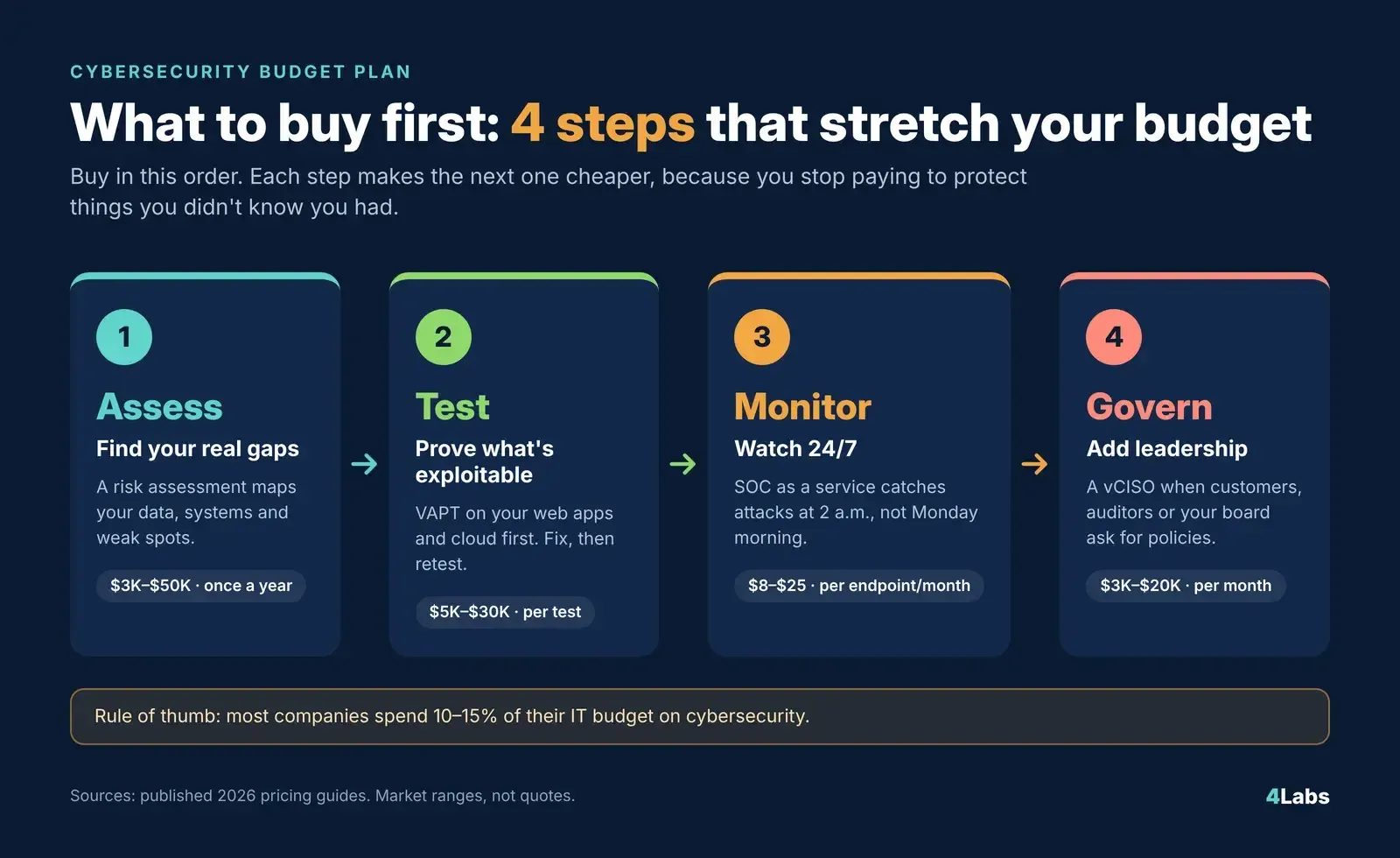
Buy in this order. Each step makes the next one cheaper, because you stop paying to protect things you didn't know about.

Step 1: Assess Before You Spend

Start with a risk assessment. It tells you which systems hold your most valuable data and where the biggest gaps are.

Step 2: Test What Matters Most

Run VAPT on your internet-facing apps and your cloud first. Fix what the testers find, then retest.

Step 3: Monitor Around the Clock

Add managed detection and response or SOC as a service. Attackers don't keep office hours, so 24/7 eyes on your network matter more than one more tool.

Step 4: Add Leadership When Compliance Demands It

Bring in a vCISO when customers, auditors or your board start asking for policies, risk registers and reports.

4-step cybersecurity budget plan: assess, test, monitor, govern

Why Enterprises Choose 4Labs to Cut Cybersecurity Costs Without Cutting Corners

4Labs Technologies is an ISO 9001-certified IT services company headquartered at Technopark, Thiruvananthapuram, with offices in five countries. Our 200+ specialists have delivered 220+ projects for clients across the USA, UAE and India. Our cybersecurity consulting services cover security assessments, VAPT, 24/7 threat monitoring and compliance support for SMBs and enterprises. Here's how we keep your cybersecurity services cost predictable.

Enterprise-Grade Testing at Offshore Delivery Rates

Our testers follow the same methods and tools as large Western firms. Because the team works from India, you pay offshore rates for senior work, not junior work at US prices.

One Partner From First Assessment to 24/7 Monitoring

You don't need three vendors who each charge for their own discovery phase. The team that assesses your systems is the team that tests them and helps you fix what it finds. The same team can then watch your systems around the clock, with an incident response retainer ready if something goes wrong.

Automation for the Routine, Experts for the Findings

AI and automation are core to how 4Labs works. We use them to run repeat scans and sort the noise. Every finding that reaches your report has been checked by a person.

Fixed-Scope Quotes With Retests Included

You get one price for one written scope. After you fix the issues, we retest them, so you have proof the gaps are closed.

Reports Your Auditor and Board Can Both Read

Each report maps findings to the framework you care about, such as ISO 27001, SOC 2 or PCI DSS. It also opens with a one-page summary your leadership can read in five minutes.

Get Your Fixed Quote in 3 Simple Steps

  1. Share your setup. Tell us about your apps, cloud and compliance goals in a 15-minute call.
  2. Get a scoped, fixed quote. You'll have it within 48 hours, with every line item explained.
  3. Start on your date. We agree the test window with your team, so nothing breaks during business hours.

Let's connect. Get a fixed cybersecurity quote in 48 hours. No padded scope. No surprise retest fees. See my price in 48 hours →

Cybersecurity Services Cost: Your Questions Answered

How much do cybersecurity services cost per month?

Cybersecurity services cost most small businesses $1,500 to $5,000 a month in 2026. That usually covers monitoring, endpoint protection, a yearly pentest and staff training. Companies with 101 to 250 employees usually pay $10,000 to $30,000 a month. The main drivers are how many devices you have, whether you need 24/7 monitoring and how much compliance work is involved.

How much does VAPT cost in India?

A penetration testing engagement in India typically costs ₹2 lakh to ₹8 lakh. A vulnerability scan alone costs ₹25,000 to ₹1 lakh. The price depends on how many apps and servers are tested, how much of the work is manual, and whether a retest is included.

Is SOC as a service worth it for a small business?

Yes, if you hold customer data and can't staff a team around the clock. Building an in-house SOC costs $1.2 million or more a year. SOC as a service pricing starts at about $8 per endpoint per month. Avoid tiers that only forward alerts and leave the response to you.

What percentage of the IT budget should go to cybersecurity?

A common benchmark is 10% to 15% of the total IT budget. Industry surveys put the average share at about 12% to 13%. Healthcare, finance and other regulated sectors usually sit at the higher end, because compliance adds testing, documentation and audit costs.

Is a cheap penetration test worth it?

A low-cost automated test, from about $3,000, is fine for routine checks between releases. It won't satisfy most auditors or find business logic flaws. Before you buy, ask how many hours are manual, whether a retest is included and whether you can see a sample report.

How much does a vCISO cost?

A vCISO costs $3,000 to $20,000 a month in 2026, depending on hours and compliance load. Many mid-market firms pay $5,000 to $12,000 a month. For one-off advice, hourly rates sit around $250 to $500. That vCISO cost is a fraction of a full-time CISO's salary.

Is it safe to outsource cybersecurity to an offshore provider?

Yes, with the right controls in place. Insist on a signed NDA, named testers, least-privilege access and a clear data-handling policy that meets the DPDP Act or GDPR. Your data should stay in your own environment wherever possible. A trustworthy provider puts all of this in writing before work starts.

Let's connect. Your cybersecurity services cost should buy the protection you need, not the biggest package on the menu. Tell Santhosh and the 4Labs security team what you run, and we'll show you where every dollar should go. Book my free scoping call →

‹ PreviousNext ›
author_icon
About the Author

Santosh Parameswaran

Director

A results-oriented Chief Operating Officer focused on operational excellence, process improvement, and business efficiency. Experienced in managing cross-functional teams and ensuring smooth execution of strategies that support sustainable growth.

Usually the highest day rates
Large enterprises with complex regulation
Offshore IT services partnerTesting, monitoring and compliance from one teamLower labor cost for senior workSMBs and mid-market firms watching their budget