The business case slide always looks the same. One system, clean data, faster close, better decisions.
Month fourteen rarely looks like the slide. Three regions want an exception to the standard process, finance is running the old reports in parallel because nobody trusts the new ones yet, and the integration to the warehouse system is still a spreadsheet.
ERP for large enterprises is not a software purchase. It is an enterprise resource planning programme that touches finance, supply chain, HR, reporting and every regional exception that grew up over twenty years. Get it right and the company gets one version of the truth. Get it wrong and you have paid a great deal for the same mess in newer software.
This guide covers what actually changes, why enterprises are moving now, what these programmes really cost in time and disruption, why they overrun, and what the first ninety days after go-live decide. The numbers come from named research with dates attached.
Key takeaways
- At enterprise scale, ERP is a data and process problem. Features rarely decide the outcome. Master data quality, process variance across entities, and integration do.
- There is a real deadline. SAP has stated mainstream maintenance for Business Suite 7 runs to the end of 2027, with optional extended maintenance to the end of 2030.
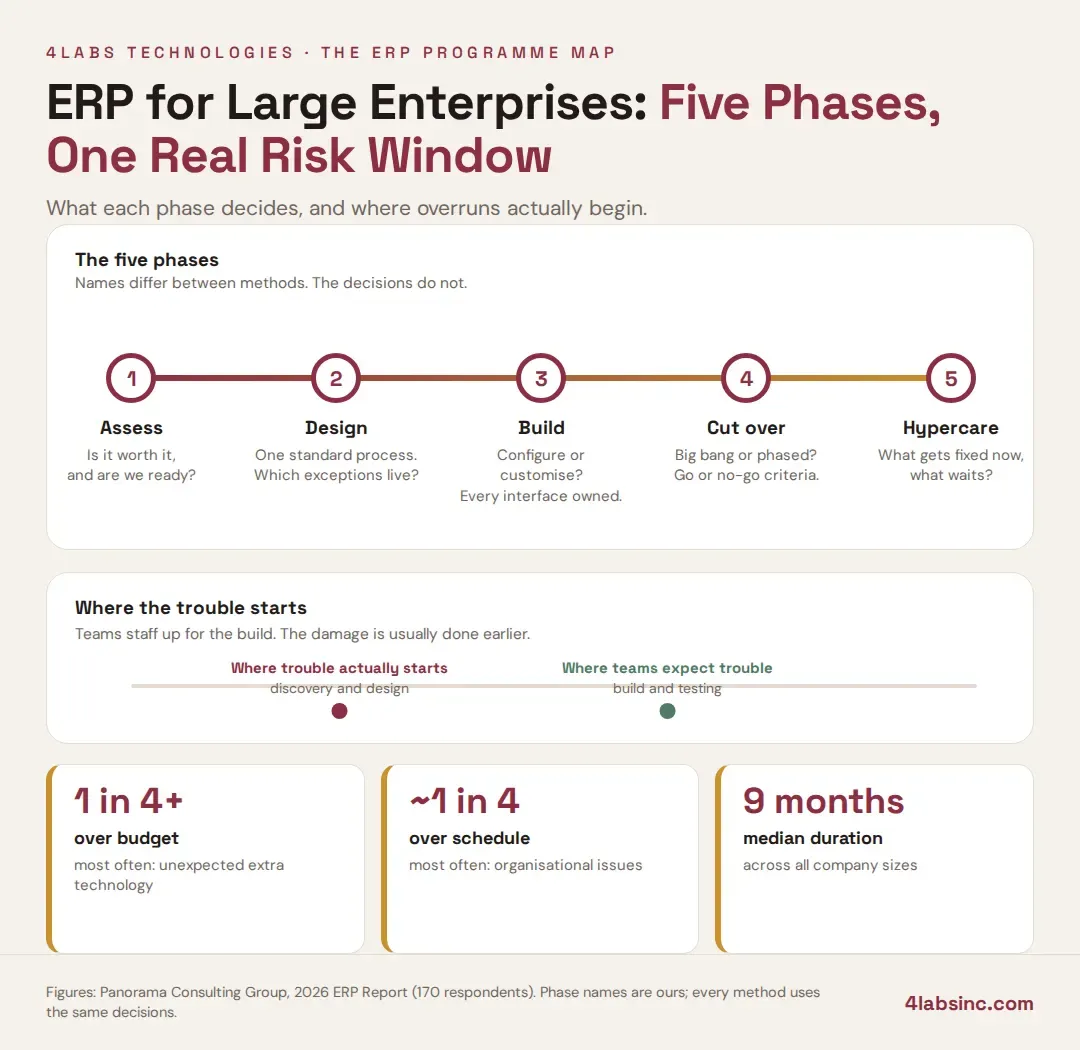
- Overruns have named causes. Panorama's 2026 ERP Report found more than a quarter of organisations over budget, mostly because of unexpected additional technology, and almost a quarter over schedule, mostly because of organisational issues.
- The benefits are real but conditional. Removing silos was realised by 77.4% of the organisations that expected it, up from 55.2% the year before. It depends on what you standardise.
- Go-live is the midpoint, not the finish. The first 90 days of hypercare and adoption decide whether the business case survives.
What is ERP for large enterprises, and how is it different?
ERP for large enterprises is a single system of record for finance, supply chain, procurement, manufacturing and HR, shared across every business unit, country and legal entity in the group. Enterprise resource planning software holds the transactions, and the programme around it standardises the processes that feed them.
The definition is the easy part. The difference from mid-market ERP is what catches people out.
| Mid-market ERP | ERP for large enterprises | |
|---|---|---|
| The hard problem | Choosing the right product | Data, process variance and integration |
| Process design | One way of working | Ten regional variants, each with a reason |
| Data |
Why are large enterprises replacing ERP now?
Five reasons for an enterprise ERP transformation come up again and again, roughly in this order.
1. The vendor set a date. SAP has stated that mainstream maintenance for Business Suite 7 core applications runs until the end of 2027, with optional extended maintenance available from the start of 2028 to the end of 2030. For a large share of enterprises running older SAP estates, that single sentence is why ERP is on the board agenda. Whatever platform you land on, the planning horizon is now, not later, because a programme of this size does not start in the last year before a deadline.
2. Twenty years of customisation became technical debt. Every custom object made sense at the time. Together they make upgrades expensive, testing slow, and any change a negotiation. Many large enterprises reach a point where modifying the old system costs more than replacing it.
3. Acquisitions left three finance systems. Growth by acquisition leaves a group with several charts of accounts, several definitions of "customer" and a consolidation process held together by spreadsheets and one very patient person.
4. Reporting takes too long and still gets argued about. When the month-end close runs into the third week and two directors bring different revenue numbers to the same meeting, the problem is not the report. It is that there is no single source of truth underneath it. Our note on ERP and financial reporting covers that mechanism in detail.
5. The old estate costs more to run than to replace. Hardware refresh cycles, data centre contracts, specialist skills that are getting harder to hire. At some point the run cost of the legacy ERP system makes the business case on its own.
One honest note. None of these five is a reason to move this quarter. They are reasons to start planning, which is a different decision with a different budget.
What actually changes when an enterprise ERP system goes live
Every benefit below is real. Every one of them has a precondition, and the precondition is where programmes quietly fail. The full benefit case sits in our note on the benefits of an ERP system; this section is about what has to be true first.
Finance and reporting
What changes. One ledger across entities, intercompany handled in the system rather than in spreadsheets, a faster close, and management reporting that comes from the same numbers as the statutory accounts.
The precondition. A single chart of accounts that every entity actually uses. If three regions keep local variants "for now", you have bought a consolidation engine and kept the reconciliation work.
Supply chain and procurement
What changes. Stock, orders and supplier performance visible across sites in one place. Procurement sees group-level spend with a supplier instead of eleven separate relationships, which is usually where the fastest savings appear.
The precondition. A common item master and supplier master. Two plants calling the same component by different codes will produce two sets of numbers, confidently.
HR and the workforce
What changes. One employee record, one org structure, and workforce reporting that does not require a data request. Onboarding, movements and leavers run as process rather than email.
The precondition. Agreement on what a job title and a cost centre mean across countries. This sounds trivial and takes months.
Data and analytics
What changes. The phrase everyone uses is "single source of truth". What it means in practice is that a number in a board pack can be traced to a transaction without anyone having to open a spreadsheet.
The precondition. Master data governance with a named owner per domain, running before go-live and continuing after it. Data quality is not a migration task that ends. Teams extending into analytics after go-live often build on the ERP data model directly, which is where platform work like SAP BTP data and analytics services and workflow automation on SAP BTP comes in.The pattern across all four: the ERP system delivers the capability, and the organisation delivers the benefit. Panorama's 2026 ERP Report puts numbers on that. Most benefit categories were realised by more than half the organisations that expected them, and "removing silos" rose from 55.2% to 77.4% year on year. Better than the folklore suggests, and still not automatic.
What does an enterprise ERP programme really cost?
Not the licence. The licence is the number finance asks about first and the one that varies least between comparable platforms.
The real cost of an enterprise ERP implementation sits in four places: implementation effort, your own people's time, the disruption around go-live, and the change management that makes any of it stick. We are not publishing rate tables here, because every serious number depends on scope, region and how bad your data is. What we can give you is what the research says about how these programmes land.
What the research shows
| Finding | Figure | Source |
|---|---|---|
| Organisations over budget | More than a quarter | Panorama Consulting Group, 2026 ERP Report, 170 respondents |
| Most common cause of cost overrun | Unexpected need for additional technology | Same report |
Why do ERP programmes overrun, and how do you avoid it?
Six causes of ERP implementation overruns. The research names the top two directly, and the other four are what they look like on the ground.
1. Scope discovered in design. The process you were told exists turns out to have four regional variants, two of them undocumented. Countermeasure: run process discovery before the contract, not after. Walk the actual transaction in each major entity, not the flowchart someone drew in 2019.
2. The data is worse than anyone said. Duplicate customers, items with no owner, historical records nobody will vouch for. Countermeasure: profile the master data early and report the findings to the steering group in the first month. Data cleansing is a workstream with a budget, not a task in the migration plan.
3. Customisation creeps back in. The promise is a standard implementation. Then each business unit asks for one exception, and each is reasonable on its own. Countermeasure: a written rule for exceptions, an owner who can say no, and a log that shows the steering group what the exceptions are costing.
4. Change management is underfunded. Panorama names organisational issues, including resistance to change and process redesign, as the top cause of schedule overrun. Countermeasure: fund training and communication as a named line, and measure adoption after go-live rather than assuming it.
5. Integration is underestimated. The ERP system has to talk to the warehouse system, the bank, the CRM, the tax engine and two systems nobody owns. Countermeasure: inventory every interface in the assessment phase, with an owner and a test plan per interface. This is where the "unexpected additional technology" that Panorama names as the top cost driver usually appears.
6. Nobody is truly accountable. A steering group of twelve is a committee, not an owner. Countermeasure: one executive accountable for the outcome, with authority over the business units, and a decision log. Programmes with a real owner make decisions in days rather than quarters.
Notice the shape. Five of the six are organisational, and one is technical. That ratio matches what the research found, and it is why picking a better ERP vendor does not solve them for large enterprises. Our post on ERP implementation best practices goes further into the delivery detail.
How do you run an enterprise ERP transformation?
Five phases in an enterprise ERP transformation. The names vary between methodologies; the decisions do not.
Phase 1: Assessment and business case
You decide: what problem this solves, what it is worth, and whether the organisation can absorb it now.
You produce: a process inventory, a master data profile, an interface list, a benefits baseline you can measure against later, and a phased roadmap.
In the room: the executive owner, finance, the process owners for each major function, and someone who knows the integration estate.
The benefits baseline is the one people skip. If you do not record what the close takes today, you cannot prove it improved.
Phase 2: Design and data
You decide: the standard process, and which exceptions survive. Then the data rules: who owns each domain, what good looks like, and what gets archived rather than migrated.
You produce: the process design, the exception log, the data cleansing plan, and the security and authorisation model.
In the room: business process owners with authority, not delegates. This phase fails when the people attending cannot commit their function.
Phase 3: Build and integrate
You decide: configuration versus customisation, every time it comes up.
You produce: the configured system, the interfaces, the reports, and the migration routines. Interfaces get their own plan and owner each.
In the room: the delivery team, with process owners available for questions within a day. Slow answers are the quiet killer of this phase.
Phase 4: Test, train and cut over
You decide: big bang or phased, and the go or no-go criteria. Write the criteria before you are emotionally invested in the date.
You produce: test cycles including one full dress rehearsal with real volumes, trained users, and a cutover plan with hours and owners.
In the room: everyone. This is the phase where enterprise programmes discover which regional processes were never really tested.
Phase 5: Hypercare and adoption
You decide: when normal support takes over, and what gets fixed versus what gets deferred to enhancement.
You produce: a triaged issue list, adoption measures, and the first benefits review.
In the room: the same executive owner. Programmes that disband leadership at go-live lose the benefit case in the following quarter.On resourcing: most large enterprises run this with a core internal team plus external specialists for the peaks. Our guide to staff augmentation for enterprises covers how that model works without handing over control of the programme.
When should a large enterprise wait?
Four situations where the honest answer is not yet.
A merger or divestment is in flight. Designing a target operating model while the shape of the company is still moving means designing it twice. Finish the structural change, then start.
There is no single accountable executive. If the programme is owned by a committee, or by IT alone, the first real conflict between two business units has no resolution path. Find the owner before the budget.
Nobody has looked at the master data. Not "we think it is fine". Profiled it, counted the duplicates, found the records with no owner. Do this first regardless, because it takes a month and it changes the plan.
Finance is already at capacity. If the close is consuming the team every month and there is no backfill plan, adding a transformation will damage both. Fix the capacity first or fund the backfill properly.
Waiting two quarters to start properly is cheaper than starting now and stopping in month eight. That is not a comfortable thing for a delivery partner to write, but it is what the overrun research keeps pointing at: the problems that derail ERP programmes in large organisations are present before anyone writes a line of configuration.
What happens after go-live?
Most ERP guides end at the launch. The enterprise value is decided in the two years afterwards.
The first 90 days: hypercare. A named support team, daily triage, and a clear route for a user who cannot complete a task. Expect a spike in issues in week one and a second smaller spike at the first month-end close, because that is when the edge cases arrive.
Measure adoption, not logins. Are people using the new process or working around it? The warning signs are specific: shadow spreadsheets reappearing, manual journals climbing, a workflow that everyone skips. Ask the process owners, and look at the transaction data.
Run the benefits review at six and twelve months. Against the baseline recorded in phase 1. Close time, reconciliation effort, stock accuracy, order cycle time, whichever measures the business case claimed. Without a baseline this conversation becomes opinion.
Set a decision cadence for enhancements. Requests will arrive continuously. A monthly forum with the executive owner, a visible backlog, and a rule that anything touching the standard process needs a reason beyond preference. Otherwise the customisation you avoided during the build arrives afterwards.
Then, and only then, look at what is next. Analytics on top of the clean data, automation of the processes now running consistently, and the newer capabilities covered in our note on . Those pay off on a stable ERP system and disappoint on an unstable one.
How 4Labs Technologies supports enterprise ERP work
We work alongside enterprise teams rather than replacing them, usually on the parts that need specialist hands or extra capacity.
We start with readiness, not a proposal. Master data profile, process variance across entities, integration inventory, and whether there is one accountable owner. Those four findings decide whether the programme should start now, and sometimes they say wait.
We build the parts around the core. Integrations, extensions, migration tooling, reporting and the automation that sits on top of the ERP system. Our ERP software development services cover that work directly.
We staff peaks without taking over. Design, testing and cutover need more hands for a period, and the knowledge has to stay with you afterwards. Code review by your team from week one, documentation in your repositories.
Your systems and data stay yours. Accounts in your name, documentation in your environment, no dependency created deliberately.
We are not reselling a platform, which means we can tell you when the answer is a smaller change than the one you were considering.
Planning an ERP programme, or recovering one? Tell us where you are: assessment, design, mid-build or post-go-live. We will come back with what we would check first, the risks we see, and an honest view on timing. Talk to 4Labs Technologies.
Frequently asked questions
What is ERP for large enterprises?
Enterprise resource planning at this scale is a single system of record for finance, supply chain, procurement, manufacturing and HR, shared across every business unit, country and legal entity in a group. At enterprise scale the software is only part of it. The programme also standardises processes, cleans master data and connects the systems that are staying, which is where most of the effort goes.
How long does an enterprise ERP implementation take?
Panorama's 2026 ERP Report put the median at nine months across organisations of all sizes. Large enterprises with several entities, regional process variants and a heavy integration estate should expect longer and should plan in waves rather than one date. Treat the median as a benchmark for a simple implementation, not a target for a complex one.
Why do ERP implementations fail?
Usually for organisational reasons rather than technical ones. Panorama names organisational issues, including governance, resistance to change and process redesign, as the most common cause of schedule overruns, and unexpected additional technology needs as the most common cause of cost overruns. Scope discovered late, poor master data and no single accountable owner sit behind most of it.
Should a large enterprise choose cloud or on-premise ERP?
Cloud is the default for new implementations, and the vendors are investing there. On-premise still appears where data residency, latency or a specific regulatory position requires it, and hybrid estates are common in groups with recent acquisitions. The decision follows your regulatory and integration constraints, not a trend. Our comparison of cloud versus on-premise infrastructure runs through the trade-offs, and Microsoft Dynamics cloud ERP is one example of the cloud-first approach.
What is two-tier ERP, and when does it make sense?
The corporate suite runs at head office while subsidiaries or newly acquired businesses run a lighter ERP system that reports upward. It suits groups where a full corporate rollout would overwhelm a small entity, and where speed of integration matters more than uniformity. The trade-off is two systems to maintain and a consolidation layer that has to be designed properly.
How do you measure ERP success after go-live?
Against the baseline recorded before the ERP transformation started: days to close, reconciliation effort, stock accuracy, order cycle time, the measures your business case actually claimed. Add adoption measures, because a process people work around has not been implemented. Review at six and twelve months with the same executive owner who signed the business case.
The system is the easy part
ERP for large enterprises is sold as a technology decision and delivered as an organisational one. The software will do what the demo showed. Whether your group gets one version of the truth depends on whether the regions accept a standard process, whether the master data is trustworthy, and whether one person can settle an argument between two business units.
So start an ERP transformation with readiness rather than vendors. Profile the data. Count the process variants. Name the owner. Record the baseline you intend to improve, because in eighteen months somebody will ask what changed.
The programmes that go well are rarely the ones with the best software. They are the ones that knew what they were walking into.
Talk to 4Labs Technologies about your ERP programme · 30 minutes, no obligation.