Logo
Logo
ServicesIndustriesCase StudiesBlogsCareersLet's Connect
blue-white-icon
black-image
Logo
ServicesIndustriesCase StudiesBlogsCareersLet's Connect
burger-icon
hamburger
It infrastructure
Blogs/Network Operations Center (NOC)

Network Operations Center Best Practices: The Four Clocks That Decide Whether Your NOC Works

January 8, 2026
Share Now

Table of Contents

  1. 1. The four clocks a NOC has to beat
  2. 2. NOC best practices that survive an audit
  3. 3. What a NOC is worth, in terms you can check
  4. 4. Building or fixing your NOC
  5. 5. Frequently asked questions

Most advice on NOC best practices reads as a list of good habits. Monitor proactively, document everything, train the team. All true, and none of it tells you whether your own network operations center is doing its job tonight.

A NOC is a promise about time: something breaks, somebody finds out, somebody acts, and somebody writes it down. Every one of those steps has a clock on it, and three of those clocks are now set by regulators rather than by you.

This guide covers what a network operations center actually does, the four clocks that decide whether it works, the handoff between the NOC and the SOC, the six practices that survive an audit, and when running your own stops making sense.

No downtime cost figures appear here, because the per-minute and per-hour numbers everyone quotes trace back to vendor surveys with undisclosed samples, so they are not worth repeating on a page you might show a board.

If you want the wider context first, our guide to IT infrastructure management practices sets out the ground floor.

What a network operations center actually does

A network operations center is the team and the room that keep services available and network performance steady. Not the tools, which change every few years, while the job does not.

Stay Ahead of Cyber Threats

Get expert insights, security briefings, and the latest innovations in your inbox.

  • Afghanistan+93
  • Albania+355
  • Algeria+213
  • Andorra+376
  • Angola+244
  • Antigua and Barbuda+1268
  • Argentina+54
  • Armenia+374
  • Aruba+297
  • Australia+61
  • Austria+43
  • Azerbaijan+994
  • Bahamas+1242
  • Bahrain+973
  • Bangladesh+880
  • Barbados+1246
  • Belarus+375
  • Belgium+32
  • Belize+501
  • Benin+229
  • Bhutan+975
  • Bolivia+591
  • Bosnia and Herzegovina+387
  • Botswana+267
  • Brazil+55
  • British Indian Ocean Territory+246
  • Brunei+673
  • Bulgaria+359
  • Burkina Faso+226
  • Burundi+257
  • Cambodia+855
  • Cameroon+237
  • Canada+1
  • Cape Verde+238
  • Caribbean Netherlands+599
  • Cayman Islands+1
  • Central African Republic+236
  • Chad+235
  • Chile+56
  • China+86
  • Colombia+57
  • Comoros+269
  • Congo+243
  • Congo+242
  • Costa Rica+506
  • Côte d'Ivoire+225
  • Croatia+385
  • Cuba+53
  • Curaçao+599
  • Cyprus+357
  • Czech Republic+420
  • Denmark+45
  • Djibouti+253
  • Dominica+1767
  • Dominican Republic+1
  • Ecuador+593
  • Egypt+20
  • El Salvador+503
  • Equatorial Guinea+240
  • Eritrea+291
  • Estonia+372
  • Ethiopia+251
  • Faroe Islands+298
  • Fiji+679
  • Finland+358
  • France+33
  • French Guiana+594
  • French Polynesia+689
  • Gabon+241
  • Gambia+220
  • Georgia+995
  • Germany+49
  • Ghana+233
  • Gibraltar+350
  • Greece+30
  • Greenland+299
  • Grenada+1473
  • Guadeloupe+590
  • Guam+1671
  • Guatemala+502
  • Guinea+224
  • Guinea-Bissau+245
  • Guyana+592
  • Haiti+509
  • Honduras+504
  • Hong Kong+852
  • Hungary+36
  • Iceland+354
  • India+91
  • Indonesia+62
  • Iran+98
  • Iraq+964
  • Ireland+353
  • Israel+972
  • Italy+39
  • Jamaica+1876
  • Japan+81
  • Jordan+962
  • Kazakhstan+7
  • Kenya+254
  • Kiribati+686
  • Kosovo+383
  • Kuwait+965
  • Kyrgyzstan+996
  • Laos+856
  • Latvia+371
  • Lebanon+961
  • Lesotho+266
  • Liberia+231
  • Libya+218
  • Liechtenstein+423
  • Lithuania+370
  • Luxembourg+352
  • Macau+853
  • Macedonia+389
  • Madagascar+261
  • Malawi+265
  • Malaysia+60
  • Maldives+960
  • Mali+223
  • Malta+356
  • Marshall Islands+692
  • Martinique+596
  • Mauritania+222
  • Mauritius+230
  • Mayotte+262
  • Mexico+52
  • Micronesia+691
  • Moldova+373
  • Monaco+377
  • Mongolia+976
  • Montenegro+382
  • Morocco+212
  • Mozambique+258
  • Myanmar+95
  • Namibia+264
  • Nauru+674
  • Nepal+977
  • Netherlands+31
  • New Caledonia+687
  • New Zealand+64
  • Nicaragua+505
  • Niger+227
  • Nigeria+234
  • North Korea+850
  • Norway+47
  • Oman+968
  • Pakistan+92
  • Palau+680
  • Palestine+970
  • Panama+507
  • Papua New Guinea+675
  • Paraguay+595
  • Peru+51
  • Philippines+63
  • Poland+48
  • Portugal+351
  • Puerto Rico+1
  • Qatar+974
  • Réunion+262
  • Romania+40
  • Russia+7
  • Rwanda+250
  • Saint Kitts and Nevis+1869
  • Saint Lucia+1758
  • Saint Pierre & Miquelon+508
  • Saint Vincent and the Grenadines+1784
  • Samoa+685
  • San Marino+378
  • São Tomé and Príncipe+239
  • Saudi Arabia+966
  • Senegal+221
  • Serbia+381
  • Seychelles+248
  • Sierra Leone+232
  • Singapore+65
  • Slovakia+421
  • Slovenia+386
  • Solomon Islands+677
  • Somalia+252
  • South Africa+27
  • South Korea+82
  • South Sudan+211
  • Spain+34
  • Sri Lanka+94
  • Sudan+249
  • Suriname+597
  • Swaziland+268
  • Sweden+46
  • Switzerland+41
  • Syria+963
  • Taiwan+886
  • Tajikistan+992
  • Tanzania+255
  • Thailand+66
  • Timor-Leste+670
  • Togo+228
  • Tonga+676
  • Trinidad and Tobago+1868
  • Tunisia+216
  • Turkey+90
  • Turkmenistan+993
  • Tuvalu+688
  • Uganda+256
  • Ukraine+380
  • United Arab Emirates+971
  • United Kingdom+44
  • United States+1
  • Uruguay+598
  • Uzbekistan+998
  • Vanuatu+678
  • Vatican City+39
  • Venezuela+58
  • Vietnam+84
  • Wallis & Futuna+681
  • Yemen+967
  • Zambia+260
  • Zimbabwe+263
Our Services
Digital Marketing
Staff Augmentation
IT Infrastructure
ERP Solutions
Software Development
Web & App Development
Industries
Cryptocurrency and Blockchain
Banking, Financial Services, and Insurance (BFSI)
Lending and FinTech
Oil and Gas
Energy and Utilities
Automotive and Manufacturing
Agriculture
Real Estate
E-commerce and Retail
Case Studies
Financial Services Test Automation
AI-Driven Customer Risk Profiling
Elevating Mobile Performance
Jewelry Client Transformation
AI Underwriting Revolution
Advanced Cybersecurity Solutions
Eyewear Retailer Transformation
Revolutionizing Manufacturing Operations
Offshore Development Excellence
Company

About Us

Careers

Let's Connect

Business Referral

Engagement Model

Partnership Programs

Resources

Blogs

footer1-iconfooter2-iconiso_iconiso_icon2

4labsicon

Copyright © 2026 4Labs Technologies. All Rights Reserved.

Privacy Policy

Terms & Conditions

Accessibility

fb-icon
twitter-icon
instagram-icon
linkedin-icon

The four jobs, in order

Watch. Proactive monitoring collects telemetry from the network, the servers and the services, and turns it into alerts a person can act on.

Decide. Judge whether an alert matters, how badly, and who should hold it.

Act. Fix it, work around it, or escalate it, which is where incident response begins.

Record. Write down what happened and when, in an order somebody can check later.
Most NOC teams do the first three well and the fourth badly, and the fourth is the one an auditor reads.

NOC and SOC are not the same room

The NOC owns availability and network performance, while the SOC owns threat. A link goes down, a disk fills, a route flaps: that is the NOC. Someone is inside your network and does not belong there: that is the SOC.

The two share tooling and often share people, so the line that matters is not organisational. It is the handoff rule.

The rule worth writing down: the moment an event looks deliberate, the SOC owns the investigation and the NOC still owns the service. Both clocks keep running, and nobody hands over and walks away.

Without that rule you get the two common failures. Either the NOC sits on a security event for an hour because it looks like a performance problem, or the SOC takes an incident and the service stays down while everyone investigates. Our post on what a security operations center does covers the security half in depth.

What a NOC is not

Not a help desk, because the help desk serves people who report problems, while the NOC serves services that cannot report anything.
Not a network monitoring tool, because buying an observability platform gives you telemetry rather than a NOC, and the NOC is what happens after an alert fires.

Not a wall of dashboards, because a screen nobody is accountable for is decoration, and if nobody is named against a red tile, it stays red.
These three confusions explain most disappointing NOC services engagements, where somebody bought network monitoring and expected operations.

The four clocks a NOC has to beat

Stopwatch dial split.webp
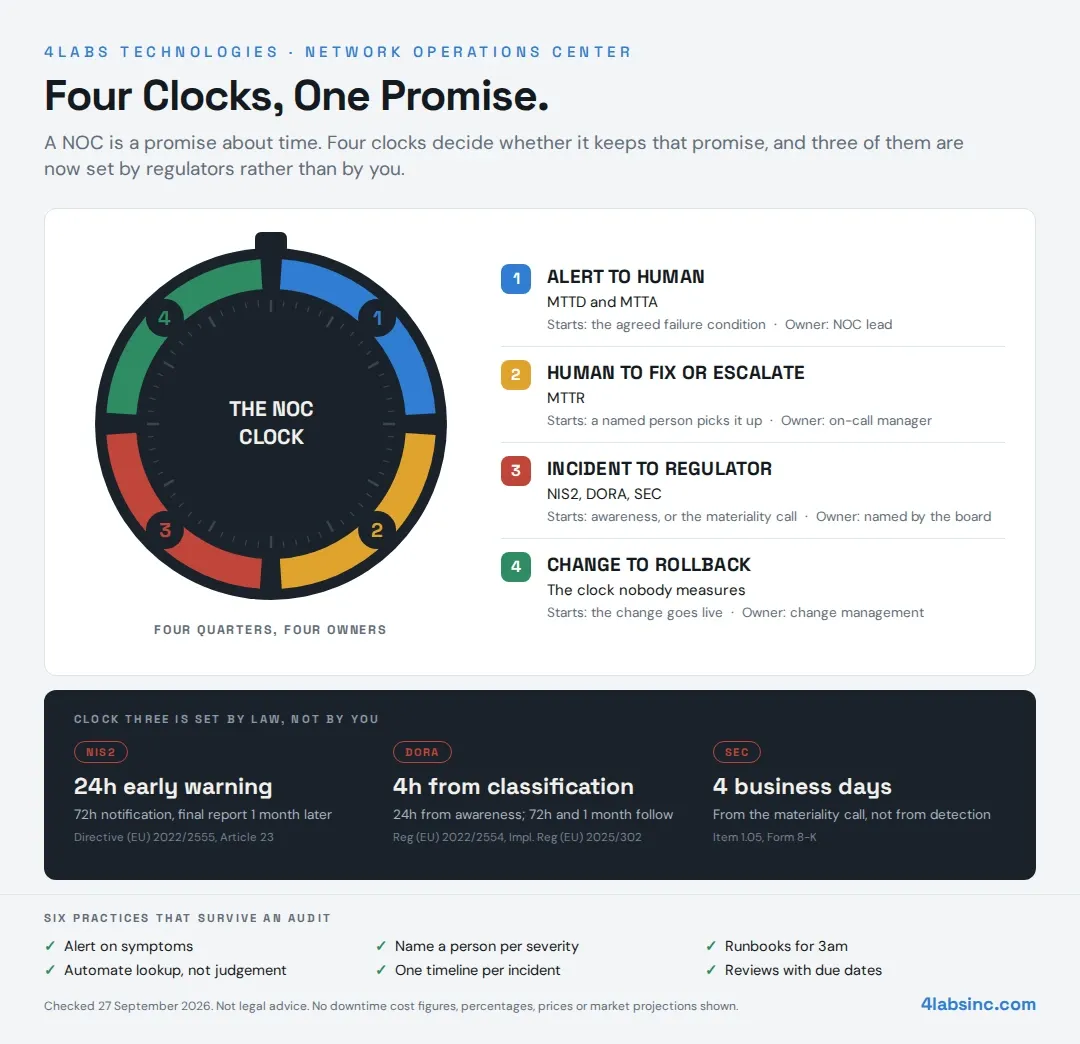
Every NOC decision comes back to one of four clocks, and the positions below were checked on 27 September 2026.

Clock one: alert to human

Two measures cover this clock: MTTD is mean time to detect, from the moment a service degrades to the moment your systems know. MTTA is mean time to acknowledge, from the alert to a named person picking it up.
Most teams report these and most of those reports are wrong, because nobody agreed what starts the clock. Detection at the first failed health check gives one number, detection at the third consecutive failure gives another, and detection when a customer calls gives a third, which is the honest one.
Write down the start condition before you report the metric, because a NOC that cannot say what starts its own clock cannot defend the number.

Owner: the NOC lead. Test: can two engineers independently produce the same MTTD for last month?

Clock two: human to fix or escalate

MTTR is mean time to restore, not to repair, and the service coming back matters more than the root cause being understood, because mixing the two produces a number nobody trusts. Every minute on this clock is network downtime a customer can feel.
Incident response at this stage needs an escalation ladder with real names on it. Severity one wakes a specific person at 3am, while severity three waits until morning. The failure mode is a ladder that names teams rather than people, because a team is not awake at 3am.

An escalation path with no named person is not a path, it is a hope.

Owner: whoever runs the on-call rota. Test: pick a random hour last week and name the person who held severity one.

Clock three: incident to regulator

This is the clock nobody's NOC best practices list mentions, and the one that turns an operational problem into a legal one. Three rules now set hard deadlines for enterprises, and each of them assumes you can produce a timestamped account of what happened.

If your network is in scope for any of them, network security in your infrastructure stops being a separate workstream from operations.

NIS2: 24 hours, then 72 hours, then one month

Under Article 23 of Directive (EU) 2022/2555, an entity in scope sends an early warning to its CSIRT or competent authority "without undue delay and in any event within 24 hours of becoming aware of the significant incident". An incident notification follows within 72 hours. A final report is due "not later than one month after the submission of the incident notification".

Read that as an operations requirement, because within a day you have to state that something happened and give a first assessment. Your NOC is where "becoming aware" gets timestamped.

DORA: four hours from classification

Regulation (EU) 2022/2554 has applied to financial entities since 17 January 2025. The reporting windows sit in Commission Implementing Regulation (EU) 2025/302: an initial notification within 4 hours of classifying an incident as major, and no later than 24 hours from becoming aware of it. An intermediate report follows within 72 hours of that notification, and a final report within one month of the last intermediate report.

Four hours is the number that changes NOC design, because classification cannot wait for the post-incident review. Somebody has to be able to say "this one is major" while the incident is still running, and that person has to be on the rota.

SEC: four business days from the materiality call

Item 1.05 of Form 8-K requires a US registrant to disclose a cybersecurity incident determined to be material within four business days of that determination, with the determination made without unreasonable delay. Disclosure can be delayed only where the US Attorney General determines it poses a substantial risk to national security or public safety.

The subtlety worth knowing: the clock starts at the decision, not at the detection. So the NOC's job is to give the people making that decision an accurate timeline fast enough that "without unreasonable delay" is defensible.

This is not legal advice, and scope depends on your sector and where you operate. Check the current position with counsel before you build a process on it.

Clock four: change to rollback

The clock almost nobody measures, though most bad nights start with a planned change.

Measure the time from a change going live to the moment it is fully backed out. If that number is unknown, your change window is not really a window, only a hope that nothing goes wrong.

Two rules make it real. The first: every change entering a change window has a written rollback step, tested at least once. And the NOC can trigger that rollback without waiting for the team that made the change, because that team is asleep.
Owner: change management, with the NOC. Test: for the last ten changes, how long would a rollback have taken?

NOC best practices that survive an audit

Six practices follow, and each one has an owner and a test, because a practice nobody owns is a slide.

Alert on symptoms, not on causes

Alert fatigue is a design fault rather than a staffing one, and a NOC team that ignores alerts is usually a NOC team that was handed too many.

The fix is to alert on what a customer would notice: checkout is failing, logins are slow, orders stopped. Those alerts always deserve a human, while a CPU at eighty percent is a fact rather than an alert, and it belongs on a graph.

Thresholds on causes multiply as the estate grows, while symptoms do not, because your services are finite.

Owner: the NOC lead, with service owners. Test: what fraction of last month's alerts led to an action?

Every severity level has a named owner

Write the NOC team rota as names and hours rather than team names, then test it by paging it.

An unannounced page test once a quarter tells you more about your incident response than any audit, and if nobody answers within the window you set, the rota is fiction and the escalation stops there.

Proactive monitoring means nothing if the alert lands in a queue nobody watches at two in the morning.
Owner: the on-call manager. Test: page the rota unannounced. Who answered, and how fast?

Runbooks written for 3am

A runbook is written for the worst hour rather than the best, because it is read by someone tired, on a phone, under pressure.

So: exact commands rather than descriptions of commands, the rollback first and then the diagnosis, one page, and a named person to call when the runbook runs out.

The habit that keeps them honest is to update the runbook during the incident review, while the detail is fresh, rather than adding it to a backlog.

Owner: the engineer who last used it. Test: could a new starter follow it without asking anyone?

Automate the lookup, not the decision

Automation belongs on everything that happens before judgement. Gather the logs, pull the last change, check the peer link, open the ticket, attach the graph: that work is repetitive, slow by hand, and identical every time.

Correlation tools help here too, because grouping a thousand alerts into one incident is genuine work that a person does badly at 3am.

Keep the judgement human where the blast radius is real. Automatic failover of a read replica is fine, while automatic failover of a payment path at month end is a decision, and decisions need a person who can be asked why. Our guide to automation in IT infrastructure services covers where that line sits across the wider estate.

Owner: the automation owner in the NOC. Test: which automated action has the largest blast radius, and who approved it?

One timeline per incident

One incident gets one timeline, timestamped, in one place, covering detection, acknowledgement, first action, escalation, classification, restoration, and who did each.

This is the practice that pays for itself twice, because it makes the post-incident review honest and it is the raw material for every report in clock three. A NOC that reconstructs its timeline from chat messages a week later will miss a 24-hour deadline, and an audit will find the gap. Our guide to an IT audit covers what reviewers actually ask for.

Owner: the incident commander. Test: for the last severity-one incident, produce the timeline in under ten minutes.

Post-incident reviews with a due date

Run the incident response review within a week, while people still remember, and ask what happened, what made it slow, and what would have caught it earlier.

Then do the part most teams skip: every action gets an owner and a date. An action with neither is a wish, and a review that produces five wishes is worse than no review, because it teaches the team that reviews do not matter.

Track the closure rate, because it is the single best indicator of whether your network operations center is improving or just surviving.

Owner: the service owner. Test: what share of actions from the last three reviews are closed?

What a NOC is worth, in terms you can check

What improves

Network downtime falls, through a mechanism. Faults get seen sooner and held by a named person sooner, and nothing mystical happens: the gain is the minutes between something breaking and somebody competent looking at it.

Network performance stops degrading quietly, because slow is harder to notice than down, and continuous network monitoring against symptom thresholds catches the degradation that nobody reports because everyone assumes it is their own connection.

Your audit position improves, and this is the underrated one. An organisation with one timeline per incident can answer a regulator in the window, while an organisation without one cannot, whatever its uptime and SLA reporting look like.
Change gets safer, because once clock four is measured, rollback plans stop being a formality.
What will not improve on its own: anything nobody owns. A NOC makes ownership visible, but it does not create it.

What it costs you

Three real costs, and any honest conversation names them.
Tooling. Network monitoring, correlation, ticketing and paging all accumulate, and the integration work between them is usually underestimated.

Coverage. Round-the-clock cover needs a team large enough to rotate without burning out. This is the cost that decides most build-or-buy questions, and it scales with your tolerance for waking people.

The record. Somebody has to maintain runbooks, rotas and post-incident actions, and unfunded, this is the first thing to slip, which is exactly what clock three depends on.
If the estate is still growing, a scalable IT infrastructure matters more than the NOC headcount, because a NOC watching a fragile estate spends its nights firefighting.

When an in-house NOC stops making sense

Three conditions apply, and if any two of them hold, NOC services from a partner usually beat building your own.

You need cover outside your own working hours. A follow-the-sun rota needs roughly eight to ten engineers. Below that number, people cover nights, and that is how good engineers leave.

Your incident volume is low but your severity is high. A quiet network where any network downtime is expensive is costly to staff in-house, because you pay for readiness rather than for work.

A compliance date is approaching and you have no timeline discipline. Buying a NOC buys process, while building one means writing that process while the clock runs.

The reverse also holds. If your estate is unusual, your engineers are already on call and your volumes are steady, in-house wins. Our guide to IT infrastructure management strategy sets out the wider trade-off.

Building or fixing your NOC

Two conversations, depending on where you are.

A NOC that exists but misses its clocks. Send us your escalation path and the last three incidents, and we will tell you which of the four clocks is broken and whether the cause is tooling or ownership. In most estates we look at it is ownership, which is cheaper to fix and less fun to hear.

No NOC yet, and a compliance date approaching. The first move is a coverage model and an escalation rota, not a monitoring purchase. Tools bought before the rota exists get configured around whoever happens to be available, and that shape is hard to undo later.

Our IT infrastructure services team covers both, from network operations center design through to the on-call model and the incident record, as one part of wider IT infrastructure management. Where the work crosses into threat detection and the SOC handoff, our cybersecurity consulting team picks it up.
No obligation and no pitch deck.

Frequently asked questions

What is a network operations center?

A network operations center is the team and the room that keep services available. It watches telemetry from the network and the services, decides which alerts matter, acts on them or escalates them, and records what happened. The tools change every few years, while those four jobs do not.

What is the difference between a NOC and a SOC?

The NOC owns availability and network performance. The SOC owns threat. A failed link is a NOC problem, while an intruder is a SOC problem. They often share tooling and people, so the thing that matters is the handoff rule: when an event looks deliberate, the SOC owns the investigation and the NOC still owns the service.

What does a NOC monitor?

Network monitoring covers links, routers, switches, firewalls, servers, cloud services and the applications running on them, through syslog, SNMP, agents and service checks. The better question is what it alerts on, because a good NOC alerts on symptoms a customer would notice, and keeps causes such as CPU or disk usage on graphs rather than in the paging queue.

How is NOC efficiency measured?

A network operations center is measured by four clocks: time from fault to detection and acknowledgement, MTTD and MTTA, then time from acknowledgement to service restored, MTTR. Time from incident to regulatory report, where NIS2, DORA or SEC rules apply. And time from a change going live to a completed rollback. Define what starts each clock before reporting any of them.

What are the most important NOC best practices?

Alert on symptoms rather than causes, name a person rather than a team against every severity level, and write runbooks for 3am. Automate the lookup and keep the judgement human. Keep one timestamped timeline per incident. Run post-incident reviews where every action has an owner and a due date. Those six habits are what separate working incident response from a wall of dashboards.

Do we need a NOC if we are on cloud?

Yes, though it watches different things. The cloud provider owns the hardware, while you still own your services, your integrations, your identity platform and your spend. Alerting on symptoms matters more in cloud, not less, because you cannot see the layer underneath. Our comparison of cloud or on-premises infrastructure covers what changes hands.

‹ PreviousNext ›
author_icon
About the Author

Jithesh Rajasekharan

CTO

A technology-focused Chief Technology Officer driving innovation, scalable solutions, and digital transformation. Experienced in leading technical teams, shaping technology strategies, and building reliable solutions aligned with business goals.