Frequently asked questions
What are the main benefits of RPA?
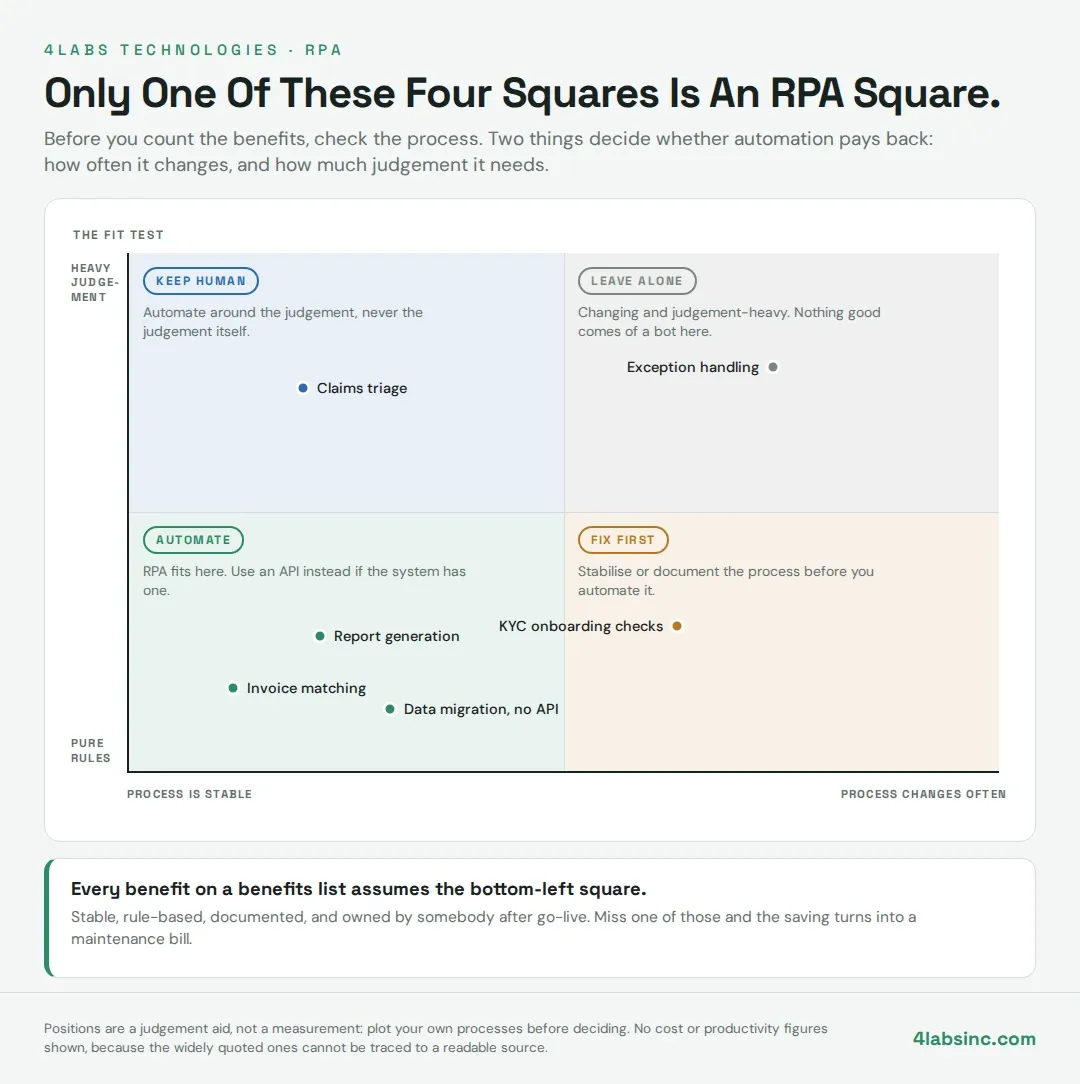
Business process automation benefits fall into three groups. Work gets done faster, mainly because bots run outside office hours rather than because they type quickly. Work gets done consistently, with fewer errors and a complete audit log. And capacity flexes for peaks without hiring. Each benefit depends on the process being stable, measured before automation and owned afterwards.
What processes are best suited to RPA?
The best business process automation candidates are high volume, rule-based and stable, with digital inputs. Invoice processing, first-pass claims handling, report generation, data migration between systems that have no API, and routine account or user administration. Avoid processes that change every quarter, contain a real judgement step, or have never been documented.
How long does it take to see a return from RPA?
A single well-chosen RPA implementation usually pays back within months rather than years, but only if you measured it before automating. Automation ROI arrives sooner on processes that run daily than on processes that run at quarter end, because a bot saves time per run. Programmes that automate five processes at once take longer to show anything, which is why one at a time works better.
Is RPA being replaced by AI agents?
No, robotic process automation is being absorbed rather than replaced. Gartner's market is now business orchestration and automation technologies, with mandatory features around AI agent orchestration and multiagent coordination, and vendors describe extending existing RPA investments rather than replacing them. Existing bots keep working. The thing you buy next will be a larger intelligent automation platform with RPA inside it.
Does RPA fall under the EU AI Act?
Plain rule-following RPA is not an AI system, so it sits outside. Once a bot scores, ranks or screens people, the question changes. Under the Digital Omnibus agreement of 6 May 2026, obligations for Annex III high-risk systems move to 2 December 2027 and Annex I systems to 2 August 2028, while Article 50 transparency obligations remain from 2 August 2026. Take legal advice for your own use case.
What does RPA cost to maintain?
Robotic process automation costs more to maintain than most business cases assume. Bots break when vendors change screens, when file formats shift and when rules are updated, so plan for ongoing engineering time rather than a one-off build. The practical rule is to treat every bot as an application in production, with an owner, a monthly review and a budget line. Automations without an owner stop working quietly.